In the ever-evolving discourse on humanity's place in the cosmos, a recent compilation by The Times of India has reignited debates over ancient mysteries that some researchers argue point to extraterrestrial influences. Titled "10 historical signs that suggest aliens exist," the article explores anomalies from across the globe, from precision-engineered stone structures to unexplained astronomical knowledge, challenging conventional archaeological narratives. Published on the outlet's science section, the piece draws on historical records, scientific journals, and declassified documents to highlight what it calls "historical and celestial anomalies in human history that make us question what we thought we knew about how technology and the stars interacted in the past."
At the heart of these discussions is the Giza Plateau in Egypt, home to the Great Pyramid of Giza, which the article describes as achieving "geodetic alignment to an accuracy of three-sixtieths of a degree, as confirmed by many archaeologists." Constructed around 2580-2565 BCE, the pyramid's 2.3 million blocks, each weighing up to 80 tons, were transported and positioned with mathematical precision that remains unmatched in modern construction projects, according to the report. Mainstream scholars attribute this to the ingenuity of ancient Egyptians, employing ramps, levers, and workforce organization, but the Times of India piece lends credence to the "paleocontact hypothesis," suggesting lost human creativity alone may not explain the logistical and mathematical complexities involved.
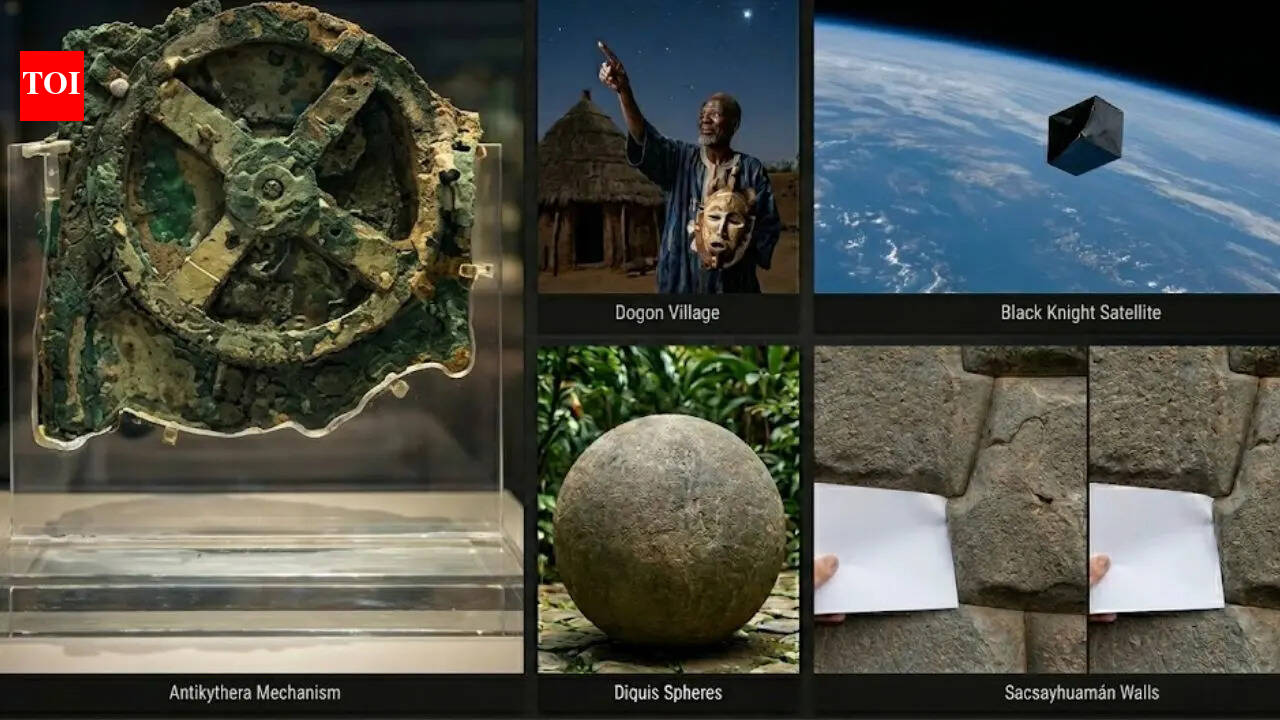
Similarly, the Antikythera Mechanism, recovered from a Roman shipwreck off the Greek island of Antikythera in 1901 and dating to the 1st century BCE, is hailed as the world's first mechanical computer. Recent publications in Nature journal, as cited in the article, document its ability to track celestial cycles and predict eclipses using gears—technology not seen again for another 1,500 years. "The Antikythera Mechanism has been recognised as the first mechanical computer," the Times of India reports, noting its sophistication in modeling astronomical positions, which some fringe theorists link to advanced external knowledge, though experts like those at the National Archaeological Museum in Athens maintain it reflects Greek engineering prowess from the Hellenistic period.
Turning to South America, the massive stones of Sacsayhuamán near Cusco, Peru, exemplify construction feats that puzzle engineers today. These megaliths, some weighing over 200 tons, feature "zero-tolerance joinery," where joints are so tight that "a piece of paper cannot be inserted between them," according to archaeological studies referenced in the article. Built by the Inca in the 15th century CE, the site demonstrates dry-stone masonry techniques that provide earthquake resistance through interlocking designs. While Incan laborers are credited with quarrying and transporting the stones using ropes and ramps, the precision "defies the methods used to produce them," the report states, fueling speculation among paleocontact advocates about non-human assistance.
In Costa Rica, the Diquís Spheres—more than 300 in number, some reaching 16 tons and exhibiting near-perfect spherical geometry—add another layer to the enigma. UNESCO research, as quoted, indicates they were crafted from gabbro or granodiorite between 600 CE and the present day by the Diquís culture. "How they were made, however, is the question that eludes us," the Times of India article notes, emphasizing the mathematical precision impossible to replicate with the era's primitive iron tools. Mainstream archaeologists suggest molding techniques and abrasives, but the spheres' uniformity continues to intrigue, with some drawing parallels to advanced machining.
Celestial events also feature prominently, such as the Star of Bethlehem, described in the article as a "rare triple conjunction of Jupiter and Saturn," based on modern astrophysicists' analyses in the Quarterly Journal of the Royal Astronomical Society. Recorded in biblical texts around 7-6 BCE, the phenomenon reportedly moved vertically or hovered, leading scholars to speculate on its nature beyond a natural alignment. While astronomers like David A. Weintraub of Vanderbilt University support the planetary conjunction theory, alternative interpretations persist, viewing it as potential evidence of extraterrestrial observation during Jesus's birth.
Ancient artifacts from Al Ubaid in southern Iraq, unearthed in excavations dating back 7,000 years, depict lizard-like figures with elongated heads and slit eyes. British Museum archaeologists involved in the digs noted that these "ophidian figurines were unlike any other evidence of a humanoid form of worship currently unearthed in that region," according to the report. Representing a departure from typical Near Eastern spiritual iconography, the anthropomorphic statues have been interpreted by some as depictions of reptilian extraterrestrials, though conventional views see them as symbolic of fertility or mythological beings in Sumerian culture.
The Dogon people of Mali provide one of the most cited examples of anomalous knowledge. Anthropological studies, including those archived at the Smithsonian Institution, document that the Dogon knew about Sirius B—a white dwarf star invisible to the naked eye—decades before its 1975 confirmation by modern telescopes. "Human Anthropologists have documented... that the Dogon people knew about the density and orbit of the star 50 years ago when there were no telescopes available," the article states. Researchers like Robert Temple in his 1976 book The Sirius Mystery argue for ancient alien contact, but skeptics, including Smithsonian folklorists, propose the knowledge stemmed from 1930s European missionaries or was coincidental folklore.
Modern sightings bridge the historical to the contemporary, with the Black Knight satellite mystery. Described as "an unknown object in a non-geosynchronous, polar orbit," it was captured on film during NASA's STS-88 mission in December 1998. NASA officially identified it as a "jettisoned EVA thermal shroud lost during a space walk," per their statements. However, paleocontact proponents cite Nikola Tesla's 1899 reception of strange radio signals as evidence of earlier contact with the object, a claim the agency dismisses as misinterpretation of space debris.
The 1980 Rendlesham Forest incident near RAF Woodbridge in Suffolk, England—dubbed "Britain's Roswell"—involved U.S. Air Force personnel observing a metallic object emitting light. According to Ministry of Defence documents released under the Freedom of Information Act, "significant levels of radiation were found at the crash site, and anomalies were found when tracking the object on radar for three days." Witnesses like Lieutenant Colonel Charles Halt described the craft as triangular and hovering, but official investigations concluded it was a lighthouse beam or meteorological phenomenon, highlighting ongoing disputes between military accounts and skeptical analyses.
Finally, the 1947 Roswell incident in New Mexico remains a cornerstone of UFO lore. The U.S. Air Force's initial press release referred to recovering a "Flying Disc," sparking global interest, but their 1994 "Roswell Report" determined the wreckage was from Project Mogul, a classified balloon program to detect Soviet nuclear tests. "Despite the US Air Force’s findings, the initial press release... provided the backbone of UFO research related to the American government’s systemic institutional opacity," the Times of India article observes, noting persistent claims of extraterrestrial debris cover-ups by researchers like Stanton Friedman.
These accounts, spanning millennia and continents, underscore a persistent human fascination with the possibility of extraterrestrial visitors. While mainstream academia attributes the feats to human innovation—lost technologies, cultural exchanges, or natural explanations—the paleocontact hypothesis gains traction in popular media, as seen in this compilation. Experts like those from UNESCO and the British Museum emphasize rigorous evidence, cautioning against speculative leaps.
As interest in unidentified aerial phenomena surges, fueled by recent U.S. government disclosures on UFOs, these historical signs prompt broader questions about our shared past. Whether echoes of advanced civilizations or hints of cosmic neighbors, they remind us that history's pages may hold more secrets than we currently comprehend. Ongoing excavations and astronomical research continue to probe these mysteries, potentially reshaping our understanding of ancient interactions with the stars.