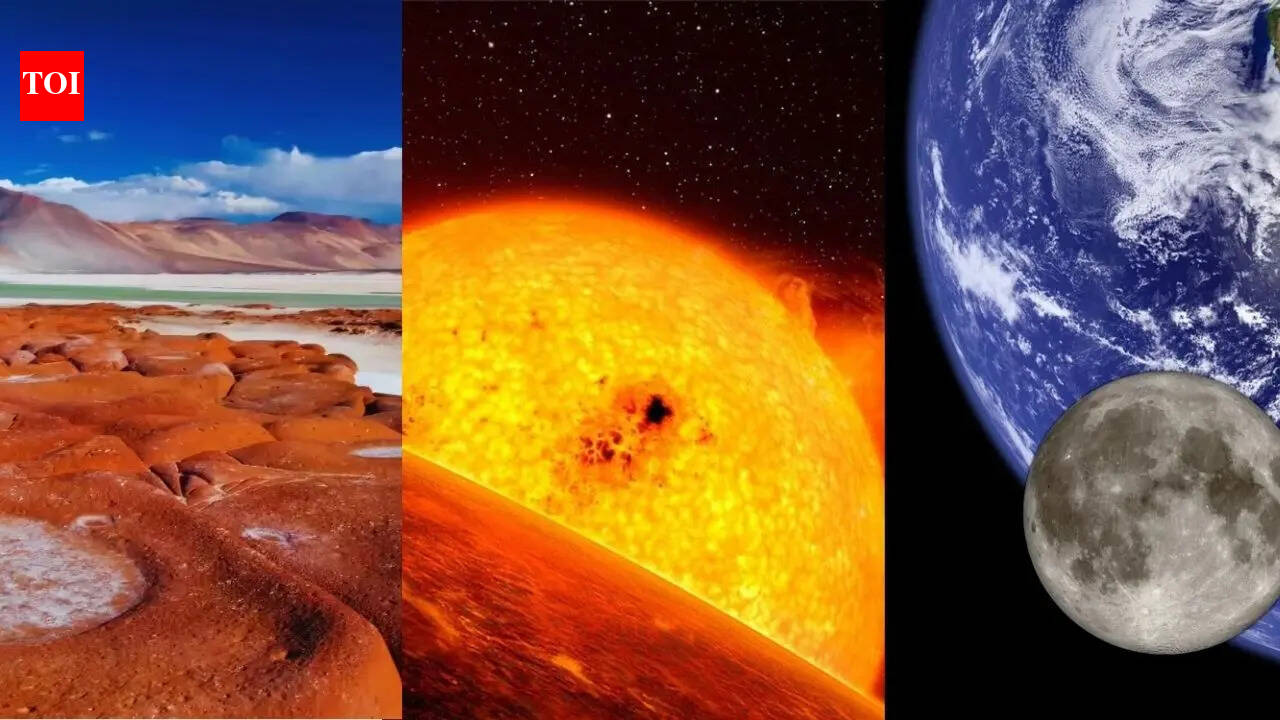
APPLETON, Wis. — Beneath our feet lies a world that appears steadfast and unchanging, yet scientists reveal Earth as a dynamic sphere shaped by relentless geological and cosmic forces. From the slow drift of the Moon to the daily barrage of space dust, our planet's story is one of constant evolution. A recent compilation of facts from NASA and other experts highlights these intricacies, reminding us that the third rock from the Sun is far more alive than it seems.
One of the most subtle yet profound changes occurring on Earth involves its nearest celestial neighbor. According to NASA, the Moon is gradually migrating away from our planet at a rate of about 3.8 centimeters per year. This movement, driven by tidal friction, acts like a brake on Earth's rotation, slowing it down by an estimated 1.8 milliseconds per century. As a result, days are lengthening imperceptibly over time, a process that has been ongoing since the Moon formed billions of years ago.
Earth itself has a well-documented birthday, pegged at approximately 4.54 billion years old. Scientists arrived at this figure through radiometric dating of the planet's oldest rocks and ancient meteorites, which originated alongside the Solar System. "These meteorites were created alongside the rest of the Solar System, so they can serve as a reliable ‘birth certificate’ for the Earth," the Times of India reported, citing geological experts. This age provides a timeline for understanding everything from continental drift to the rise of life, offering geologists a vast canvas to study the planet's transformation.
Imagine the oceans vanishing entirely — what would remain is a staggering testament to Earth's salty history. If all the water evaporated, the salt left behind would form a crust roughly 500 feet thick, or about the height of a 40-story building, blanketing the entire land surface. This salt accumulates as rocks erode on continents and rivers carry minerals to the seas, a process that has built up over eons. Such a scenario underscores the delicate balance of Earth's water cycle, where evaporation, precipitation, and erosion interplay to sustain life.
Turning to the planet's bodies of water, the Caspian Sea stands out as the largest inland expanse, covering an estimated 143,000 square miles — more than all the Great Lakes combined. Though technically a lake due to its disconnection from the oceans, its ancient name and slightly elevated salinity have long earned it the title of "sea." Straddling countries like Kazakhstan, Russia, and Iran, the Caspian influences regional climates and economies, supporting fisheries and serving as a vital waterway despite environmental pressures from pollution and overexploitation.
On the opposite end of the spectrum lies the Atacama Desert in Chile, declared the driest non-polar place on Earth. Weather stations there record an average annual rainfall of just 0.03 inches, and some have never seen a drop in recorded history. "Its extreme conditions are comparable to those of the Martian surface," according to reports from the Times of India. NASA frequently tests rovers and life-detection technologies in the Atacama, using its barren landscape as a stand-in for the Red Planet. Located along Chile's northern coast, the desert spans over 40,000 square miles, where fog from the Pacific provides the only moisture for sparse vegetation.
While the Atacama parches, Antarctica freezes to extremes that challenge human endurance. The continent holds the record for the coldest temperatures, plunging to nearly -144 degrees Fahrenheit on the East Antarctic Plateau. "The presence of very dry air along with clear skies during winter contributes to the ability of the air to reach these exceptionally low temperatures," experts note. Even coastal areas, considered warmer, face wind chills that make survival treacherous. Home to research stations from around the world, Antarctica's ice sheet, averaging 1.6 miles thick, stores about 70% of the planet's fresh water and plays a crucial role in global climate regulation.
Earth's oceans have risen and fallen dramatically over millennia, reflecting the planet's climatic swings. About 20,000 years ago, during the peak of the last Ice Age, vast ice sheets locked up so much water that sea levels were 410 feet lower than today. As glaciers melted with the end of that glacial period, oceans swelled to their current levels. Now, climate change is accelerating this rise through polar ice melt, with scientists warning of faster, more dangerous increases. According to the Intergovernmental Panel on Climate Change, global sea levels have risen about 8 inches since 1900, threatening coastal cities worldwide.
Looking far into the future, Earth's fate is tied to the Sun's life cycle. In roughly 1 to 1.5 billion years, the Sun will brighten by 10%, boiling away the oceans and rendering the planet uninhabitable for complex life. "Current predictions indicate that it will likely boil Earth’s oceans in 1 to 1.5 billion years as the Sun grows 10% brighter," the Times of India article states, drawing from astronomical models. Further out, in about 5 billion years, the Sun will exhaust its hydrogen, swell into a Red Giant, and expand dramatically — potentially engulfing Earth in its fiery embrace, increasing brightness by 2,000% and dwarfing our world.
A more speculative idea from lunar science is the "Big Splat" theory, which suggests Earth once had a second, smaller moon. This mini-moon allegedly collided catastrophically with the primary Moon over time, explaining the differences in the satellite's far side — thick, mountainous crust — versus the near side's smoother, volcanic plains. While not universally accepted, the theory gains traction from orbital data and simulations. "This collision Theory attempts to explain the disparity between the crustal thickness of the Moon’s mountainous ‘far side’ and the lower, volcanic plains of the ‘near side’ that faces Earth," researchers propose.
Daily, Earth endures a cosmic bombardment that adds to its ever-changing nature. The United States Geological Survey estimates that approximately 100 tons of cosmic dust falls to the surface every single day. Much of it is microscopic, burning up in the atmosphere, but larger pieces occasionally reach the ground. "There are approximately 100 tons of cosmic dust falling to Earth every single day," the USGS reports. Compounding this are thousands of man-made space junk fragments re-entering annually, as per the European Space Agency, which tracks detectable debris to mitigate risks to satellites and spacecraft.
These facts paint a picture of Earth not as a static home but as a vibrant, evolving entity influenced by forces both intimate and immense. The Moon's retreat, the salt-laden oceans, and the impending solar changes all weave into the narrative of a planet in flux. Scientists continue to refine these understandings through missions like NASA's Artemis program, which aims to return humans to the Moon and study its geology up close.
As climate models predict rising seas and shifting weather patterns, the lessons from Earth's past — like the post-Ice Age floods — become increasingly relevant. In places like the Atacama and Antarctica, ongoing research informs our approach to extreme environments, from Mars exploration to climate adaptation on our own world. The Caspian Sea's plight, meanwhile, highlights the need for international cooperation to protect shared resources.
Looking ahead, astronomers and geologists emphasize the long view. While the Sun's evolution looms distant, nearer threats like space debris demand immediate attention. The European Space Agency's efforts to catalog and deorbit junk aim to prevent catastrophic collisions in orbit, safeguarding the satellites that underpin modern life.
In the end, these mind-blowing insights from NASA, the USGS, and other bodies remind us of Earth's fragility and resilience. As we mark another year on this 4.54-billion-year-old sphere, the facts underscore a call to appreciate and protect our blue planet amid its ceaseless transformations.