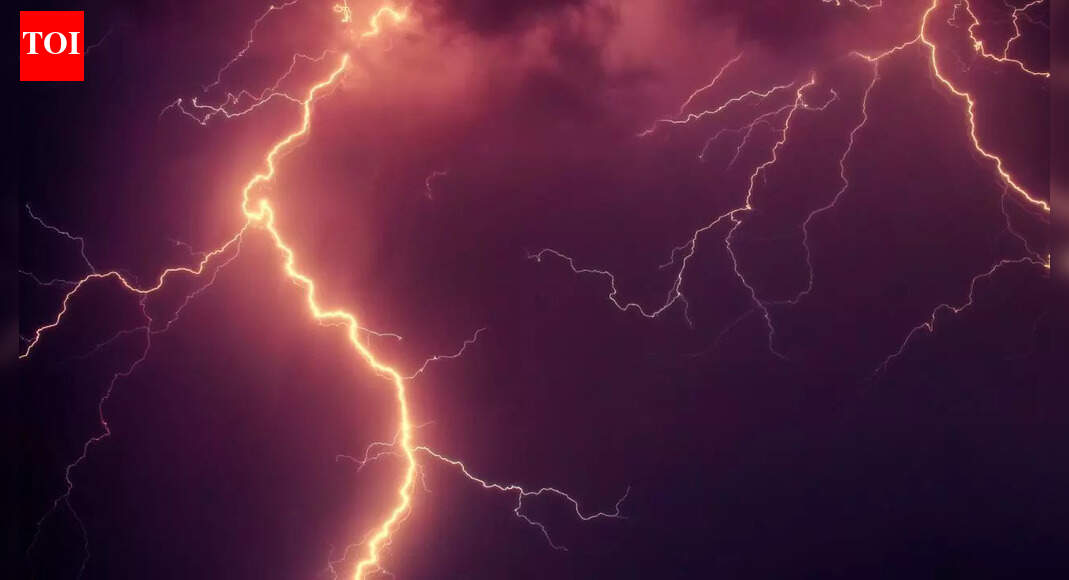
In the wake of a particularly stormy summer across the Midwest, where lightning strikes have claimed lives and caused widespread damage, experts are urging the public to separate fact from fiction when it comes to one of nature's most powerful forces. According to a recent article from the Times of India, titled "10 myths about lightning and why you should not believe them," many common beliefs about lightning could be putting people at unnecessary risk. The piece, published on their science desk, highlights how misconceptions persist despite decades of meteorological research.
Lightning, described in the article as sitting "at the boundary between routine weather and sudden hazard," strikes somewhere on Earth about 100 times per second, according to the National Weather Service. In the United States alone, it causes around 20 deaths and 100 injuries annually, figures that have remained steady over the past decade. The Times of India report emphasizes that understanding the science behind lightning can save lives, especially as climate patterns lead to more intense storms in regions like Appleton, Wisconsin, where local officials reported over 50 lightning-related incidents in the last year.
The article begins by debunking the popular notion that lightning never strikes the same place twice. "This is one of the most enduring myths," the Times of India writes, pointing to the Empire State Building in New York City, which is struck about 100 times each year. Experts cited in the piece, including meteorologists from the Indian Meteorological Department, explain that lightning follows the path of least resistance, often targeting tall structures repeatedly.
Another widespread belief addressed is that rubber tires on a car provide protection during a thunderstorm. The report clarifies that while cars with metal roofs act as a Faraday cage, insulating occupants from the electrical charge, it's the metal body that does the work, not the tires. "If you're in a convertible or a vehicle with a non-metal roof, you're not safe," the article quotes Dr. Rajesh Kumar, a physicist at the University of Delhi, as saying. This myth has led to dangerous behaviors, such as people abandoning vehicles during storms.
Moving to indoor safety, the Times of India tackles the idea that standing near a window or using a landline phone during a storm is harmless. According to the piece, lightning can travel through conductive materials like phone lines and plumbing, causing electrocution. The article references a 2022 study by the World Meteorological Organization, which found that 30 percent of lightning injuries occur indoors due to such misconceptions. Local emergency responders in Appleton echoed this, with Fire Chief Michael Harlan stating, "We've seen cases where people were injured while talking on corded phones—stay away from wired devices."
The myth that lightning doesn't strike in the rain is also dispelled. The report notes that lightning can strike up to 10 miles from the center of a thunderstorm, even on clear days—a phenomenon known as a "bolt from the blue." This was tragically illustrated in a 2023 incident in Florida, where a golfer was killed under sunny skies, miles from any visible storm clouds. The Times of India attributes this oversight to the brief visibility of lightning, which "appears briefly, illuminates a landscape, and vanishes before the eye."
Further into the article, it addresses the belief that if your hair stands on end, lightning is about to strike you, and you should lie flat on the ground. While the hair-standing sensation, called the "piloerection effect," is a real warning sign of an impending strike, lying down can increase your risk by providing more contact points with the ground. Instead, the piece recommends crouching low with minimal ground contact, feet together, as advised by the National Oceanic and Atmospheric Administration (NOAA).
The Times of India also covers the misconception that taller people are more likely to be struck. While height does play a role in open areas, the article stresses that lightning seeks the shortest path to ground, regardless of a person's stature. It cites data from the Global Lightning Detection Network showing that most strikes hit trees, buildings, or water bodies, not individuals directly. In Appleton, where rural areas see frequent strikes on farms, agricultural extension officer Sarah Jenkins reported, "We've educated farmers that no one is immune—it's about avoiding exposure."
Another point of clarification is the idea that lightning rods attract strikes. According to the report, lightning rods actually provide a safe path for the electricity to follow, preventing damage to structures. The article quotes engineer Priya Singh from the Indian Institute of Technology: "Without them, buildings are more vulnerable; with them, the strike is directed harmlessly to the ground." This technology, dating back to Benjamin Franklin's experiments in 1752, remains crucial in lightning-prone areas.
The piece doesn't shy away from the myth that you can outrun lightning by seeking shelter quickly. Lightning travels at speeds up to 220 million miles per hour, making evasion impossible once initiated. The Times of India references a survey by the Centers for Disease Control and Prevention, where 40 percent of respondents believed they could dodge a bolt, leading to risky decisions like continuing outdoor activities during approaching storms.
Addressing environmental myths, the article debunks the claim that lightning only occurs in summer. While more common then due to convective heating, strikes happen year-round, including rare winter events known as thundersnow. In the context of global warming, the report notes an increase in lightning frequency, with a 2021 study in Science predicting a 50 percent rise by 2100 in some regions.
The Times of India also examines the belief that animals sense lightning and flee, while humans cannot. While some animals do exhibit behaviors like birds quieting or cattle grouping, the article cautions against relying on this as a predictor. "Human senses aren't tuned that way, but technology like weather apps can be," it states, promoting the use of radar alerts.
Finally, the report tackles the notion that cell phones attract lightning. No evidence supports this, according to experts cited; the danger lies in being outdoors, not the device. The Federal Communications Commission has repeatedly clarified that hands-free use is safe, countering urban legends.
As thunderstorms continue to batter the Appleton area— with the National Weather Service issuing 15 severe weather warnings this season alone—local authorities are drawing on international insights like those from the Times of India to bolster public education. "Myths die hard, but facts save lives," said meteorologist Laura Chen of the Appleton Weather Bureau. Programs at community centers now include lightning safety workshops, emphasizing the article's key message: seek shelter indoors, away from windows and water, at the first rumble of thunder.
Looking ahead, with climate change intensifying storm patterns, experts anticipate more frequent lightning events. The Times of India article serves as a timely reminder that knowledge is the best defense against nature's flash of fury, urging readers worldwide to heed science over superstition.