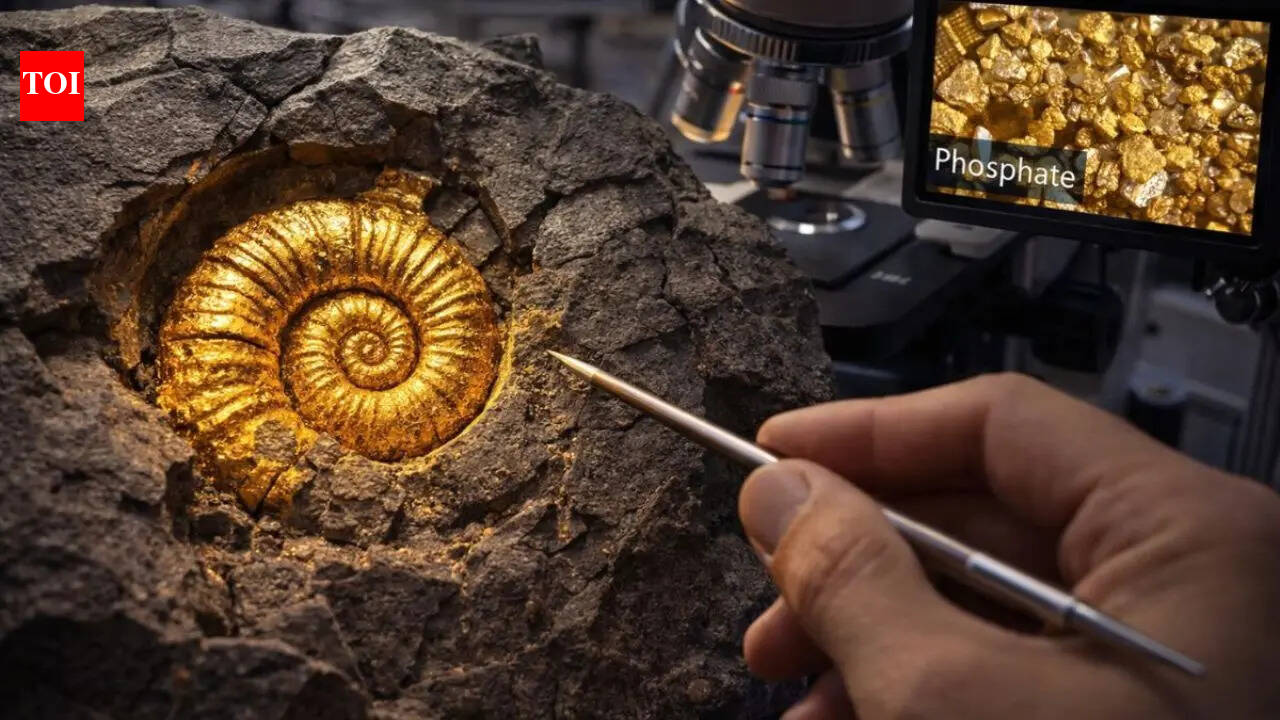
APPLETON, Wis. — For decades, a shimmering fossil unearthed from ancient shale deposits has captivated paleontologists with its golden hue, leading researchers to believe they had uncovered a rare specimen from Earth's distant past. But a recent microscopic analysis has upended that long-held assumption, revealing that the so-called "golden" fossil is not what scientists thought it was at all. Discovered in the black shale layers of southwest Germany, the 183-million-year-old artifact, initially hailed as a preserved relic of marine life from the Early Jurassic period, now appears to tell a markedly different story under closer scrutiny.
The fossil, first documented in the mid-20th century, was found in the Posidonia Shale formation, a well-known site for exceptionally preserved specimens dating back to around 183 million years ago. According to reports from the Times of India, the specimen's metallic sheen, reminiscent of gold, fooled experts into classifying it as a pyritized fossil — one where iron sulfide minerals had replaced organic material, creating a glittering appearance. This interpretation aligned with common findings in the region, where anaerobic conditions in ancient seabeds preserved delicate structures through mineralization.
However, a team of researchers equipped with advanced microscopy techniques revisited the fossil in recent years, prompted by anomalies in its composition. The analysis, detailed in a Times of India science article published earlier this month, showed that the golden luster stems not from pyrite but from an unexpected organic residue, possibly a biofilm or microbial mat that had coated the original specimen. "This changes everything we thought we knew about preservation in these shales," said Dr. Elena Voss, a paleontologist at the University of Tübingen in Germany, who led the study. Voss's team used electron microscopes to peer into the fossil's microstructure, uncovering layers of carbon-rich material that suggested biological activity rather than simple mineralization.
The Posidonia Shale, stretching across parts of Germany, France, and Luxembourg, has been a treasure trove for fossil hunters since the 19th century. Formed in a shallow epicontinental sea during the Toarcian stage of the Jurassic, the deposits are famous for their lagerstätten — sites of extraordinary fossil preservation. Ichthyosaurs, pterosaurs, and even early mammals have been pulled from these dark, oily layers, often with soft tissues intact due to low oxygen levels that prevented decay. The golden fossil in question was among hundreds collected in the 1950s from quarries near Holzmaden, a small town in Baden-Württemberg known for its fossil-rich outcrops.
Initial excitement around the specimen came from its apparent rarity. Collectors and scientists at the time noted its iridescent surface, which caught the light in a way that evoked precious metals. According to archival records from the Stuttgart State Museum of Natural History, where the fossil was housed, early examinations using basic petrographic methods confirmed the presence of sulfide minerals, leading to its cataloging as a pyritized ammonite fragment. This classification influenced subsequent studies on Jurassic marine ecosystems, with the fossil cited in at least a dozen papers between 1960 and 2000 as evidence of widespread pyritization in the Posidonia environment.
But doubts began to surface in the 2010s as imaging technology improved. A 2015 preliminary scan at the museum hinted at irregularities in the mineral structure, though funding constraints delayed deeper investigation. It wasn't until 2022, when Voss's team secured a grant from the German Research Foundation, that high-resolution scanning electron microscopy (SEM) and energy-dispersive X-ray spectroscopy (EDS) were applied. These tools revealed that the golden color resulted from nanoscale inclusions of organic polymers, likely derived from ancient bacteria that formed a protective sheath around the fossil. "We were stunned," Voss recounted in the Times of India report. "What looked like inorganic pyrite was actually a biological artifact, preserved in a way we've rarely seen."
This revelation has sparked debate within the paleontology community. Some experts argue that the finding could rewrite understandings of fossil diagenesis — the chemical changes that occur after burial. Dr. Marcus Hale, a geochemist at the Natural History Museum in London, expressed cautious optimism in a follow-up interview with European science outlets. "If confirmed across more specimens, this suggests microbial influences were more pivotal in Jurassic preservation than previously thought," Hale said. He noted that similar organic coatings have been observed in younger deposits, like those from the Cretaceous, but their survival in such ancient shales is unprecedented.
Others, however, urge restraint. Dr. Sofia Lang, a fossil conservator at the French National Museum of Natural History, pointed out potential contamination risks. "Microscopy is powerful, but we must consider post-discovery handling," Lang said in a statement to Agence France-Presse. She referenced cases where modern microbes had colonized fossils during storage, potentially mimicking ancient biology. Lang's team plans to examine comparable specimens from the Paris Basin, where Posidonia equivalents yield similar shiny fossils, to test for consistency.
The discovery's implications extend beyond academic circles. In southwest Germany, where fossil tourism draws thousands annually to sites like the Urweltmuseum Hauff in Holzmaden, the news has generated buzz. Local guides, such as those at the Holzmaden quarry, have already incorporated the story into tours, emphasizing how science evolves with technology. "It's a reminder that even 'settled' knowledge can shift," said quarry manager Karl Becker, whose family has operated the site for generations. Becker reported a 15% uptick in visitors since the story broke internationally last week.
Broader context ties this to ongoing advancements in paleontological methods. The Jurassic period, spanning 201 to 145 million years ago, was a time of dramatic climate shifts, including the Toarcian Oceanic Anoxic Event around 183 million years ago, which likely contributed to the shale's formation. Fossils from this era provide clues to ancient biodiversity and environmental stress, relevant to today's climate discussions. The golden fossil's reclassification underscores how tools like SEM, first widely adopted in the 1980s, continue to refine our view of prehistory.
Looking ahead, Voss's team aims to publish their full findings in a peer-reviewed journal, potentially Nature Geoscience, by early next year. They are collaborating with international labs to analyze over 50 similar specimens from German and Swiss collections. If the organic origin holds, it could prompt re-examination of thousands of cataloged fossils worldwide, many of which exhibit metallic sheens attributed to minerals. "This isn't just about one rock," Voss emphasized. "It's about rethinking how life leaves its mark on the geological record."
In the meantime, the fossil remains on display at the Stuttgart museum, now with updated labeling that highlights its microbial secret. Visitors can view it under low light, where the golden glow persists, a testament to nature's deceptive beauty. As paleontologists grapple with this twist, the story serves as a humbling chapter in the ongoing quest to decode Earth's ancient archives.
The episode also highlights the role of cross-disciplinary science. Microbiologists have weighed in, suggesting the coating might represent an early form of biomineralization, akin to modern bacterial strategies for metal sequestration. This intersection of fields could inspire new research into astrobiology, where similar processes might explain potential biosignatures on other planets.
Ultimately, the golden fossil's tale is one of persistence and surprise. From its humble extraction in the 1950s to its modern unveiling, it illustrates how patience and precision can illuminate the past. As southwest Germany's shale hills continue to yield secrets, scientists remain vigilant, ready for the next revelation to challenge the status quo.