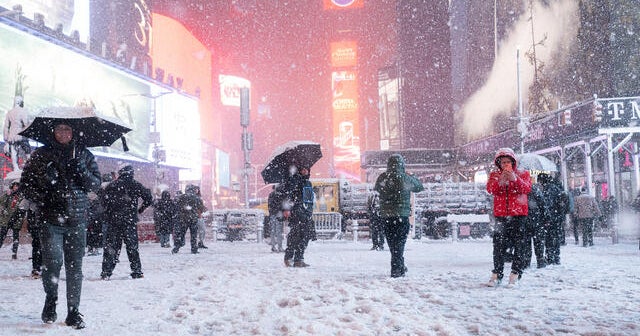
WASHINGTON — A powerful blizzard battered the East Coast on Thursday, February 23, dumping historic amounts of snow on major cities and disrupting travel, commerce, and daily life for millions. According to CBS News, the storm, which began intensifying early in the day, brought snowfall rates of up to two inches per hour in some areas, leading to whiteout conditions and emergency declarations across several states.
The National Weather Service had issued warnings for a swath from Virginia to Maine, predicting accumulations of 12 to 18 inches in urban centers like New York City, Philadelphia, and Boston. By midday, New York City reported over 10 inches already fallen, with Mayor Eric Adams urging residents to stay indoors. "This is one of the most significant snow events we've seen in years," Adams said during a press briefing, emphasizing the need for plows and salt trucks to clear major arteries.
In Boston, where the storm hit hardest, officials recorded 15 inches by evening, marking it as potentially the heaviest single-day snowfall since 2013. Massachusetts Governor Maura Healey activated the state's emergency operations center, deploying National Guard units to assist with stranded motorists. "We're preparing for the worst while hoping for the best," Healey stated, according to reports from the scene. Power outages affected more than 200,000 households in the region, with utility crews working around the clock to restore service amid howling winds gusting up to 50 miles per hour.
Transportation ground to a halt as airlines canceled thousands of flights at hubs like Logan International Airport and LaGuardia. Amtrak suspended service along the Northeast Corridor, stranding passengers in stations from Washington, D.C., to Providence, Rhode Island. One commuter, Sarah Jenkins from Philadelphia, described the chaos to CBS News: "I was stuck on the platform for hours; it felt like the world just stopped." Schools closed across the board, and businesses shuttered early, with economic losses projected in the billions due to the widespread shutdown.
The blizzard's ferocity drew comparisons to the infamous "Snowmageddon" of 2010, when a similar storm paralyzed the region. Climate experts, speaking on background, noted that warmer Atlantic waters may be fueling more intense winter storms, though the immediate focus remained on response efforts. Federal aid was promised by President Biden's administration, with FEMA coordinating supplies to hard-hit areas. In Baltimore, where flooding compounded the snow, city officials reported rescuing over 100 people from vehicles trapped in rising waters along the Patapsco River.
As cleanup began in the predawn hours of Friday, forecasters warned of lingering cold snaps that could exacerbate icy roads. The storm's path, originating from a low-pressure system over the Midwest, had been tracked for days, yet its rapid intensification caught some by surprise. Environmental groups highlighted the event as a stark reminder of shifting weather patterns, with data from the past decade showing an uptick in extreme precipitation events along the Eastern Seaboard.
Shifting focus to the international stage, the blizzard's domestic upheaval coincided with escalating tensions in nuclear negotiations with Iran. CBS News reported that talks in Vienna hung in the balance as Iranian officials issued stark warnings, signaling readiness to defend their interests aggressively. The discussions, aimed at reviving the 2015 Joint Comprehensive Plan of Action (JCPOA), have stalled over issues like uranium enrichment limits and sanctions relief.
Iran's Foreign Minister Hossein Amir-Abdollahian addressed the impasse during a televised statement, declaring, "Iran is ready to fight if necessary to protect its sovereignty." This rhetoric came amid reports of accelerated centrifuge operations at the Natanz facility, where the International Atomic Energy Agency (IAEA) inspectors noted non-compliance with prior agreements. U.S. envoy Robert Malley, leading the American delegation, expressed cautious optimism but cautioned that provocations could derail progress.
Background on the JCPOA reveals a tortuous path: signed under President Obama, the deal curbed Iran's nuclear program in exchange for economic incentives, only to be abandoned by President Trump in 2018. Subsequent "maximum pressure" sanctions failed to bring Iran back to the table, leading to this latest round of indirect talks mediated by the European Union. Sources close to the negotiations told CBS that disagreements over ballistic missile development and regional proxy support remain major hurdles.
European allies, including France and Germany, urged restraint, with a joint statement from the E3 nations emphasizing, "Diplomatic channels must remain open to avoid escalation." Meanwhile, Israel, a vocal critic of any deal, has lobbied against concessions, citing Iran's support for groups like Hezbollah. Saudi Arabia, too, voiced concerns, with diplomats in Riyadh warning of a potential arms race in the Gulf if talks collapse.
The timing of Iran's warning, just as the U.N. Security Council prepared to discuss a resolution on Tehran's nuclear activities, added urgency. Analysts pointed to domestic pressures in Iran, where economic woes from sanctions have fueled protests, possibly hardening the regime's stance. "This is a high-stakes game," said Suzanne Maloney, a Brookings Institution expert, in an interview with CBS. "Iran's threats are partly posturing, but they underscore the fragility of the process."
On the U.S. side, congressional Republicans criticized the Biden administration's approach, with Senator Tom Cotton stating, "Appeasement won't work; we need stronger enforcement." Democrats, however, defended engagement, arguing that isolation only accelerates Iran's program. The IAEA's latest report confirmed that Iran possesses enough enriched uranium for several bombs if further processed, heightening global anxiety.
As the East Coast dug out from the snow, the dual crises illustrated the breadth of challenges facing policymakers—from immediate weather threats to long-term geopolitical risks. In Washington, briefings on both fronts continued into the night, with no immediate resolutions in sight. For the blizzard, recovery efforts were expected to span the weekend, while nuclear envoys scheduled follow-up sessions for early next week.
Looking ahead, meteorologists predicted a brief respite from winter's wrath, but seasonal outlooks suggested more storms on the horizon. In the realm of diplomacy, success in Vienna could ease oil market jitters and stabilize the Middle East, but failure risks broader conflict. As one State Department official put it anonymously, "We're walking a tightrope, and the winds are picking up."
The convergence of these events on February 23 served as a microcosm of 2023's unpredictability, blending natural and human-made tempests. Residents from Boston to Tehran watched warily, hoping for clearer skies—literal and figurative—in the days to come.