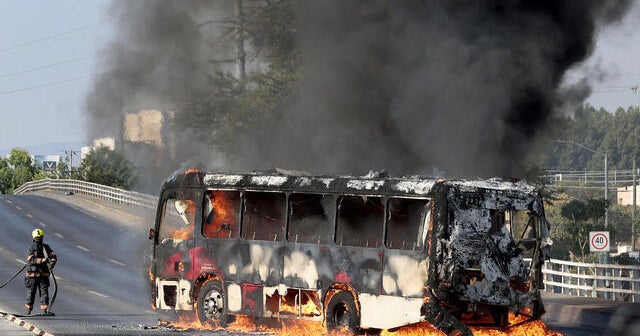
In a rapidly escalating situation along the U.S.-Mexico border, U.S. officials have issued a shelter-in-place order for American citizens and residents in several parts of Mexico following the killing of a prominent cartel leader. The order, announced on February 23, 2023, affects communities in the states of Sinaloa and Chihuahua, where violence has surged in the aftermath of the death of Joaquín 'El Chapo' Guzmán's son, Ismael 'El Mayo' Zambada's associate, though specifics on the exact leader remain unconfirmed by Mexican authorities. According to the U.S. State Department, the directive urges Americans to remain indoors, avoid travel, and monitor local news for updates as rival cartels clash over territory.
The incident stems from a reported ambush in Culiacán, Sinaloa's capital, where the cartel leader was gunned down during a confrontation between the Sinaloa Cartel and the Jalisco New Generation Cartel. Mexican officials said the violence erupted around 2 a.m. local time, leading to at least 15 deaths and widespread gunfire that spilled into residential areas. 'We are advising all U.S. personnel and citizens to shelter in place immediately,' stated a spokesperson for the U.S. Embassy in Mexico City during a press briefing. The order marks the third such advisory in the region this year, reflecting ongoing instability tied to Mexico's ongoing battle against organized crime.
Background on the cartel dynamics provides crucial context: The Sinaloa Cartel, one of Mexico's most powerful drug trafficking organizations, has been fractured since the 2019 arrest and extradition of El Chapo Guzmán to the United States. His sons, known as the Chapitos, have vied for control, often clashing with older factions loyal to El Mayo Zambada. Reports from the region indicate that the killed leader was a key enforcer for the Chapitos, and his death could trigger a power vacuum. According to security analysts cited in the CBS News segment 'The Takeout with Major Garrett,' aired on February 23, this event 'could lead to weeks of retaliatory violence, potentially affecting cross-border trade and tourism.'
Local residents in Culiacán described scenes of chaos. 'Bullets were flying everywhere; we barricaded our doors and stayed inside all night,' said Maria Gonzalez, a shop owner in the affected neighborhood, in an interview relayed through local media. Mexican President Andrés Manuel López Obrador addressed the nation from Mexico City, condemning the violence but stopping short of declaring a state of emergency. 'Our security forces are deployed, and we will restore order,' López Obrador said during a morning press conference. However, critics, including opposition lawmakers, argue that the government's 'hugs, not bullets' approach to cartels has exacerbated such incidents.
On the U.S. side, the shelter-in-place order has prompted concern among border communities in Texas and Arizona. The U.S. Consulate in Ciudad Juárez reported that over 500 Americans have sought guidance since the announcement. Federal officials emphasized that while no direct threats to U.S. soil have been identified, heightened vigilance is necessary. 'This is a precautionary measure to ensure the safety of our citizens abroad,' said State Department spokesperson Ned Price in a statement. Travel advisories for Mexico were updated to Level 4: Do Not Travel for the affected states, a level unchanged since 2020 but now with added urgency.
Shifting focus to domestic politics, California Governor Gavin Newsom is facing significant backlash for his recent comments on standardized testing, particularly regarding SAT scores. During a February 22 education roundtable in Sacramento, Newsom suggested that over-reliance on SAT scores in college admissions perpetuates inequality. 'These tests don't measure true potential; they favor those who can afford tutors,' Newsom remarked, advocating for a statewide shift toward holistic admissions criteria. The statement, part of a broader push to reform California's higher education system, has drawn fire from educators, parents, and Republican critics.
The controversy erupted as Newsom's administration proposes legislation to make SAT optional for University of California system applicants, building on a 2020 suspension due to COVID-19. According to the CBS News summary of 'The Takeout,' Newsom's remarks 'have ignited a debate on meritocracy versus equity in education.' Conservative commentators, including those from the California Republican Party, accused the governor of undermining academic standards. 'Dismissing SAT scores is code for lowering the bar to push a progressive agenda,' said state GOP chair Jessica Millan Patterson in a public statement.
Supporters of Newsom's position point to data showing socioeconomic disparities in test performance. A 2022 study by the University of California Board of Regents found that students from low-income families scored an average of 200 points lower on the SAT than their affluent peers. 'Governor Newsom is right to question a system that disadvantages underrepresented groups,' said Dr. Elena Ramirez, an education policy expert at UCLA, in comments to local outlets. The backlash has been particularly vocal from Asian American advocacy groups, who argue that test-optional policies could harm high-achieving students from immigrant families reliant on objective metrics.
Newsom's comments come amid California's ongoing budget battles, with education funding at the forefront. The state faces a $22 billion deficit, prompting scrutiny of all spending priorities. During the roundtable, Newsom highlighted successful test-optional pilots at UC Berkeley and UCLA, where diversity in admissions increased by 15% without a drop in graduation rates. 'We're preparing students for the real world, not just multiple-choice questions,' he added, drawing applause from attending teachers' union representatives.
Opponents, however, warn of unintended consequences. The College Board, which administers the SAT, issued a statement defending the test's validity. 'Decades of research show SAT scores predict college success across demographics,' said spokesperson Kate McLaughlin. In interviews following the event, some parents expressed frustration. 'My daughter studied for months to boost her score; now it feels devalued,' said Linda Chen, a parent from the Bay Area, to the Sacramento Bee.
The dual stories—from border violence to education debates—highlight broader challenges in U.S. policy. The Mexico situation underscores the persistent impact of drug cartels on bilateral relations, with U.S. aid to Mexico's security forces totaling $3.5 billion since 2008 under the Mérida Initiative. Yet, violence persists, with over 30,000 homicides reported in Mexico last year. Experts suggest that without addressing U.S. demand for drugs, such incidents will continue.
For Newsom, the SAT controversy could influence his national profile as he eyes a potential 2024 presidential run. Polls show divided opinions: a recent Public Policy Institute of California survey found 52% of Democrats support test-optional policies, compared to just 28% of Republicans. As the governor navigates these waters, his office has scheduled follow-up meetings with stakeholders to refine the proposal.
Looking ahead, the shelter-in-place order in Mexico is set for review in 48 hours, depending on stabilization efforts by Mexican federal police, who have deployed 2,000 troops to Sinaloa. U.S. officials are coordinating with counterparts to facilitate any necessary evacuations. Meanwhile, Newsom's education initiative faces legislative hurdles, with a key hearing slated for March 15 in the state assembly.
These events, as discussed on CBS's 'The Takeout with Major Garrett' on February 23, illustrate the interconnectedness of international security and domestic policy debates. As Americans grapple with these issues, calls for comprehensive solutions grow louder—from bolstering border cooperation to rethinking educational equity.
In the coming days, updates from both fronts will be critical. For those in affected Mexican regions, safety remains paramount, while California's education discourse promises to shape future generations. Officials urge vigilance and informed engagement on all sides.