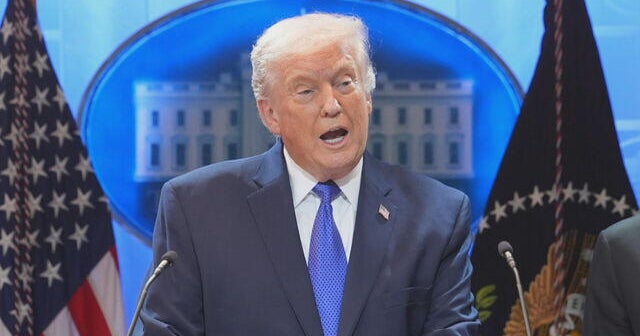
WASHINGTON — As the nation braces for a pivotal moment in American politics, anticipation is building around what former President Donald J. Trump might say in a potential State of the Union address, should he return to the White House. According to a recent segment on CBS Evening News aired on February 24, 2024, Trump's remarks could focus heavily on economic recovery, border security, and foreign policy challenges, reflecting his signature style of direct, unfiltered commentary. The broadcast highlighted how Trump's address, if delivered, would come at a time of deep national division, with polls showing a tight race against incumbent President Joe Biden in the lead-up to the November election.
The CBS report, led by anchor Norah O'Donnell, delved into the expectations set by Trump's campaign team. Sources close to the former president indicated that he plans to emphasize achievements from his first term, such as tax cuts and deregulation, while criticizing what he calls the Biden administration's 'failed policies' on inflation and immigration. 'Trump will paint a picture of America first, putting the needs of working families ahead of globalist agendas,' one anonymous GOP strategist told CBS, underscoring the populist tone likely to dominate the speech.
Meanwhile, across the Atlantic, the war in Ukraine entered a grim new phase as Russian forces intensified strikes on the country's power infrastructure, effectively weaponizing the harsh winter against civilians. The CBS Evening News segment detailed how these attacks, which began escalating in late 2023, have left millions without heat or electricity amid subzero temperatures. Ukrainian officials reported that on February 23 alone, Russian missiles targeted energy facilities in Kyiv and Kharkiv, knocking out power for over 500,000 households.
'Winter has become a weapon in Putin's arsenal,' said Ukrainian President Volodymyr Zelenskyy in a statement quoted by CBS, as blackouts plunged cities into darkness and forced schools and hospitals to rely on generators. The strikes, which the International Atomic Energy Agency warned could risk nuclear safety at facilities like the Zaporizhzhia plant, have drawn international condemnation. European Union foreign policy chief Josep Borrell called the tactics 'barbaric,' vowing increased military aid to Ukraine during a Brussels summit on February 24.
Context for the Ukrainian crisis traces back to Russia's full-scale invasion on February 24, 2022 — exactly two years prior to the CBS broadcast. Since then, Moscow has systematically targeted Ukraine's energy grid, destroying about 50% of its thermal and hydroelectric capacity, according to the Ukrainian Ministry of Energy. This year's winter offensive marks a strategic shift, with analysts noting that President Vladimir Putin aims to erode civilian morale and pressure Kyiv into negotiations on Russia's terms.
On the U.S. political front, Trump's potential State of the Union remarks are seen by some as a preview of his convention speech at the Republican National Convention in July. CBS correspondent Jan Crawford reported from Mar-a-Lago, where Trump has been preparing with advisors. She quoted Trump himself from a recent rally: 'We're going to make America great again, stronger and safer than ever before.' The segment contrasted this with Democratic critiques, noting that Biden's team views Trump's rhetoric as divisive, potentially alienating moderate voters.
Shifting back to Ukraine, eyewitness accounts from the ground paint a harrowing picture. In Lviv, resident Olena Kovalenko described to CBS the chaos of a recent blackout: 'We huddled in the basement with candles, the cold seeping through the walls. It's not just power they're taking — it's our hope.' Humanitarian organizations like the Red Cross have airlifted emergency generators to affected areas, but supply chains are strained by ongoing drone attacks on supply routes near the Polish border.
U.S. officials, speaking on condition of anonymity to CBS, expressed frustration over the limited impact of sanctions on Russia's energy sector. 'Putin's war machine is resilient, but these strikes on civilians cross a red line,' one State Department source said. The Biden administration announced an additional $1 billion in aid to Ukraine on February 24, including anti-air defense systems to protect power plants, though delivery timelines remain uncertain amid congressional debates over funding.
Trump's address expectations also tie into broader foreign policy debates, particularly regarding Ukraine. During his presidency, Trump faced impeachment over withholding aid to Kyiv, a saga CBS revisited in the segment. Advisors suggest he might use the platform to advocate for a quick resolution to the conflict, potentially through direct talks with Putin — a stance that contrasts with the Biden administration's commitment to Ukrainian sovereignty. 'Peace through strength is the only way,' Trump posted on social media recently, as quoted by CBS.
In Ukraine, the human cost of the power strikes is mounting. The World Health Organization reported a 30% spike in hypothermia cases in eastern regions since January, with at least 15 deaths attributed to cold-related illnesses. Zelenskyy's government has implemented rolling blackouts to conserve energy, but experts warn that without swift international intervention, the grid could collapse entirely by spring. NATO Secretary General Jens Stoltenberg, in a February 24 press conference, urged allies to ramp up support: 'We cannot let Russia win by freezing out Ukraine's people.'
Domestically, the Ukraine crisis influences U.S. election dynamics. CBS polling showed that 62% of Republicans favor reducing aid to Ukraine, aligning with Trump's 'America First' doctrine, while Democrats overwhelmingly support continued assistance. The Evening News segment featured a split-screen analysis, with conservative commentator Marc Thiessen arguing that 'endless wars drain our resources,' and liberal analyst Rahm Emanuel countering that 'abandoning Ukraine emboldens tyrants worldwide.'
As preparations for Trump's address continue, details emerge about its format. Expected to last around 90 minutes, it would be delivered from the House chamber on a date yet to be set post-inauguration, should he win. CBS noted historical precedents, like Trump's 2019 address where he highlighted the U.S.-Mexico border wall, drawing bipartisan applause at times but also protests.
The interconnectedness of these stories — U.S. politics and global conflict — underscores the high stakes of 2024. In Ukraine, repair crews work around the clock to restore power, but Russian advances near Avdiivka threaten further disruptions. U.S. Energy Secretary Jennifer Granholm, speaking to CBS, emphasized America's role: 'We're providing technical expertise to rebuild Ukraine's grid, ensuring they can withstand this onslaught.'
Looking ahead, the implications for both narratives are profound. A Trump-led address could signal a pivot in U.S. foreign policy, potentially accelerating peace talks in Ukraine or straining alliances. For Ukrainians enduring the winter siege, the path forward hinges on sustained Western resolve. As one Kyiv-based analyst told CBS, 'Every kilowatt saved is a victory against aggression.' With elections looming and the war grinding on, these developments will shape the global landscape for years to come.
In summary, the CBS Evening News on February 24 captured a world at a crossroads, from the rhetoric of American leadership to the resilience of a nation under siege. Officials on both sides urge vigilance, as the coming months promise pivotal decisions.