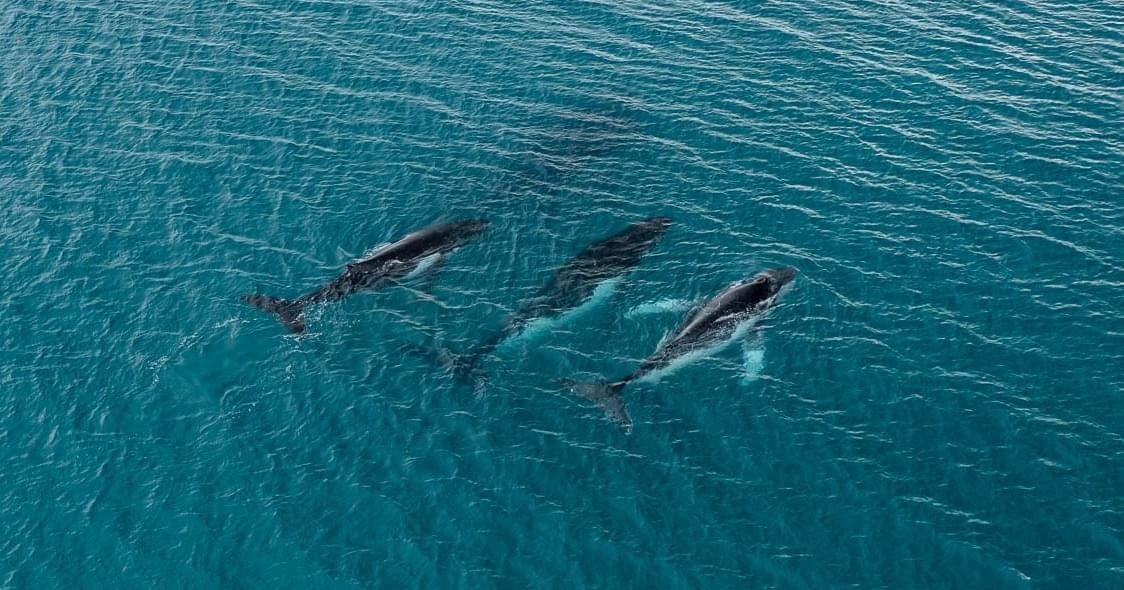
A pair of humpback whales has completed what researchers describe as the longest recorded journeys between breeding grounds on opposite sides of the world, according to a new study that relied on thousands of photographs to track the animals over more than two decades.
One whale first photographed off Queensland, Australia, in 2007 later appeared near Sao Paulo, Brazil, in 2019, covering roughly 8,823 miles. A second individual spotted off Bahia, Brazil, was identified 22 years later in Hervey Bay, Australia, after traveling about 9,383 miles. The findings, published Wednesday in Royal Society Open Science, mark the greatest distances ever documented between sightings of the same humpback whales.
The research team examined nearly 20,000 images collected from 1984 through 2025 by scientists and citizen contributors in eastern Australia and Latin America. An automated image-recognition system helped match the distinctive tail patterns that allow researchers to identify individual whales.
"The pictures represent the longest distance ever seen between two pictures of the same humpback whale," the scientists reported. Such crossings remain exceedingly rare for the animals, which can reach lengths of 55 feet.
Griffith University PhD researcher Stephanie Stack, a co-author of the study, noted the broader significance of even infrequent movements. "Despite their rarity, these exchanges matter for the long-term health of whale populations," she said. "Occasional individuals moving between distant breeding grounds can help maintain genetic diversity across populations."
Stack added that the whales may also transport cultural elements between regions. "They may even carry new song styles from one region to another — humpback whale songs are known to spread culturally across ocean basins, much like music trends in human populations."
Dr. Cristina Castro of the Pacific Whale Foundation emphasized the role of public participation in the discovery. "This kind of research highlights the value of citizen science," she said in a statement. "Every photo contributes to our understanding of whale biology and, in this case, helped uncover one of the most extreme movements ever recorded."
The observations lend support to a hypothesis known as the Southern Ocean Exchange, which proposes that humpbacks sometimes feed in Antarctic waters and then return to a different breeding area than the one they left. Griffith University researchers suggested that ongoing climate shifts in the Southern Ocean, including changes in sea ice and the distribution of Antarctic krill, could make such long-distance crossings more common in the future.
Humpback whales were listed as endangered in the United States in the 1970s after decades of commercial whaling. A global moratorium on commercial whaling took effect in 1985. According to the National Oceanic and Atmospheric Administration, four of the 14 distinct population segments remain protected as endangered, while one is listed as threatened.
The two documented cases stand out because most humpback populations show strong fidelity to specific breeding and feeding sites. Researchers said the new data illustrate how individual animals can occasionally link distant groups that were previously considered more isolated.
Photographs used in the study came from both professional surveys and contributions by whale-watchers and other observers. The automated matching process allowed the team to sift through the large collection efficiently before confirming matches through manual review.
Officials and scientists involved in the project stressed that continued monitoring will be important as ocean conditions evolve. They noted that tracking these rare movements provides insight into how whale populations may adapt or redistribute in response to environmental pressures.
The study authors said further research could reveal whether additional long-distance travelers exist among other populations. They encouraged ongoing photo submissions from the public to expand the dataset and improve understanding of these patterns.