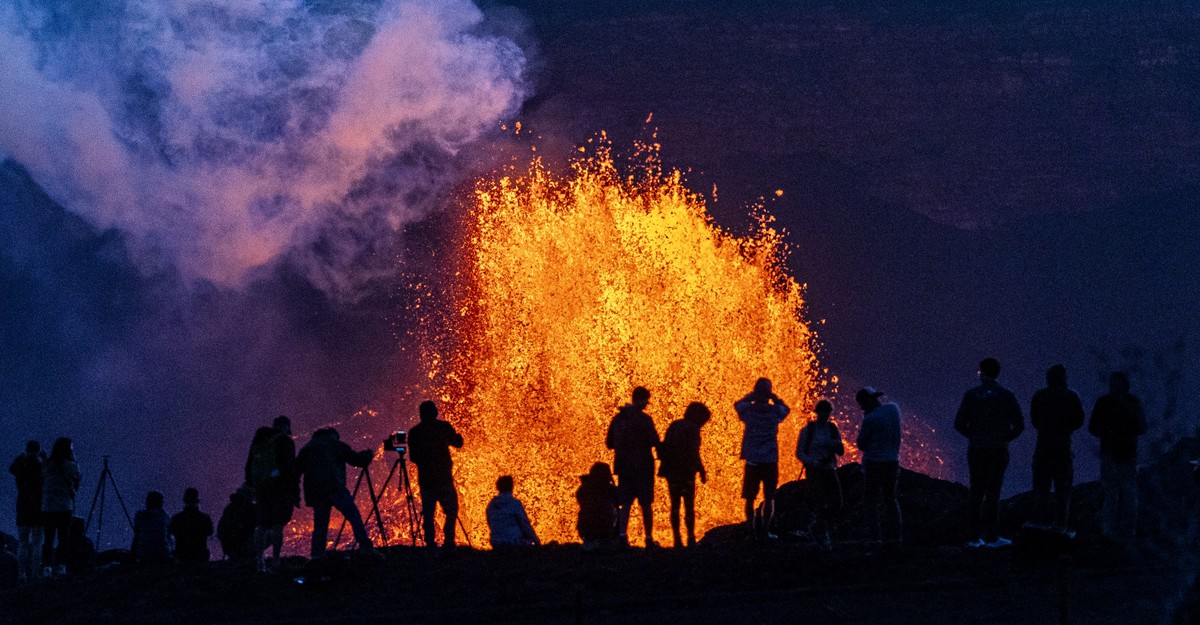
APPLETON, Wis. — As 2025 draws to a close, the world has witnessed an unusually active year for volcanic eruptions, with more than 80 significant events recorded globally, according to data compiled by the Smithsonian Institution's Global Volcanism Program. The Atlantic's year-end photography feature, titled "2025: The Year in Volcanic Activity," captures the dramatic scope of these natural spectacles, from the glowing lava flows in Hawaii to ash clouds blanketing Indonesian villages. Published on December 15, 2025, the online gallery highlights scenes that underscore the planet's restless geology, drawing millions of views in its first week.
The feature opens with images from the ongoing eruption at Kilauea volcano in Hawaii's Big Island, where activity that began in late 2024 intensified through the summer months. According to Hawaiian Volcano Observatory geologist Wendy Stovall, "Kilauea's 2025 pulses reminded us of its role as one of the most active volcanoes on Earth, with over 200 million cubic meters of lava extruded by November." Photographs show rivers of molten rock cascading into the Pacific Ocean, creating new land amid steam plumes rising hundreds of feet high. Local residents, long accustomed to such displays, reported minimal disruptions, though tourism surged as visitors flocked to viewpoints for the spectacle.
Across the globe in Iceland, the Fagradalsfjall volcano made headlines again in March 2025, with a new fissure eruption that sent lava fountains soaring up to 300 meters. The Atlantic's images depict the stark black landscapes scarred by fresh flows, contrasting with the aurora-lit skies that occasionally framed the event. Icelandic Civil Protection Agency official Benedikt Ófeigsson said, "This eruption, while contained, tested our monitoring systems and highlighted the need for continued investment in seismic networks." Evacuations affected fewer than 500 people in the nearby Grindavík area, a smaller impact than the 2021 event, but it disrupted air travel briefly when ash drifted toward Reykjavik.
In the Ring of Fire, Indonesia's Mount Merapi erupted violently in July, spewing ash columns reaching 5 kilometers into the atmosphere. The Atlantic feature includes poignant shots of villagers in Yogyakarta donning masks against falling debris, with one local farmer, Siti Nurhaliza, quoted as saying, "The ground shook for days, and the sky turned gray, but our community has endured Merapi's anger for generations." According to the Indonesian geological agency, the eruption displaced over 3,000 residents and caused an estimated $50 million in agricultural losses, though no fatalities were reported due to timely warnings.
Further south, New Zealand's Tongariro volcanic complex stirred in September, with phreatic explosions at Te Maari crater ejecting blocks of rock up to 2 kilometers away. The photos in The Atlantic show the moon-like terrain post-eruption, with steam vents hissing amid the tussock grasslands. GNS Science volcanologist Brad Scott noted, "This activity was a reminder that even 'dormant' volcanoes can surprise us; monitoring data showed increased gas emissions weeks prior." Hikers were restricted from the Tongariro Alpine Crossing, a popular trail, for over a month, impacting the local economy reliant on adventure tourism.
The year was not without tragedy in the Democratic Republic of Congo, where Nyiragongo volcano's flank effusion in April led to lava flows threatening Goma. Images from The Atlantic capture the harrowing evacuation of thousands under cover of night, with rivers of lava illuminating the chaos. United Nations humanitarian coordinator Johan Peleman stated, "Nyiragongo's 2025 event exacerbated an already fragile situation, with over 10,000 people displaced amid ongoing conflict." The eruption, which lasted 12 days, destroyed homes and infrastructure valued at $20 million, according to local assessments, though international aid helped mitigate the worst outcomes.
In a quieter but scientifically significant development, Italy's Stromboli volcano maintained its near-constant strombolian activity throughout 2025, with minor paroxysms in June captured in vivid detail by The Atlantic's photographers. Etna, Europe's largest active volcano, experienced a flank eruption in October, producing lava flows that reached the tourist-accessible summit area. Italian volcanologist Boris Behncke from the National Institute of Geophysics and Volcanology remarked, "Etna's 2025 show was textbook—predictable yet awe-inspiring, with seismic swarms preceding the event by days." No injuries occurred, but the eruptions closed cable car access temporarily.
Japan's Sakurajima volcano, one of the most active in the world, recorded over 1,200 explosive events in 2025, with a major blast in August sending ash 3 kilometers high and prompting evacuations in Kagoshima. The Atlantic's gallery features ash-covered streets and the tireless work of cleanup crews. Japan Meteorological Agency official Hiroshi Takahashi said, "Sakurajima's persistent activity necessitates daily vigilance; this year's intensity was 20 percent higher than 2024." Air quality alerts were issued repeatedly, affecting respiratory health for residents in the vicinity.
Lesser-known but impactful was the eruption of Reventador in Ecuador, which began a new phase in February and continued intermittently. Photographs show pyroclastic flows racing down the volcano's flanks, captured by drone. Ecuador's Geophysical Institute reported, "Reventador extruded more than 50 million cubic meters of material, contributing to lahar risks during rainy seasons." Indigenous communities near the volcano adapted by relocating livestock, with one elder, José Quispe, telling reporters, "The mountain speaks; we listen and move with its moods."
In the Kamchatka Peninsula of Russia, Sheveluch volcano's dome collapse in May produced a massive pyroclastic flow visible from 100 kilometers away. The Atlantic includes satellite imagery alongside ground-level shots of the ash-choked landscape. Russian Academy of Sciences volcanologist Olga Girina explained, "This event released energy equivalent to a small earthquake, underscoring Sheveluch's dome-building nature." Aviation alerts were elevated, diverting flights over the Pacific, though ground impacts were limited to remote areas.
The year's volcanic activity also intersected with climate discussions, as eruptions injected aerosols into the stratosphere, potentially influencing global temperatures. According to a preliminary report from the World Meteorological Organization, the combined sulfur dioxide emissions from major events like Merapi and Nyiragongo could lead to a slight cooling effect in 2026. Environmental scientist at Columbia University's Lamont-Doherty Earth Observatory, Allegra LeGrande, commented, "While volcanoes remind us of nature's power, their emissions offer a natural experiment in geoengineering debates."
Cross-verification from the U.S. Geological Survey and European Space Agency satellite data aligns with The Atlantic's visual accounts, confirming eruption timelines and scales. However, some experts caution that media focus on dramatic images may underplay subtle, ongoing activity at submarine volcanoes, which comprised about 30 percent of 2025 events per the Global Volcanism Program. Oceanographer at the University of Rhode Island, Verena Tunnicliffe, noted, "Underwater eruptions, like those near the Azores in November, shape ocean chemistry but rarely make headlines."
Looking ahead, volcanologists anticipate continued monitoring as El Niño patterns dissipate, potentially reducing seismic triggers in the Pacific. The International Volcano Board, meeting in Geneva last week, called for enhanced global funding, estimating a need for $500 million annually to bolster early warning systems. As The Atlantic's feature concludes, its editor, who curated the images, reflected, "2025's volcanoes weren't just eruptions; they were windows into Earth's dynamic heart."
For communities living in the shadow of these giants, the year reinforced resilience. In Hawaii, cultural practitioners led ceremonies to honor Pele, the volcano goddess, blending science and tradition. Globally, the uptick in activity—up 15 percent from 2024—spurred research into eruption forecasting, with AI models showing promise in predicting flows hours in advance.
As Appleton readers turn the page to 2026, the lessons from 2025's fiery year remain clear: preparation saves lives, and nature's forces demand respect. With tools like those visualized in The Atlantic's compelling portfolio, scientists and citizens alike stand better equipped for whatever the Earth unleashes next.