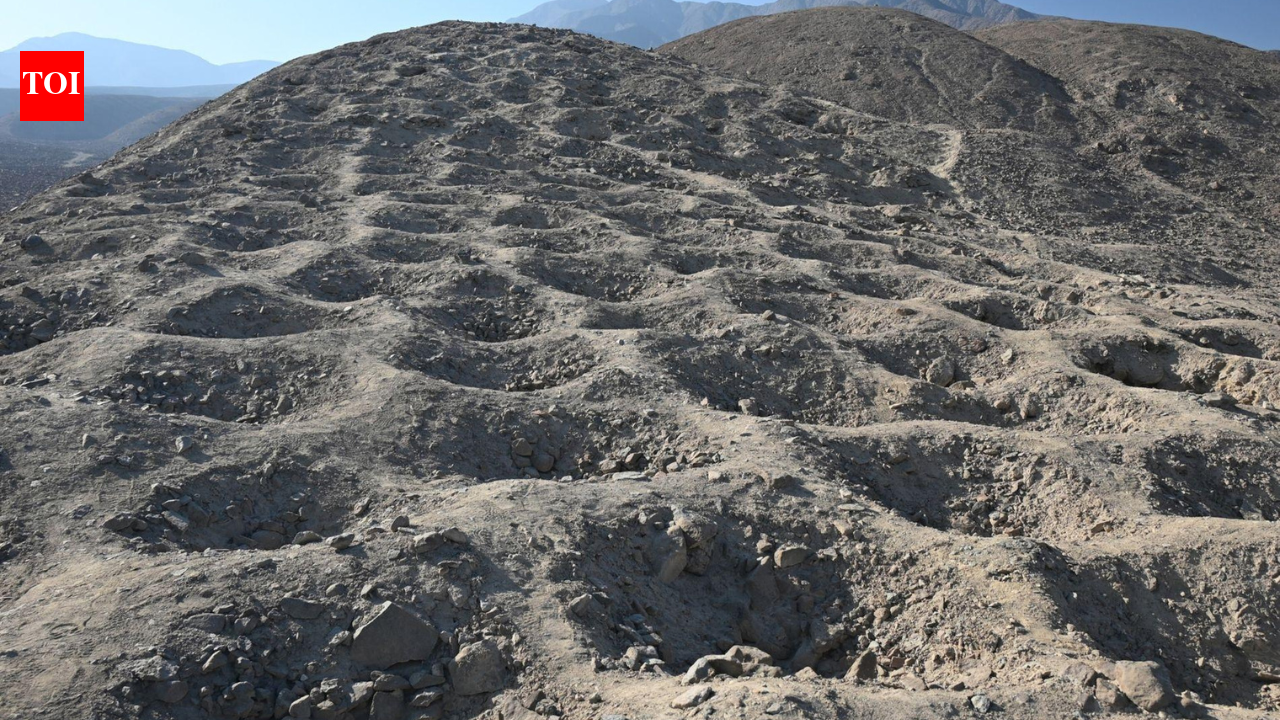
For nearly a century, thousands of strange holes carved into a barren Peruvian hillside have puzzled archaeologists and historians alike. Now, a new theory suggests these 5,000 mysterious indentations may have served as an ancient accounting system, functioning much like an early computer for tracking resources and labor.
The site, located in the coastal region of Peru, features rows of carefully dug holes that stretch across the landscape. According to reports from the Times of India Science Desk, researchers propose the holes were used for accounting purposes in pre-Inca societies.
"The arrangement and precision of these holes indicate a sophisticated method of record-keeping," one expert noted in the coverage. Officials and researchers have long debated the purpose, with theories ranging from ceremonial uses to irrigation markers.
Archaeologists first documented the holes in the early 20th century. Over the decades, the formations drew attention from both scientists and those interested in alternative explanations, including conspiracy theories about ancient technology.
The latest interpretation frames the holes as a practical tool for managing community resources. According to the report, the system could have allowed ancient inhabitants to tally goods, track work contributions, or monitor agricultural output in an organized way.
Similar to how an abacus or ledger might function, the holes reportedly provided a visual and tactile method for calculations. This view challenges earlier assumptions that the site held purely ritual significance.
Local historians have pointed to the region's rich pre-Columbian history as context. Peru is home to numerous archaeological wonders, from the Nazca Lines to Machu Picchu, each revealing different aspects of ancient ingenuity.
While the accounting theory has gained traction in recent coverage, not all experts agree on the exact function. Some maintain the holes could relate to astronomical observations or water management techniques common in Andean cultures.
The Times of India article emphasizes the site's ongoing mystery despite the new proposal. Researchers continue to study the patterns for more clues about their original creators.
Excavations and surveys at the location have yielded limited artifacts so far, leaving room for further interpretation. Officials involved in preservation efforts stress the importance of protecting the site from erosion and unauthorized access.
Broader implications of this discovery touch on how early civilizations developed complex administrative systems without written language. The holes may represent one of the earliest known examples of such organized record-keeping in the Americas.
Future studies could involve advanced mapping technology to analyze the precise spacing and depth variations among the holes. According to the report, this might help confirm or refine the accounting hypothesis.
Communities near the hillside have expressed interest in the findings, hoping increased attention could boost heritage tourism while respecting the site's cultural value.
As investigations proceed, the 5,000 holes stand as a testament to human innovation across time. Whether used for counting crops or coordinating labor, they highlight the resourcefulness of ancient Peruvian societies.