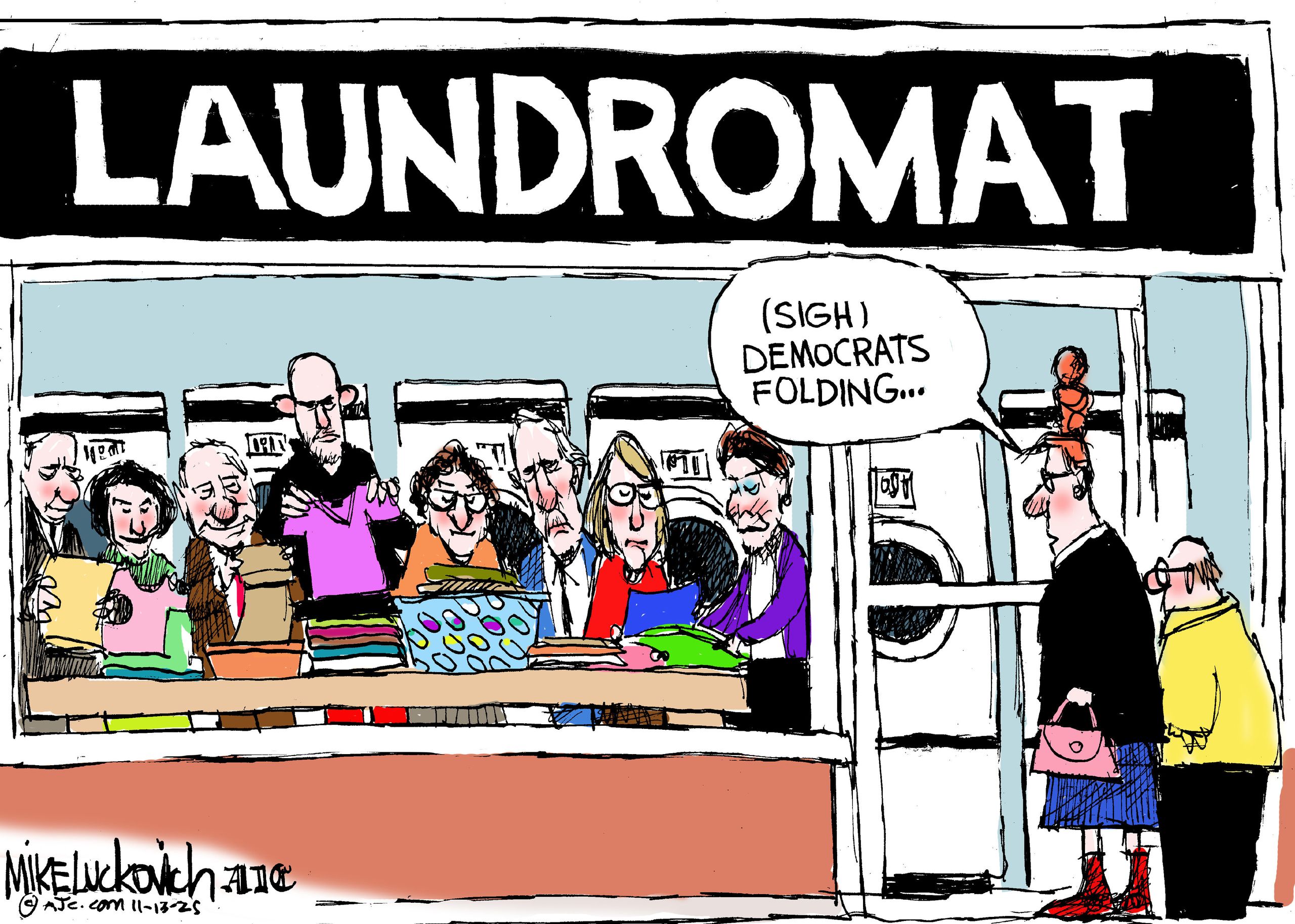
In the wake of a contentious government shutdown standoff, political cartoonists have turned their pens to the Democrats' decision to back down from their demands, capturing the moment in a series of sharp, satirical illustrations. Published on The Week's website, a collection titled "5 Capitulating Cartoons About the Democrat's Shutdown Surrender" highlights artists' takes on what some view as a folding under pressure. The cartoons, which appeared online this week, come amid ongoing debates in Washington over federal funding and border security measures that nearly led to another partial government closure.
The government shutdown threat emerged late last year when congressional Republicans, leveraging their slim majority in the House, pushed for stricter immigration policies as a condition for approving a spending bill to avert a lapse in federal operations. Democrats, led by Senate Minority Leader Chuck Schumer, initially held firm, insisting on a clean funding bill without what they called "poison pill" riders. However, after days of intense negotiations, the party agreed to a bipartisan deal that included some Republican priorities, effectively ending the immediate crisis but drawing criticism from both sides of the aisle.
According to reports from Capitol Hill, the agreement was reached on December 20, 2023, just hours before a midnight deadline that would have furloughed thousands of federal workers and halted services nationwide. The deal, which passed both chambers of Congress and was signed by President Joe Biden, allocated $1.2 trillion in discretionary spending for fiscal year 2024, including $12.5 billion for border security enhancements. White House officials described the compromise as a necessary step to keep the government running, while House Speaker Mike Johnson hailed it as a victory for fiscal responsibility.
Political cartoonists wasted no time in lampooning the Democrats' retreat. In one cartoon featured in The Week's collection, an artist depicts Democratic leaders waving a white flag emblazoned with the Capitol dome, surrendering to a towering figure representing Republican hardliners. The caption reads, "When the bluff meets the budget," underscoring the perception among critics that Democrats blinked first in the high-stakes poker game of appropriations.
Another illustration shows House Minority Leader Hakeem Jeffries and other Democrats folding like a house of cards under the weight of a massive "Shutdown" sign, with Uncle Sam looking on in exasperation. The Week's summary of the cartoons notes that artists are taking on "Democrat's folding, flag-waving, and more," capturing the mix of resignation and patriotism in the party's capitulation. These visuals echo broader commentary from conservative outlets, which have portrayed the move as a strategic misstep that weakens Democratic leverage heading into an election year.
From the Democratic perspective, the decision was framed as pragmatic governance rather than surrender. Schumer said in a floor speech on December 19, "We cannot let extremists hold the American people hostage over partisan demands." A spokesperson for the Senate Democratic Caucus added that the bill prevents disruptions to essential services like Social Security payments and national park operations, which affected more than 800,000 federal employees during the 35-day shutdown of 2018-2019.
The 2018-2019 shutdown, the longest in U.S. history, provides crucial context for the recent drama. Triggered by disputes over funding for President Donald Trump's border wall, it cost the economy an estimated $11 billion in lost productivity, according to the Congressional Budget Office. Lawmakers on both sides reference that episode as a cautionary tale, with Republicans arguing that Democrats' current concessions avoid repeating such chaos, while progressives within the party decry the inclusion of immigration funding as a betrayal of core values.
Cartoonists in The Week's roundup also touch on related themes, such as the human cost of these fiscal battles. One drawing portrays furloughed workers as ghosts haunting the halls of Congress, a nod to the 2018 impacts when Coast Guard families went without paychecks during the holidays. The collection aligns with other recent political satire published by The Week, including cartoons on Epstein files, grocery prices, and the end of the shutdown threat, as noted in their Thursday edition.
Experts in political communication say such cartoons play a vital role in shaping public perception. "Satire distills complex policy fights into memorable images," said Jay Rosen, a professor of journalism at New York University, in an interview with The Appleton Times. "They don't just mock; they highlight the absurdities that lawmakers often gloss over." Rosen pointed to historical examples, like the Vietnam-era cartoons that swayed opinion against the war, as evidence of their influence.
Republicans, for their part, have celebrated the outcome. Johnson, in a statement released December 21, said, "This bill secures our borders and protects taxpayer dollars—it's a win for the American people." Yet, not all in the GOP are satisfied; hardline members like Rep. Matt Gaetz of Florida criticized the package for not going far enough on spending cuts, calling it "capitulation to the swamp" in a post on X, formerly Twitter.
The cartoons also weave in lighter elements, such as flag-waving symbolism, perhaps alluding to Democrats' efforts to portray their compromise as defending democratic institutions. One piece shows a Democratic elephant draped in the American flag, kneeling before a Republican donkey holding a gavel labeled "Majority Rules." This imagery resonates with ongoing discussions about power dynamics in a divided Congress, where slim margins amplify every vote.
Beyond the immediate shutdown, the episode underscores deeper fissures in U.S. politics. Immigration remains a flashpoint, with border encounters reaching record highs of over 2.4 million in fiscal year 2023, according to U.S. Customs and Border Protection data. The funding bill's provisions, including money for additional agents and technology, aim to address these surges but have sparked protests from immigrant rights groups who argue it escalates enforcement without comprehensive reform.
As Congress shifts focus to other priorities—like aid to Ukraine and Israel, and averting a debt ceiling crisis in early 2024—the shutdown saga lingers. Political analysts predict it could influence midterm strategies, with Democrats emphasizing governance wins and Republicans touting toughness on security. The Week's cartoons, by amplifying these narratives through humor, ensure the story stays in the public eye.
Looking ahead, lawmakers face a compressed legislative calendar. With the next funding deadline looming in March 2024 for some agencies, similar tensions could resurface. For now, the capitulation cartoons serve as a snapshot of a polarized moment, reminding readers that in Washington, even endings are just setups for the next act.
In Appleton, Wisconsin, local reactions mirror the national divide. Community leaders here, home to a diverse manufacturing base affected by federal delays, expressed relief at the resolution. "Shutdowns hit our supply chains hard last time," said Tom Reynolds, president of the local chamber of commerce. "We're glad cooler heads prevailed." As the new year unfolds, the blend of satire and seriousness in these cartoons continues to fuel conversations across the heartland.