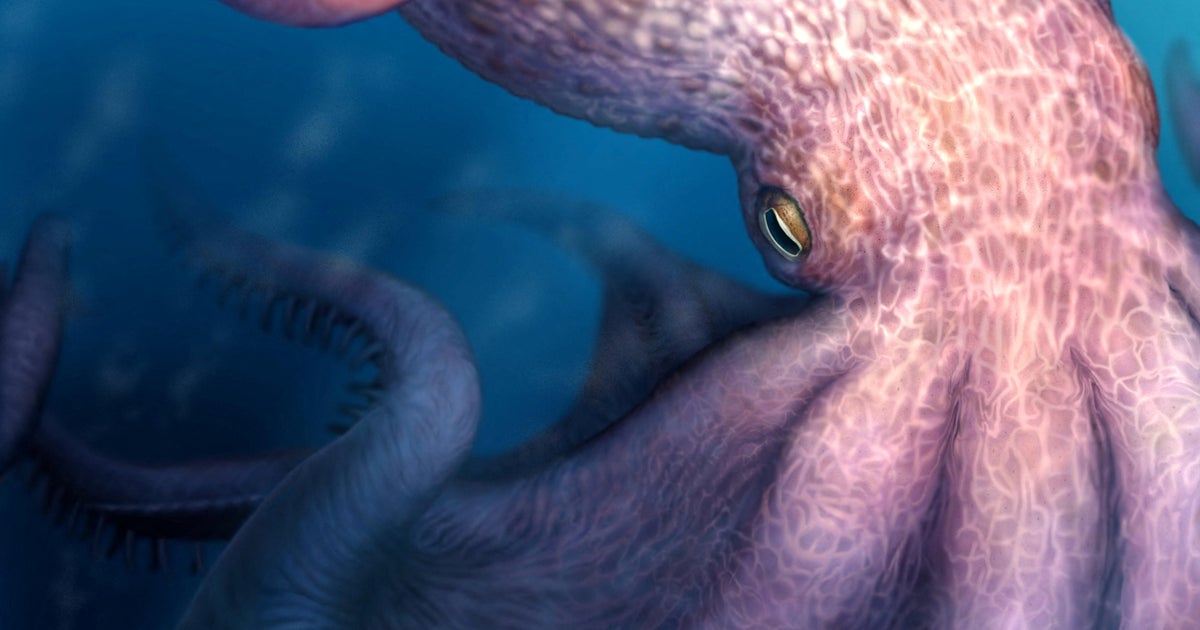
In a revelation that rewrites the undersea drama of the dinosaur era, scientists have uncovered evidence that colossal octopuses, stretching up to 60 feet long, ruled the ancient oceans as fearsome apex predators alongside the era's iconic marine reptiles. These kraken-like creatures, which prowled the seas about 100 million years ago during the late Cretaceous period, were identified through meticulous analysis of fossilized jaws unearthed in Japan and on Canada's Vancouver Island. The findings, detailed in a study published Thursday in the journal Science, challenge long-held assumptions about the dominance of vertebrates in prehistoric marine ecosystems.
The research, led by paleontologists including Yasuhiro Iba of Hokkaido University, examined 15 previously discovered ancient octopus fossils and identified 12 additional jaws using an innovative technique dubbed digital fossil mining. This method involves scanning rocks in detailed cross-sections to reveal hidden fossils within. By comparing these ancient beaks—made of tough chitin, the same material that forms modern octopus beaks—to those of contemporary species, the team estimated the beasts' sizes ranged from 23 to 62 feet in length. "The largest jaw was substantially bigger than that of any modern octopus," Iba said in an email to reporters.
These ancient cephalopods, relatives of today's octopuses and squids, boasted eight flexible arms and elongated bodies that would have made them formidable hunters. Their beaks, capable of crushing shells and bones, showed significant signs of wear, including scratches, chips, and rounded edges, indicating repeated battles with hard-shelled prey. "The animals repeatedly crushed hard prey such as shells and bones," Iba explained to Reuters, underscoring the predatory prowess of these invertebrates.
Historically, the late Cretaceous seas have been envisioned as the domain of sharp-toothed sharks, mosasaurs, and plesiosaurs—vertebrate giants that captured the imagination of dinosaur enthusiasts. Invertebrates like octopuses, with their soft bodies that rarely fossilize well, have often been overlooked or dismissed as less threatening. Yet, as University of Alabama paleontologist Adiel Klompmaker noted in an email, "These krakens must have been a fearsome sight to behold." Klompmaker, who was not involved in the study, highlighted how these creatures likely snatched fish, snails, or even larger prey with their versatile arms before dismantling them with powerful beaks.
The discovery positions these octopuses among the largest invertebrates ever recorded. Iba emphasized this point, stating, "Until now, the largest-known invertebrate has been the modern giant squid, which can reach about 12 meters (39 feet) in total length." The ancient octopus's jaw surpassed even that benchmark, suggesting it was a true leviathan of the deep. Without preserved stomach contents, scientists can't confirm exact diets or direct competition with vertebrate predators, but the evidence points to a shared hunting ground in the nutrient-rich Cretaceous oceans.
The fossils hail from diverse locations: the initial 15 from sites in Japan and Vancouver Island, Canada, with the new 12 exclusively from Japanese rock formations. These deposits, formed in ancient seabeds, preserved the chitinous beaks despite the decay of softer tissues. The digital mining technique, developed by the researchers, allowed for non-destructive exploration of rock samples, potentially opening doors to more such discoveries in museum collections worldwide.
This isn't the first time octopuses have surprised paleontologists. Earlier studies have documented smaller ancient relatives that drilled into clam shells, hinting at predatory behaviors. However, the scale of these new finds elevates their status from opportunistic feeders to potential top-tier hunters. "Our findings show that powerful jaws, and the loss of superficial skeletons, convergently transformed cephalopods and marine vertebrates into huge, intelligent predators," the researchers wrote in their Science paper, drawing parallels between the evolutionary paths of squishy invertebrates and bony reptiles.
Experts not involved in the work praised the study's implications for understanding ancient food webs. Neil Landman, a paleontologist at the American Museum of Natural History in New York, told reporters, "It's a big old planet. So we have lots to look at to piece together the marine ecosystem through time." Landman suggested that searching for octopus fossils in other regions—such as Europe's chalk deposits or the American Midwest's marine layers—could clarify how these cephalopods fit into the broader predatory hierarchy.
The timing of this announcement adds intrigue, coming just weeks after a notable correction in the fossil record. Earlier this month, what was once touted by Guinness World Records as the world's oldest octopus fossil—dating back some 296 million years—was reclassified. Scientists determined the remains actually belonged to a relative of the nautilus, a shelled cephalopod, rather than a true octopus. This reassessment, based on re-examination of the specimen from a French coal mine, underscores the challenges of identifying soft-bodied creatures in the fossil record and the ongoing refinements in paleontological classification.
Despite the excitement, uncertainties remain. The study's size estimates rely on extrapolations from modern octopuses, which may not perfectly mirror their ancient kin. Additionally, while jaw wear suggests a diet of tough prey, direct evidence of apex status—such as bite marks on larger fossils—is lacking. Researchers caution that these octopuses might have occupied a niche below the very top predators, perhaps ambushing mid-level prey rather than challenging mosasaurs head-on.
The Cretaceous period, spanning from 145 to 66 million years ago, was a time of evolutionary experimentation in the oceans. As dinosaurs dominated land, the seas teemed with biodiversity, from tiny ammonites to whale-sized reptiles. The emergence of giant cephalopods fits into this narrative, illustrating how invertebrates could evolve sophisticated hunting strategies without the rigidity of skeletons. Modern octopuses, with their problem-solving intelligence and camouflage, are distant echoes of these ancient giants, reminding us of the cephalopod lineage's enduring adaptability.
Looking ahead, the researchers hope their digital mining method will unearth more jaws and perhaps other cephalopod remains. Collaborations with international museums could expand the dataset, providing a fuller picture of Cretaceous marine life. As Iba noted, this predator represents "one of the largest invertebrates on record," potentially shifting textbooks and popular media depictions of the dinosaur age to include these elusive undersea monarchs.
For now, the study invites wonder at the hidden histories beneath the waves. In an era when marine ecosystems face modern threats, understanding past apex predators offers lessons in biodiversity's resilience. Paleontologists like Klompmaker and Landman emphasize the vastness of unexplored fossil sites, promising more surprises from Earth's deep past. As the planet's ancient oceans come into sharper focus, these 60-foot octopuses emerge not as footnotes, but as central players in the prehistoric saga.