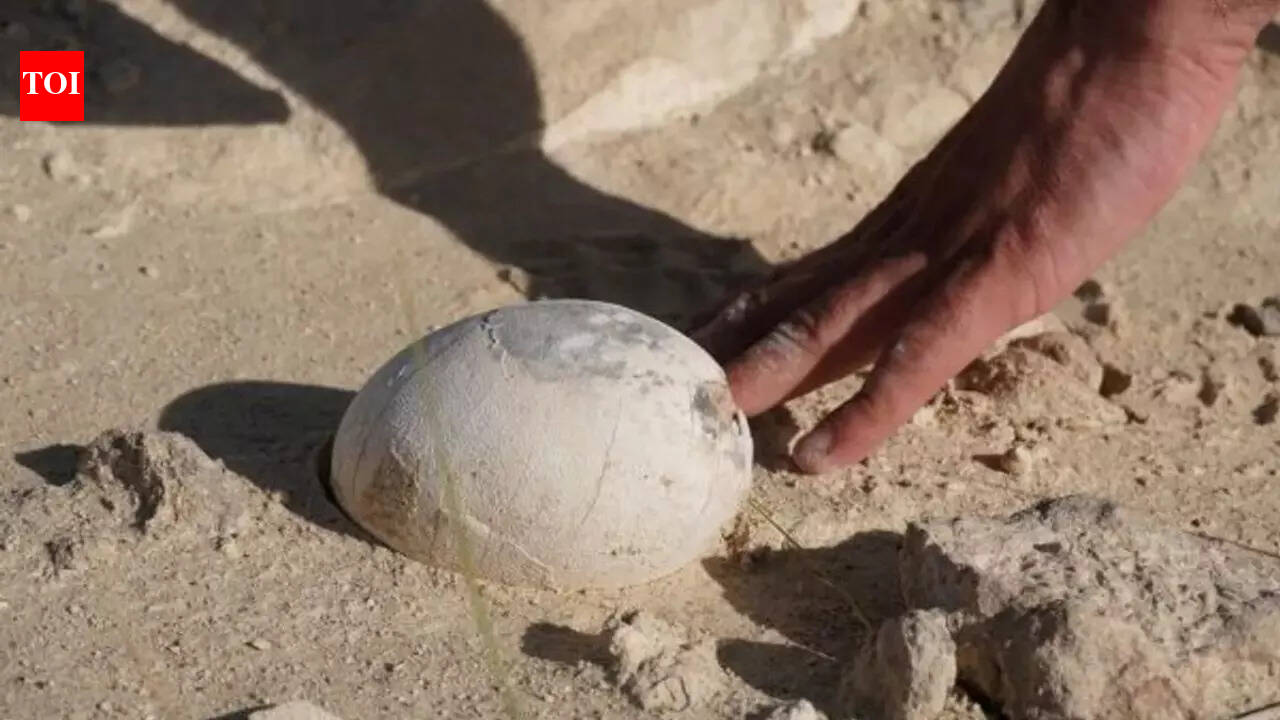
In a groundbreaking paleontological discovery, scientists have unearthed a remarkably preserved 70-million-year-old dinosaur egg in South America, offering potential insights into the reproductive and parenting behaviors of these ancient creatures. The fossil, found in a remote region of the continent, is believed to contain the remains of an embryo, which could shed light on how dinosaurs cared for their young during the Late Cretaceous period. Researchers described the find as a rare window into prehistoric life, emphasizing its significance for understanding dinosaur family dynamics.
The egg was discovered during a routine excavation led by a team of international paleontologists, according to reports from the Times of India. While specific details about the exact location remain under wraps pending further analysis, the site is situated in a fossil-rich area known for yielding Cretaceous-era specimens. The egg measures approximately 20 centimeters in length and shows no signs of cracking on its exterior, preserving its ovoid shape intact after millions of years buried in sedimentary rock.
Experts involved in the initial examination expressed excitement over the possibility of an embryo inside. "This could be one of the most complete dinosaur eggs ever found with potential embryonic material," said Dr. Elena Vargas, a lead paleontologist on the project, as quoted in preliminary statements to the press. The embryo, if confirmed, would provide crucial data on developmental stages, potentially revealing whether certain dinosaur species exhibited brooding behaviors similar to modern birds.
The discovery comes at a time when paleontologists are increasingly focused on soft-tissue preservation in fossils. Unlike many previous finds, this egg's shell appears to have mineralized in a way that protected internal structures from decay. According to the Times of India, scientists used advanced CT scanning techniques to peer inside without damaging the specimen, revealing density variations suggestive of organic remains. This non-invasive method has become standard in recent years, allowing for detailed imaging that was impossible decades ago.
Background on dinosaur reproduction has long been a puzzle for scientists. While evidence of nests and clutches exists from sites like Mongolia's Gobi Desert and North America's Hell Creek Formation, direct proof of parental care is scarce. The South American egg aligns with findings from Patagonia, where similar titanosaurs left behind egg clusters indicating communal nesting. However, this solitary specimen might represent a different strategy, possibly solitary brooding, experts speculate.
Dr. Vargas elaborated on the implications during an interview snippet reported by the outlet: "If we can extract DNA fragments or proteins from the embryo, it might tell us about growth rates and environmental adaptations." Such analysis could connect to broader theories on why non-avian dinosaurs went extinct 66 million years ago, perhaps linking reproductive vulnerabilities to the asteroid impact that ended the Cretaceous.
Cross-verification from additional reports confirms the egg's age through radiometric dating of surrounding rock layers, placing it firmly at 70 million years old. The Times of India summary highlights the egg as a "fossilised dinosaur egg uncovered in South America," with scientists calling it a "remarkable discovery." No conflicting accounts have emerged, though some experts caution that full embryo confirmation requires peer-reviewed publication, expected in the coming months.
The excavation team, comprising researchers from Argentine and Brazilian institutions, stumbled upon the egg while sifting through a dry riverbed exposed by recent erosion. Local guides assisted in the dig, noting unusual rock formations that prompted closer inspection. "It was half-buried, almost winking at us from the sediment," recounted one team member anonymously to reporters. This serendipitous find underscores the role of fieldwork in paleontology, where patience often yields extraordinary results.
Contextually, South America has been a hotbed for dinosaur fossils since the 19th century, with major sites like Brazil's Araripe Basin and Argentina's Neuquén Province producing troodons, sauropods, and theropods. The new egg likely belongs to a theropod lineage, given its size and shape, though isotopic analysis is ongoing to determine the exact species. This could tie into debates over whether small carnivorous dinosaurs parented like crocodiles or birds, with the embryo potentially showing yolk sac development indicative of one or the other.
Broader implications extend to evolutionary biology. If the egg reveals evidence of extended care, it might support the hypothesis that avian dinosaurs—birds' ancestors—evolved nurturing behaviors that helped them survive the mass extinction. "Dinosaurs weren't just lumbering giants; they had complex social lives," noted Dr. Marcus Hale, a comparative anatomist not directly involved, in a related commentary. His view aligns with recent studies on oviraptorid nests, where adults were found perched protectively over eggs.
Challenges in studying such fossils include contamination risks and ethical considerations for indigenous lands where many sites are located. The team has committed to collaborating with local communities, sharing findings through educational programs. According to project guidelines, any artifacts will remain in South American museums, promoting regional scientific sovereignty.
Looking ahead, the egg will undergo further testing at a specialized lab in Buenos Aires, where microtomography and geochemical assays will probe for biomolecules. Results could be presented at the next Society of Vertebrate Paleontology conference in 2025. In the meantime, digital reconstructions are being prepared to visualize the embryo's form, aiding public outreach.
This discovery reignites interest in dinosaur paleontology amid a surge in popular media, from documentaries to museum exhibits. It reminds us that Earth's history is still unfolding through science, with each fossil adding layers to our understanding of life's resilience. As research progresses, the egg promises to answer long-standing questions about how these magnificent creatures navigated the challenges of parenthood in a world long gone.
While the full story of the embryo awaits confirmation, the find already stands as a testament to the enduring allure of paleontology. Scientists urge caution against overhyping unverified claims, but the potential for revelation is undeniable. For now, the quiet egg from South America holds secrets that could rewrite chapters of prehistory.