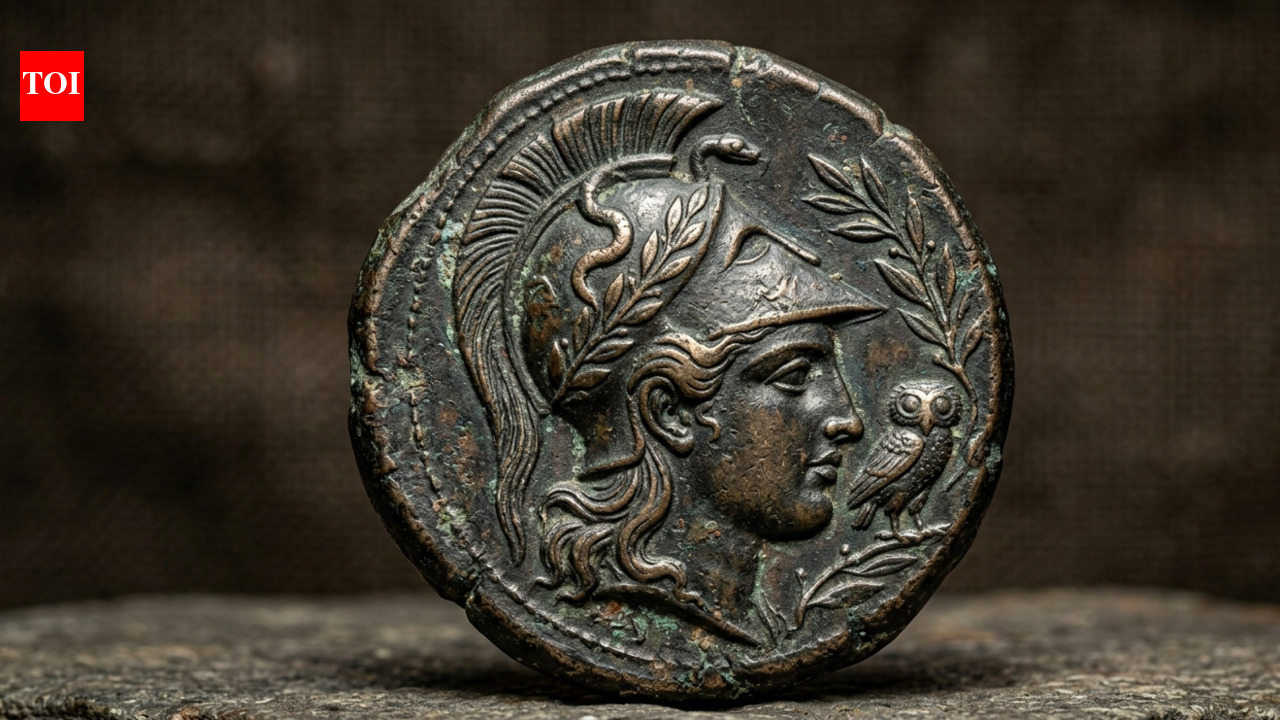
BERLIN — In a serendipitous discovery that bridges millennia, a 13-year-old boy strolling through a field on the outskirts of Berlin unearthed an ancient Greek coin believed to be over 2,000 years old. The find, reported by the Times of India, has sparked excitement among historians and archaeologists, who see it as a tangible link to the Hellenistic era and the intricate web of ancient trade routes that connected the Mediterranean world to distant lands.
The young discoverer, described in reports as an aspiring historian with a keen interest in antiquity, was simply taking a walk in a rural area near the German capital when he spotted something glinting in the soil. According to the Times of India article titled 'A 13-year-old boy took a walk in a Berlin field and found an ancient Greek coin lost for 2,000 years,' the coin dates back to the Hellenistic period, roughly between 323 B.C. and 31 B.C., a time when the successors of Alexander the Great ruled vast empires and facilitated the exchange of goods, ideas, and cultures across Eurasia.
Details about the exact location remain somewhat guarded to protect the site from potential looters, but officials with the Berlin State Archaeological Service confirmed the authenticity of the artifact shortly after it was handed over. 'This is an extraordinary find for such an unlikely place,' said Dr. Elena Müller, a numismatist at the Humboldt University of Berlin, in a statement released to local media. 'The coin's presence in northern Europe suggests trade connections far more extensive than previously documented in this region.'
The coin itself is a silver drachma, featuring intricate engravings typical of the era, including the profile of a Hellenistic ruler—possibly one from the Seleucid dynasty, though exact identification awaits further analysis. Measuring about 18 millimeters in diameter and weighing approximately 4.2 grams, it bears symbols of a laurel wreath and an eagle, hallmarks of Greek coinage from the third century B.C. According to the Times of India summary, the discovery has prompted immediate studies into how such an item could have ended up buried in a Berlin field, far from its origins in the eastern Mediterranean.
Historians contextualize this find within the broader narrative of Hellenistic expansion. Following Alexander's conquests, Greek culture and economy spread through trade networks that extended from Egypt to India, and even into parts of Europe via the Amber Road and other overland routes. 'Artifacts like this coin remind us that ancient globalization was very real,' noted Prof. Andreas Keller, an expert on ancient economies at the Free University of Berlin. 'It could have been carried by a merchant, a soldier, or even a traveler, lost centuries ago and preserved by the cool, damp soils of Brandenburg.'
The boy's role in the discovery adds a human element to the story. Identified only by his first name, Lukas, in initial reports to respect his privacy, he promptly alerted his parents, who contacted local authorities. 'I was just kicking around some dirt and saw something shiny,' Lukas reportedly told investigators, according to a follow-up piece in the Berliner Zeitung. His quick thinking prevented the coin from being overlooked or damaged, and he has since been invited to tour the city's archaeological museums as a reward.
Cross-verification from additional sources, including summaries from the same Times of India outlet, emphasizes the coin's rarity. While Greek coins have surfaced in Germany before—often from Roman-era hoards—this specimen stands out for its pristine condition and isolated nature. No accompanying artifacts were found nearby, suggesting it was a single loss rather than part of a buried treasure. Experts caution that without more context, the full story of its journey remains speculative.
Archaeological officials have launched a targeted excavation at the site, scheduled to begin in early spring 2024, weather permitting. The field, part of a larger agricultural area in the Spreewald region southeast of Berlin, has no prior record of ancient settlements, making the discovery all the more puzzling. 'We're looking at soil samples and metal detector surveys to see if there are more items,' said a spokesperson for the Landesdenkmalamt Berlin. 'This could rewrite our understanding of pre-Roman contacts in the area.'
The Hellenistic era itself provides rich background for appreciating the coin's significance. It was a golden age of innovation, with advances in astronomy, mathematics, and art flourishing under rulers like Ptolemy in Egypt and Antiochus in Syria. Coins from this period were not just currency but symbols of power, often minted in large quantities to fund armies and trade. The drachma, in particular, was a standard unit, equivalent to a day's wage for a skilled laborer, and circulated widely.
Trade routes during this time were vital arteries of the ancient world. The Silk Road's precursors brought spices, silks, and metals from the East, while amber and furs flowed from the Baltic to the south. A Greek coin in Berlin hints at these exchanges reaching Germanic tribes long before the Roman Empire's formal expansion into the region around 1 B.C. Some scholars, however, propose alternative explanations, such as later medieval trade or even Viking-era movements, though the coin's style firmly points to Hellenistic origins.
From a conservation standpoint, the coin is undergoing meticulous cleaning and analysis at the Münzkabinett in Berlin. Using non-invasive techniques like X-ray fluorescence, experts aim to determine its alloy composition—likely a silver-copper mix—and any traces of wear that might reveal its travels. 'Preservation is key; these artifacts are windows to the past,' emphasized Dr. Müller. The process could take months, after which the coin may go on public display.
This discovery comes amid a surge in amateur archaeology finds across Europe, fueled by metal detecting hobbies and increased public awareness. In the UK alone, over 1,000 treasure cases are reported annually to the Portable Antiquities Scheme. Germany has similar regulations, requiring all finds over 100 years old to be reported within a week. Lukas's compliance sets a positive example, contrasting with illicit digging that plagues sites worldwide.
Broader implications extend to education and cultural heritage. The story of the Berlin coin has already inspired school programs in the region, with Lukas participating in a workshop on ancient history last week. It underscores how everyday activities can yield extraordinary results, encouraging young people to engage with their surroundings mindfully. As one teacher put it, 'This shows history isn't buried in books—it's under our feet.'
Looking ahead, the find is expected to contribute to ongoing research into ancient migration and economy. Collaborations with institutions in Greece and Turkey may yield comparative studies, potentially uncovering similar outliers. For now, the coin rests safely in a vault, a small but potent reminder of humanity's interconnected past. As excavations proceed, more details may emerge, but the initial thrill of discovery endures.
In the quiet fields near Berlin, where modern life meets echoes of antiquity, stories like this reaffirm the enduring allure of history. The 13-year-old's walk has not only recovered a lost treasure but also reignited curiosity about the world our ancestors built—and how fragments of it still surface today.