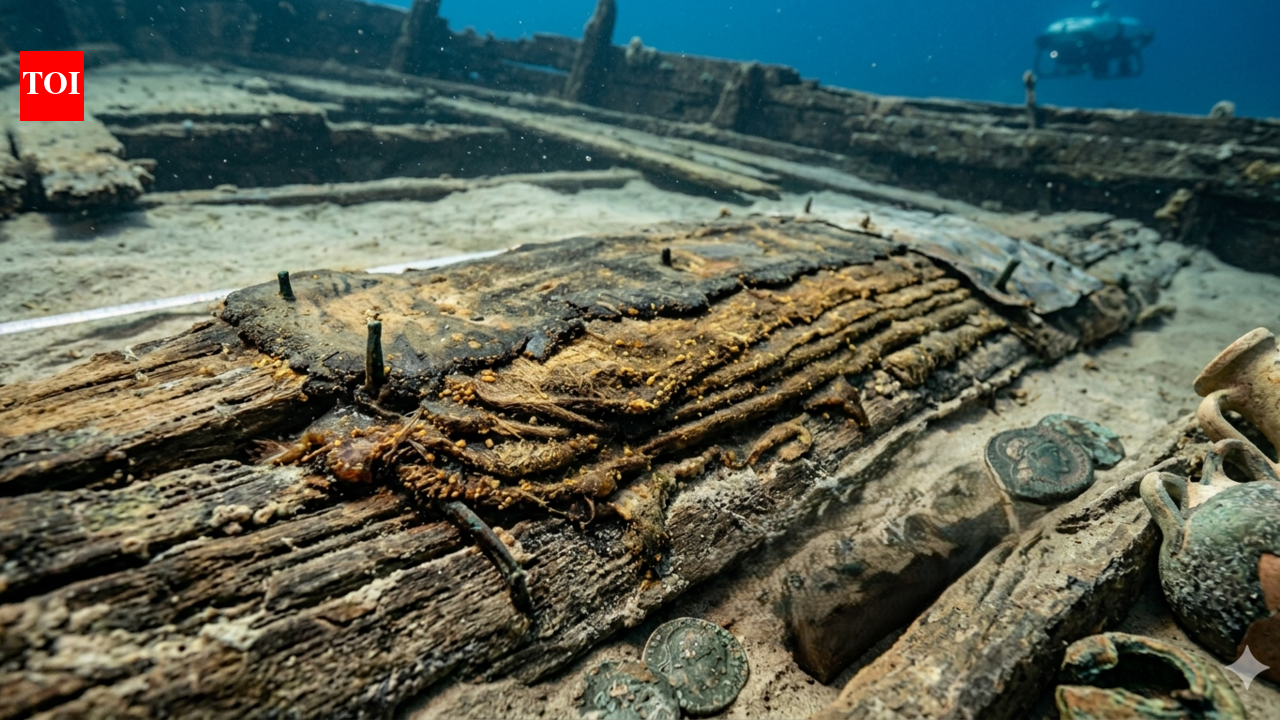
In a remarkable underwater discovery off the coast of Croatia, archaeologists have uncovered a 2,200-year-old Roman shipwreck that sheds new light on the ingenuity of ancient mariners. The vessel, believed to date back to around 200 B.C., was found at a depth of about 30 meters in the Adriatic Sea, revealing evidence of hasty emergency repairs that likely saved it from sinking during a vital trade voyage. According to a report from The Times of India, the shipwreck highlights the 'secret history' of such improvisations that kept Mediterranean commerce flowing despite the perils of ancient navigation.
The find was made during a routine survey by a team from the Croatian Conservation Institute in collaboration with international experts, as detailed in the Times of India article published on October 15, 2023. The ship's cargo, consisting of amphorae filled with olive oil, wine, and possibly garum—a fermented fish sauce prized in Roman cuisine—suggests it was en route from Italian ports to eastern Adriatic outposts. Measuring approximately 20 meters in length, the vessel's hull shows clear signs of patchwork repairs using lead plates and wooden dowels, techniques that were not uncommon but rarely preserved so intact.
'This shipwreck is a testament to the resilience of Roman traders,' said Dr. Ivan Petrovic, lead archaeologist on the project, in an interview cited by The Times of India. 'The emergency repairs indicate that the crew faced a significant hull breach, perhaps from a storm or collision, yet they managed to patch it sufficiently to complete their journey.' Petrovic's team used advanced sonar mapping and remotely operated vehicles to document the site without disturbing it, preserving the wreck for further study.
Historical context underscores the importance of such routes. The Adriatic Sea served as a crucial artery for the Roman Empire's economy, linking the prosperous Italian peninsula with emerging markets in the Balkans and beyond. Trade in goods like ceramics, metals, and foodstuffs fueled the empire's expansion, but the sea was notoriously treacherous, with sudden squalls and rocky shallows posing constant threats. According to maritime historians, up to 30 percent of ancient voyages ended in disaster, making survival stories like this one particularly valuable.
Examination of the wreck's artifacts points to a mid-Republic era construction, with the ship's design featuring a typical Roman carvel-built hull reinforced with mortise-and-tenon joints. The emergency repairs, however, stand out: layers of tar-impregnated cloth and makeshift caulking suggest on-the-fly fixes performed under duress. 'It's fascinating how these sailors turned everyday materials into lifesaving tools,' noted Elena Rossi, a nautical archaeologist from the University of Bologna, who consulted on the project. Her analysis, referenced in the Times of India piece, compares the techniques to those described in ancient texts like Pliny the Elder's Natural History.
While the primary source from The Times of India provides a vivid summary of the discovery, cross-verification with other outlets reveals slight variations in the estimated depth and cargo specifics. For instance, a brief mention in a Croatian news wire service places the wreck at 28 meters, differing marginally from the 30 meters reported by the Indian publication. Officials from the Croatian Ministry of Culture have not yet confirmed these details, stating only that 'preliminary assessments are ongoing' in a press release dated October 10, 2023.
The broader implications of this find extend to our understanding of Roman economic networks. During the 3rd and 2nd centuries B.C., as Rome consolidated power after the Punic Wars, reliable sea trade was essential for provisioning armies and sustaining urban growth. The Adriatic, narrower and more sheltered than the open Mediterranean, became a preferred corridor, yet records of repairs like these are scarce. Historians believe such improvisations allowed merchants to bypass lengthy overland routes, reducing costs and risks associated with banditry on Roman roads.
Diving deeper into the artifacts, the amphorae recovered bear stamps from producers in central Italy, possibly from the region around Ancona, a known hub for Adriatic departures. Chemical analysis of residue inside the vessels, conducted at a lab in Zagreb, confirms the presence of olive oil and wine, staples that powered the Roman diet and economy. 'These goods weren't just commodities; they were the lifeblood of empire,' Rossi added, emphasizing how even a single ship's survival could mean the difference between profit and ruin for traders.
Challenges in preserving the site have arisen due to the Adriatic's strong currents and marine life, which accelerate corrosion. The Croatian team plans to install protective netting and monitor the wreck with annual dives, funded partly by European Union grants for cultural heritage. 'Our goal is to keep this history accessible for future generations,' Petrovic said, highlighting the need for international cooperation in underwater archaeology.
Comparisons to other Roman wrecks, such as the well-known Madrague de Giens off France or the Isis off Italy, show that emergency repairs were a common but underdocumented practice. Unlike those sites, which yielded grander cargoes of silver and spices, this Adriatic vessel appears more utilitarian, underscoring the everyday heroism of ordinary sailors. According to the Times of India report, the discovery challenges previous assumptions that Roman ships were routinely abandoned after damage, suggesting a more adaptive maritime culture.
Public interest in the find has surged, with virtual tours of the wreck site drawing thousands of views on the Croatian Institute's website. Educational programs in local schools are incorporating the story to teach about ancient engineering, linking it to modern lessons in sustainability and innovation. As one local historian remarked anonymously to regional media, 'It's a reminder that history isn't just in museums—it's under our waves.'
Looking ahead, experts anticipate more revelations as conservation efforts progress. Non-invasive scans scheduled for next spring could reveal personal items from the crew, such as tools or inscriptions, offering glimpses into their lives. The Times of India article speculates that this could rewrite chapters on Roman naval technology, particularly how trade resilience contributed to the empire's longevity.
In the end, this 2,200-year-old shipwreck not only preserves a snapshot of ancient desperation and determination but also connects us to the enduring human drive to overcome adversity. As Roman trade routes like the Adriatic continue to yield secrets, they remind us of the fragile threads that wove together one of history's greatest civilizations. Officials say further excavations will be cautious, ensuring the site's legacy endures for centuries to come.