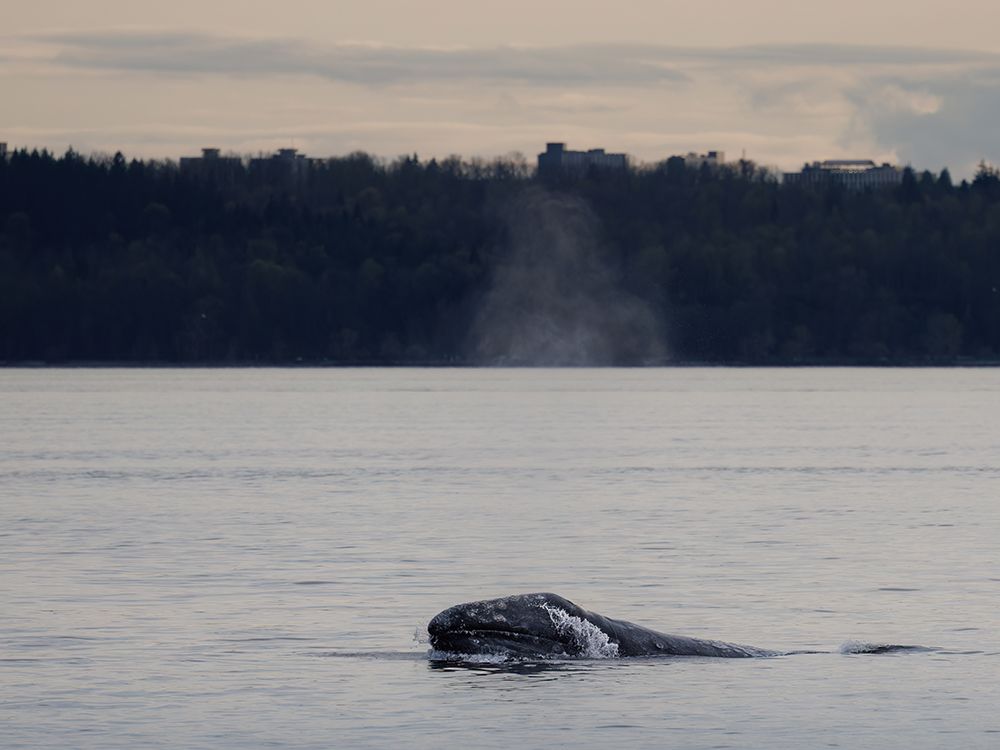
VICTORIA, British Columbia — Five gray whales have washed ashore dead along British Columbia's coast this year, with officials describing some of the massive marine mammals as emaciated to the point of resembling 'a bag of bones.' The discoveries, including four in the past 10 days, have raised alarms among scientists and wildlife experts, who point to signs of widespread malnutrition as the whales migrate north from their winter breeding grounds in Mexico.
Paul Cottrell, the marine mammal coordinator for Fisheries and Oceans Canada in the Pacific region, addressed the situation at a news conference this week. 'This die-off — with four of them just in the last 10 days — is consistent with what we are seeing in Washington State. They are up to 15 in last couple of weeks … and similarly in California and Oregon,' Cottrell said. He emphasized the poor condition of the animals, noting, 'Two of those four gray whales were extremely emaciated. I have never seen such poor body condition.'
The most recent deaths occurred off Vancouver Island, a key area for the whales during their northward journey. Necropsies — detailed examinations of the carcasses — are underway in collaboration with local First Nations communities. According to Cottrell, one examination in Sidney revealed a severe infestation of lice on a whale. 'It can actually eat the animal alive and it is actually very disturbing to see the poor shape of this animal,' he said. While the exact causes of death remain unconfirmed pending further analysis, the emaciation suggests chronic food scarcity during the previous feeding season.
Gray whales undertake one of the longest migrations of any mammal, traveling up to 12,000 miles round-trip between the warm lagoons of Baja California, Mexico, where they breed and calve in winter, and their summer feeding grounds in the Bering and Chukchi seas off Alaska and Russia. Cottrell explained that the whales arriving on the B.C. coast are not in good shape after their winter stay. 'So what we are seeing is these mammals travelling north are not in a very good body condition. Unfortunately it looks like the last feeding in the summer was not a great year,' he said.
Population trends add context to the current concerns. The eastern North Pacific gray whale population reached a peak of about 28,000 in 2016, according to DFO data. However, it experienced a sharp decline between 2018 and 2019, dropping to around 14,000 by 2023. Last year, in 2024, numbers appeared to rebound somewhat, but mortality rates have begun climbing again. The worst year on record for B.C. was 2019, when 11 gray whales were found dead along the province's coast — more than double the current tally so far this year.
Cottrell expressed cautious pessimism about the future. 'We’re hoping it’s just a blip, but the indications are that we’re likely going to see more mortalities,' he said. He highlighted a consistent pattern across the necropsies: 'very skinny animals with certain animals that are just really a bag of bones.' This echoes reports from neighboring U.S. states, where similar die-offs have been documented, suggesting a regional or broader ecological issue affecting the population.
Wendy Szaniszlo, a scientist with DFO's cetacean research program, provided additional insights into the underlying factors. Her team has been studying the whales' foraging behaviors and habitat use. 'The gray whales are heading up from the breeding grounds right now,' she said. Research indicates declining food abundance in their Arctic and sub-Arctic feeding areas, which is leading to malnutrition, reduced breeding success, and higher death rates.
Szaniszlo pointed to environmental changes as a key contributor. 'As you can imagine what we’ve found over the past few years is poor body condition, which is quite a concerning trend,' she noted. Climate change is altering ice conditions and raising ocean temperatures, which in turn reduces the availability of the whales' primary prey — small crustaceans like amphipods that they scoop from the seafloor. These shifts make it harder for the whales to find sufficient food during their critical summer foraging period.
To address the crisis, scientists from Canada, the United States, and Mexico are collaborating on research efforts. They are deploying drones to capture aerial photographs of the whales, allowing researchers to assess body conditions without disturbing the animals. This aerial surveying technique has revealed a persistent decline in overall health across the population over recent years. 'Scientists in Canada, the U.S. and Mexico are working together to use drones to take photos of the whales to learn more about what is contributing to the mortality rates,' Szaniszlo explained.
The involvement of First Nations in the necropsies underscores the cultural and ecological significance of gray whales in Indigenous communities along the coast. Groups like the Nuu-chah-nulth and Coast Salish peoples have long-standing relationships with these animals, viewing them as kin and integral to their traditions. The collaborative approach ensures that traditional knowledge is integrated with scientific analysis, potentially leading to more holistic conservation strategies.
While the immediate focus is on understanding the deaths, broader implications extend to marine ecosystem health. Gray whales play a vital role in coastal food webs, stirring up sediments as they feed and promoting biodiversity on the ocean floor. A sustained decline could ripple through these systems, affecting other species and fisheries. Officials with DFO have not yet declared an Unusual Mortality Event, as the U.S. National Oceanic and Atmospheric Administration did during the 2019 die-off, but the parallels are striking.
Historical context reveals that gray whales have faced challenges before. The population was hunted to near extinction in the 19th and early 20th centuries, rebounding only after international protections in the 1930s and 1940s. The current troubles, however, appear linked more to environmental pressures than human harvest. In 2019, when strandings peaked, investigations similarly pointed to starvation amid shifting prey distributions.
Monitoring efforts are intensifying along the B.C. coast, with beachgoers and tour operators encouraged to report sightings of distressed whales to DFO's hotline. Cottrell stressed the importance of public vigilance: 'The underlying consistent thing experts are seeing is very skinny animals.' As the migration continues through spring and into summer, experts anticipate more strandings if feeding conditions do not improve.
Looking ahead, international cooperation will be crucial. The trilateral agreement between Canada, the U.S., and Mexico under frameworks like the North American Agreement on Environmental Cooperation could facilitate data sharing and policy responses. Szaniszlo's research on habitat use may inform protected areas or restoration projects aimed at bolstering prey populations. For now, the focus remains on the whales themselves — resilient creatures whose plight serves as a stark reminder of ocean changes.
In a region where marine tourism draws thousands to witness these majestic migrators, the news has prompted calls for greater awareness. Environmental groups, though not directly quoted in recent DFO statements, have long advocated for reduced coastal development and emissions to mitigate climate impacts. As Cottrell put it, the hope is that this year's events prove to be 'just a blip,' but the evidence suggests a deeper, ongoing challenge for one of the Pacific's iconic species.