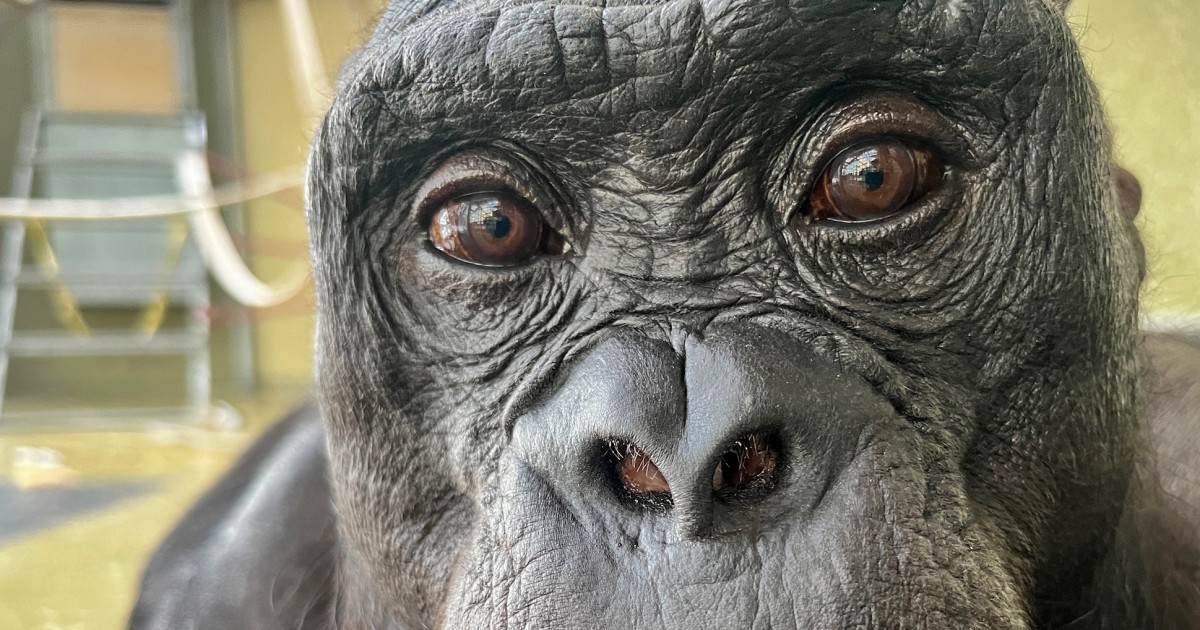
In a groundbreaking experiment reminiscent of a child's imaginary tea party, researchers have demonstrated that at least one bonobo ape possesses the cognitive ability to engage in pretend play, challenging long-held assumptions about human uniqueness in imagination. The study, published Thursday in the journal Science, involved a bonobo named Kanzi who successfully tracked invisible juice and grapes during controlled tests, suggesting that nonhuman primates can distinguish between reality and make-believe.
The experiments took place at a research facility where Kanzi, a celebrated bonobo known for his linguistic skills, participated willingly. Researchers from Johns Hopkins University and other institutions presented Kanzi with empty transparent containers and mimed pouring imaginary juice from a pitcher into bottles. In one test, after simulating the pouring and transferring of pretend juice, they asked Kanzi to point to where the juice would be located if it were real. Kanzi correctly indicated the appropriate container 34 out of 50 times, achieving a 68% success rate—a figure that aligns with typical outcomes in ape cognitive assessments, according to study co-author Chris Krupenye.
"He’s able to follow along and track the location of a pretend object, but at the same time, he appreciates that it’s not actually there," said Krupenye, an assistant professor of psychological and brain sciences at Johns Hopkins University. This ability to maintain a mental representation of an absent object while recognizing its fictional nature marks a significant finding in animal cognition research.
To ensure Kanzi was not simply confused, the team conducted a follow-up experiment offering him a choice between a cup of real juice and one of pretend juice. He selected the real juice 14 out of 18 times, confirming his grasp of the distinction. A third variation replaced juice with imaginary grapes, yielding comparable results and reinforcing the consistency of Kanzi's responses across scenarios.
The study builds on anecdotal observations of pretend-like behaviors in other primates, such as young chimpanzees treating a log as a doll or manipulating invisible blocks. Previously, scientists believed that pretending—considering hypothetical realities—was a trait exclusive to humans. However, these controlled experiments with Kanzi provide the first rigorous evidence from a manipulable setting, as Krupenye explained: "We think of our ability to imagine other worlds or other objects, or imagine futures, as one of the rich features of human mental life that are presumed to be unique to our species." Yet, he added, apes may possess "some of the foundational cognitive machinery that will enable at least some degree of imagination."
The tests were modeled after classic child psychology evaluations, where toddlers as young as two or three years old engage in similar pretend activities, like hosting tea parties with stuffed animals or conversing with imaginary friends. "Within the first years of life, you see kids engaging in pretend play," Krupenye noted. "A lot of the studies in child psychology have focused on those kinds of scenarios." This parallel underscores the evolutionary continuity between human and primate cognition.
Experts not involved in the research praised the methodology and implications. Jan Engelmann, an associate professor of psychology at the University of California, Berkeley, described the findings as "really a very big step in our understanding of how nonhuman primates think." He highlighted how the experiments support the concept of "secondary representations" in apes—mental models that allow for juggling multiple scenarios, including hypotheticals, which aid in planning, reasoning, and predicting outcomes.
Kristin Andrews, a professor of philosophy at the CUNY Graduate Center who specializes in animal minds, echoed this enthusiasm. "You can then test things out in imagination before doing it in real life," she said. "You can figure out whether you should do it or not." Andrews, who reviewed the study, found the evidence compelling, comparing it to well-known human experiments where children use everyday objects creatively, such as pretending a banana is a telephone. "If we ran a study like this on human children, we’d be drawing the same sorts of conclusions," she added.
Kanzi's background adds a layer of intrigue to the results. Born in captivity in 1979, he passed away last year at the age of 44. He gained fame as the first bonobo to comprehend elements of spoken English, achieved through exposure to lexigrams—symbols representing words that he used to communicate. As an infant, Kanzi absorbed language lessons intended for his mother, Matata, who struggled with the system. "Kanzi, as an infant, was just on his mom, clinging to her body as she was being trained on these lexigrams, and she wasn’t doing terribly well," Krupenye recounted. "He’d been soaking up all of this knowledge all along, and so they shifted the focus of the research program to Kanzi and to another bonobo, Panbanisha."
By adulthood, Kanzi could recognize hundreds of lexigrams for objects like "egg" and actions like "chase," and he responded to English instructions by selecting corresponding symbols. This linguistic prowess may have influenced his performance, though the study authors caution that it's unclear if such abilities are widespread among bonobos or other primates. Bonobos, sharing about 98.7% of their DNA with humans, diverged from our lineage between 6 million and 9 million years ago, suggesting that rudimentary imagination could be an ancient trait.
Engelmann raised the possibility that Kanzi's training enhanced his symbolic thinking, potentially unlocking pretend play that other apes might also possess innately. "It’s possible that ‘we can only tap into this ability because Kanzi has language, but all apes have this ability’ to pretend," he said. "Another option is that language gives Kanzi a new ability." The study notes that Kanzi's unique upbringing could have altered his neural pathways, but it calls for further testing with untrained bonobos and other species to clarify these dynamics.
Beyond bonobos, the research contributes to a growing body of evidence eroding the divide between human and animal minds. Andrews observed that as scientists delve deeper, "the more they learn that many things once thought to make humans exceptional are more broadly shared." Some researchers now hypothesize that human superiority lies not in individual cognition—which may be comparable to that of chimpanzees—but in social collaboration. "What humans are really good at is social rationality, social cognition and thinking together with others," Engelmann said. "Language is one adaptation that allows us to do this."
This perspective aligns with observations in wild primate groups, where cooperation enhances survival, much like human societies. The Kanzi study, while focused on one exceptional individual, opens doors to exploring how imagination evolved and whether it underpins complex behaviors like tool use or cultural transmission in animals.
Looking ahead, Krupenye and his colleagues plan to replicate the experiments with additional apes to determine if pretend play is a bonobo specialty or a broader primate capability. They also aim to investigate neural correlates using brain imaging, potentially revealing the biological roots of imagination. As Andrews put it, these findings remind us that the line between human and animal thought may be blurrier than previously imagined, prompting a reevaluation of what it means to be uniquely human.
The Appleton Times will continue to follow developments in animal cognition research, which increasingly highlights the shared intellectual heritage across species.