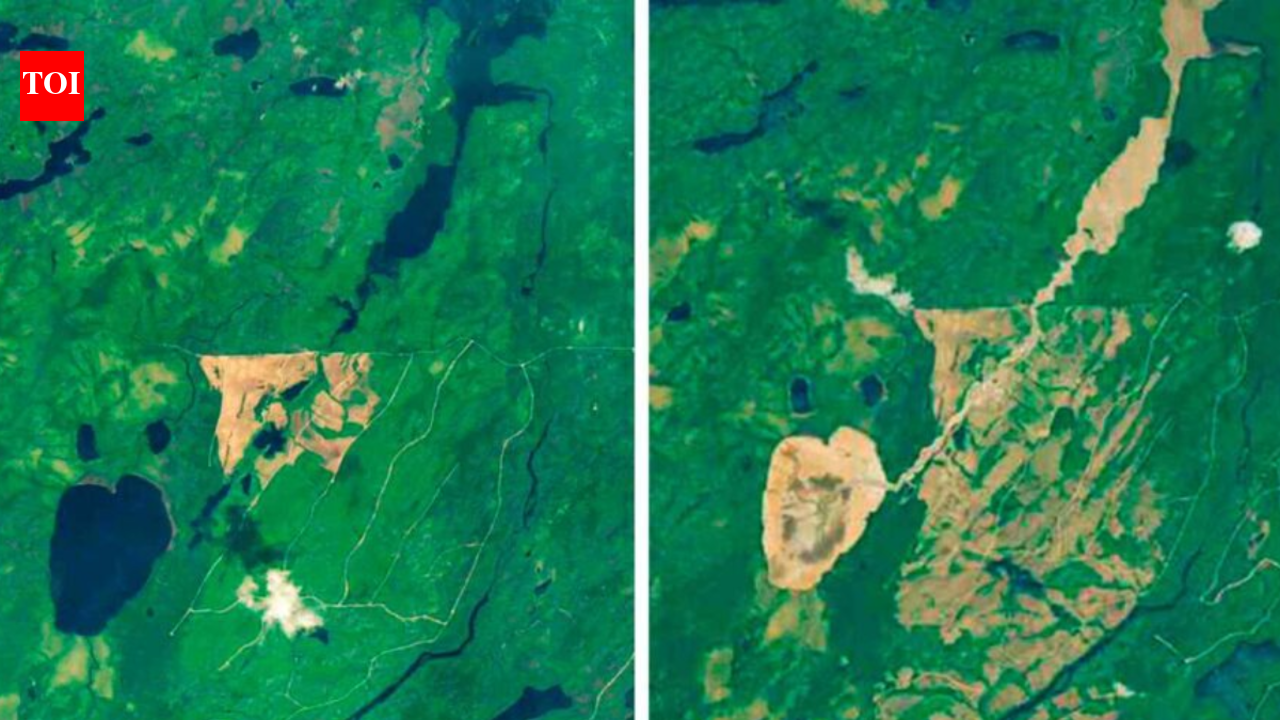
A lake in northern Quebec that bore an uncanny resemblance to a popular emoji has abruptly disappeared, with satellite imagery capturing its sudden vanishing act in recent weeks. The body of water, known locally as Lake Rouge, was situated in a remote area of the province and had long been noted for its distinctive shape that mirrored a smiling face emoticon from certain aerial perspectives.
According to reports from the Times of India Science Desk, the lake's disappearance was first flagged through satellite observations that showed the water body emptying out over a short period. Officials and researchers monitoring the region noted that the event occurred without any obvious signs of human intervention or major seismic activity in the immediate vicinity.
Scientists tracking environmental changes in the area have pointed to shifting weather patterns and thawing permafrost as potential contributing factors. "The sudden and mysterious disappearance of Lake Rouge in Quebec, a natural lake shaped like an emoji, raises concerns about climate change," the summary from the source indicated, highlighting possible links to broader ecological shifts.
Local residents in nearby communities expressed surprise at the development, though no direct eyewitness accounts of the draining process have surfaced yet. Some community members recalled the lake as a seasonal feature that fluctuated in size depending on rainfall and snowmelt cycles.
Satellite data from agencies monitoring northern Canada reportedly showed the lake's outline fading between successive image captures, leaving behind what appears to be a dry basin. Experts in remote sensing have used this imagery to document the timeline, though exact dates of the final drainage remain under review.
Climate researchers have drawn parallels to other vanishing water bodies in the Arctic and sub-Arctic regions, where rising temperatures have accelerated the loss of lakes and ponds. According to the Times of India coverage, the event underscores ongoing worries about ecosystem stability in Quebec's northern territories.
Provincial environmental officials have not yet issued a formal statement on the matter but are reportedly coordinating with federal agencies to assess any downstream effects on wildlife habitats and water tables. Early indications suggest fish populations and migratory birds that relied on the lake may need to relocate.
Geologists familiar with the region's geology noted that Lake Rouge sat atop a layer of glacial deposits prone to drainage through underground channels. Such natural processes have been documented in other parts of Canada, though the emoji-like shape made this particular lake a point of interest for both scientists and casual observers.
Further analysis of the satellite footage is underway to determine whether the vanishing was a one-time event or part of a recurring cycle influenced by seasonal variations. The Times of India article emphasized the role of space-based monitoring in detecting these rapid environmental changes.
Community leaders in the area have called for increased monitoring of similar water features to better understand the impacts of warming trends. While the precise volume of water lost has not been calculated, estimates based on historical satellite records suggest it was a modest-sized lake by northern standards.
Environmental groups have used the incident to advocate for stronger protections against climate-related disruptions in remote ecosystems. They argue that events like the disappearance of Lake Rouge serve as visible reminders of larger transformations underway across the Canadian north.
Researchers plan to conduct on-site visits once weather permits to collect soil and sediment samples from the former lake bed. These studies could provide clues about the drainage mechanism and any lasting effects on the surrounding landscape.
As satellite technology continues to improve, more such phenomena are likely to be documented in real time, offering new insights into how northern lakes respond to environmental pressures. The case of Lake Rouge stands out due to its distinctive appearance, which had previously drawn attention on social media and in scientific literature.