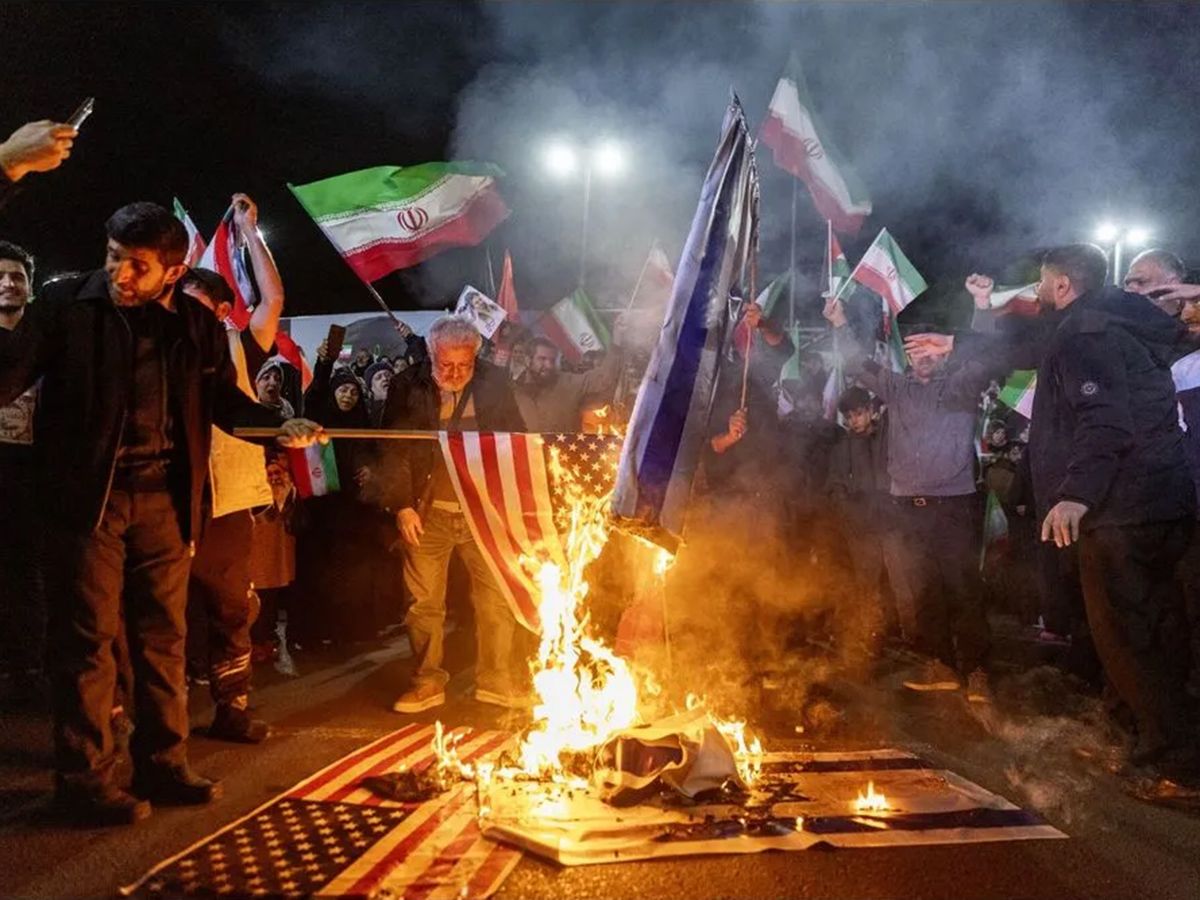
DOHA, Qatar — Iran and Israel exchanged strikes on critical energy facilities across the Middle East on Wednesday, marking a sharp escalation in their nearly three-week-old conflict and threatening to further disrupt global oil and gas supplies. The attacks, which targeted infrastructure in Qatar, Iran, and the United Arab Emirates, came after Tehran warned that energy sites in Gulf nations would be viewed as legitimate targets in retaliation for Israeli operations against Iranian assets.
Qatar's Ras Laffan Industrial City, home to the world's largest liquefied natural gas export plant, sustained extensive damage from an Iranian missile strike late Wednesday, according to state-owned QatarEnergy. Officials reported that four missiles were intercepted, but one struck the facility, and a subsequent attack early Thursday ignited a fire. The Qatar Foreign Ministry condemned the assault as “a dangerous escalation, a flagrant violation of state sovereignty.”
The strikes followed an Israeli attack on Iran's South Pars gas field, a massive shared resource with Qatar that is vital to the region's energy output. A senior Israeli official, speaking on condition of anonymity due to the sensitivity of the matter, confirmed that Israel carried out the operation. The United States was aware of the strike but did not participate, according to a person familiar with the situation.
Iran's semi-official Tasnim news agency reported that Tehran had issued a warning hours earlier, listing energy facilities in Qatar, Saudi Arabia, and the United Arab Emirates as potential targets. In response, Iranian President Masoud Pezeshkian posted on social media that attacks on the country's energy infrastructure would “yield nothing” for the U.S., Israel, and their supporters. He added, “This will complicate the situation & could have uncontrollable consequences, the scope of which could engulf the entire world.”
The tit-for-tat violence has sent shockwaves through global energy markets. Brent crude prices rose as much as 4.3 percent to nearly $112 a barrel on Wednesday, reflecting a roughly 50 percent surge since the war began 19 days ago. The conflict has choked off shipping through the Strait of Hormuz and reduced oil and gas production in the region, complicating U.S. efforts to stabilize prices.
President Donald Trump has taken steps to mitigate domestic impacts, temporarily waiving a century-old shipping mandate to lower transportation costs for energy goods within the United States. Vice President JD Vance and other administration officials are scheduled to meet with oil executives on Thursday, sources familiar with the matter said. Trump has voiced frustration over countries declining his requests to help secure the Strait of Hormuz, which remains largely impassable to commercial traffic.
The waterway's control remains a flashpoint. The U.S. military dropped 5,000-pound bunker-buster munitions on Iranian missile sites near the strait late Tuesday, according to defense officials. Russia announced plans to provide naval convoys to protect merchant ships passing through the area. Meanwhile, Iran has continued moving oil through the strait at levels close to prewar volumes, with crude loadings at Kharg Island proceeding undisturbed despite U.S. strikes on the export hub. Trump has indicated reluctance to directly target sites that could severely harm global supplies.
The escalation extended beyond energy targets. Iran set a massive natural gas field in the UAE ablaze this week as part of its stepped-up retaliation, according to reports from the region. Qatar's Foreign Ministry spokesperson, Majed Al Ansari, described Israel's targeting of the South Pars field as “a dangerous and irresponsible step” in a post on X.
Experts see the attacks as a strategic shift. Hamidreza Azizi, a visiting fellow at the German Institute for International and Security Affairs in Berlin, noted that “South Pars is central to Iran’s gas supply and, by extension, to electricity generation and industrial activity.” He added in an email, “Even limited or temporary disruptions can translate into power shortages, industrial slowdowns, and broader economic strain.”
The conflict's ripple effects are being felt across the Middle East. Iraq reported losses in power generation after Iran halted gas supplies in response to the South Pars strike, drawing the country deeper into the fray. Anwar Gargash, a top adviser to UAE President Sheikh Mohamed bin Zayed, suggested that the UAE might assist in securing the strait.
Israeli warplanes struck targets in northern Iran for the first time, the Israel Defense Forces announced. In a related development, Iran launched waves of missiles and drones at the UAE, Saudi Arabia, and Kuwait following the confirmed assassination of its security chief, Ali Larijani. Tehran also struck Tel Aviv, killing two people, while Israel and the U.S. continued their bombardment of Iranian positions.
Iran's military pledged vengeance for Larijani's death, as well as those of Gholamreza Soleimani, head of the Basij paramilitary unit, and Iranian Intelligence Minister Esmaeil Khatib. Kuwait announced additional arrests of individuals linked to Hezbollah, claiming to have thwarted a plot against vital facilities in the country.
Parallel to the Iranian front, Israel has intensified its offensive in Lebanon against Hezbollah, the Tehran-backed militant group. Lebanese government figures indicate that Israeli strikes have killed more than 900 people there. The overall death toll from the war now exceeds 4,000, with more than three-quarters of the fatalities in Iran. Dozens more have died elsewhere in the Middle East, and the U.S. has lost 13 military personnel.
Trump reiterated on Tuesday that the war was launched to neutralize a nuclear threat, asserting that Iran was just two weeks from acquiring a weapon. Tehran denies pursuing atomic arms, and most nuclear experts dispute the timeline's feasibility. Director of National Intelligence Tulsi Gabbard, appointed by Trump to oversee the nation's 18 spy agencies, removed a reference in congressional testimony claiming Iran had not resumed uranium enrichment since U.S. strikes destroyed its facilities last year. During a Senate hearing, Gabbard repeatedly declined to affirm whether Iran posed an “imminent nuclear threat,” as the White House has stated.
The economic fallout is mounting at home. U.S. gasoline prices climbed to around $3.84 a gallon on Wednesday, the highest in over two years, per the American Automobile Association. This surge is adding pressure on the administration ahead of November's midterm elections. Vance acknowledged the pain, saying, “Gas prices are up and we know they’re up, and we know that people are hurting because of it and we’re doing everything that we can to ensure that they stay lower.” He described the increase as “a temporary blip.”
Assessing the war's trajectory remains challenging. Retired U.S. Army General David Petraeus, who led operations in Iraq and Afghanistan, told the Economic Club of New York that Iran possesses “a very resilient regime” with about a million armed men capable of sustaining the fight. Such resilience, he said, complicates predictions on when the conflict might conclude.
As the violence shows no signs of abating, international observers worry about broader regional instability and its global repercussions. With key chokepoints like the Strait of Hormuz under threat and energy markets in turmoil, diplomatic efforts to de-escalate appear stalled, leaving the world on edge for what comes next.