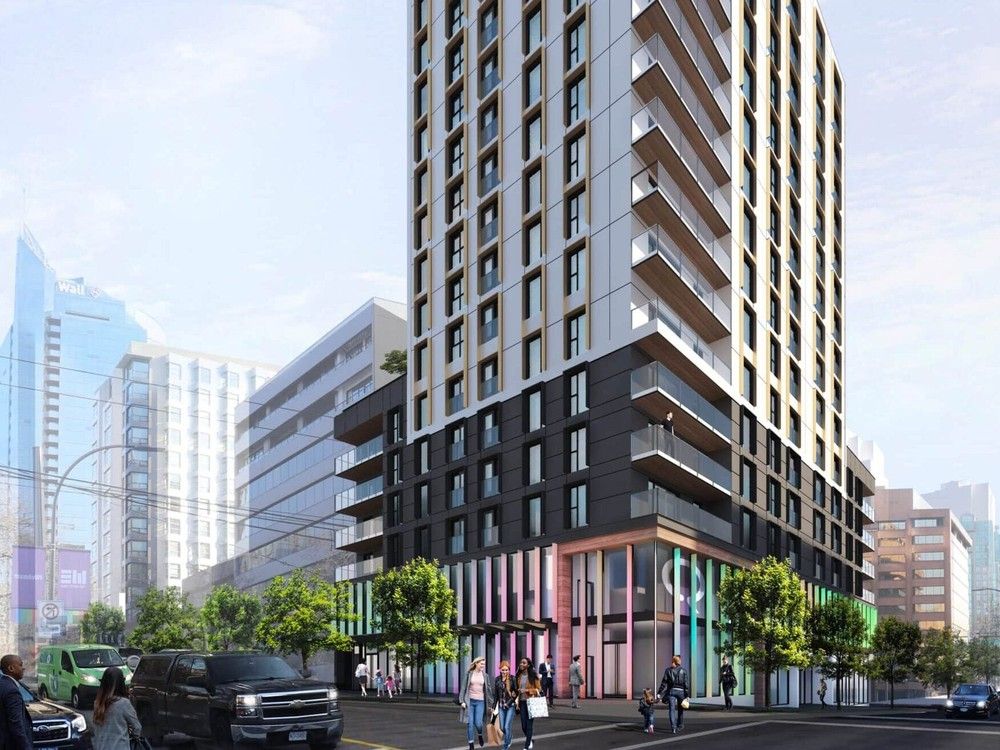
VANCOUVER, B.C. — After decades of advocacy and planning, Vancouver's long-awaited LGBTQ2+ community centre is slated to open its doors in the spring of 2027, marking a significant milestone for the city's queer communities.
The new facility, known as the QMUNITY Community Centre, will occupy the first two floors of a 17-storey mass-timber building at 981 Davie Street in the heart of Davie Village, the West End neighborhood renowned as a hub for LGBTQ2+ life in Vancouver. This development is part of a $91-million partnership funded by the federal, provincial, and municipal governments, which also includes 154 below-market rental housing units operated by the Community Land Trust and an additional 31 units managed by the McLaren Housing Society specifically for individuals living with HIV/AIDS.
At the forefront of this project is Tim Stevenson, now 80, who served as Vancouver's city councillor and became British Columbia's first openly gay Member of the Legislative Assembly. Stevenson's personal journey deeply informs his commitment to the centre. "I didn’t come out until I was 30," Stevenson recounted in a recent interview. "There was no one to talk to. I was determined that no younger person would have to go through the hell that I had gone through."
Stevenson's advocacy dates back to the early 1980s when he was president of Gay UBC, a student group at the University of British Columbia. By the early 2000s, as a councillor, he spearheaded a motion that led to the city securing the Davie Street site in 2016 after years of political negotiations. "It is one of the most important things I’ve accomplished in my career," Stevenson said. He described the centre as "a beacon of hope, not just for Vancouver or B.C., but for the entire country, especially at a time when queer and transgender communities are feeling increasingly under attack."
The QMUNITY non-profit, which has anchored Vancouver's LGBTQ2+ support services since 1981, currently operates out of a cramped 3,000-square-foot space on the second floor of a building on Bute Street, just two blocks west of the new site. That modest location, with its low ceilings, exposed pipes, and limited rooms, has been a birthplace of queer history in the city: it was there that organizers planned Vancouver's first Pride parade and launched the city's inaugural queer film festival.
Despite its historical significance, the current space falls short of meeting contemporary demands. QMUNITY serves approximately 20,000 people annually across British Columbia, but the organization struggles with overwhelming need, particularly for mental health support. Michaël Robach, QMUNITY's interim executive director, highlighted the daily challenges. "We get one to four calls every day from parents saying their kid just came out and they don’t know where to go," Robach said. For free and low-cost counselling tailored to LGBTQ+ and transgender individuals, the centre often receives 50 to 85 requests simultaneously but can only accommodate 14 or 15 clients at a time.
The new centre promises to address these gaps with a vastly expanded 13,000 square feet of space, including prominent ground-floor access that will make it far more visible than its current hidden upstairs location. "That space has so much heart," Robach noted about the existing site. But he emphasized the necessity for growth: "For marginalized communities, sometimes we don’t realize we deserve beautiful things. We get used to hiding in dark corners, but this space will be beautiful and very visible."
Upon opening, the facility will offer a suite of dedicated services designed to support LGBTQ2+ and Two-Spirit individuals from all walks of life. This includes youth and senior lounges, larger multi-use rooms for programming and peer support, and an enhanced legal clinic where volunteer lawyers provide free advice and representation on issues like immigration, housing, and human rights. Plans are underway to introduce or expand sobriety supports, sexual health services, harm reduction programs, and even a community-based pharmacy focused on trans-affirming care and HIV prevention medication.
"This is a space for everyone," Robach explained. "For youth, seniors, and people from small communities across the province, whether they need support coming out or simply want to find a safe place to belong." The centre's design prioritizes accessibility and inclusivity, contrasting sharply with the constraints of the Bute Street location that many passersby overlook entirely.
Vancouver's project aligns the city with other major North American urban centers that have established prominent LGBTQ+ hubs, such as Toronto's The 519, Los Angeles' LA LGBT Center, Chicago's Center on Halsted, and San Francisco's GLBT Historical Society and community spaces. While Vancouver has long been celebrated for its progressive stance on queer rights—hosting one of Canada's largest Pride events each year—the lack of a dedicated, large-scale community centre has been a noted gap, especially as anti-LGBTQ2+ rhetoric and policies have surged in various parts of North America and beyond.
The road to 2027 has not been without hurdles. Securing the site involved persistent lobbying through the 2000s and 2010s, amid competing urban development priorities in the densely populated West End. Construction on the mass-timber building, which emphasizes sustainable materials, began in recent years as part of broader efforts to integrate affordable housing with community services in Vancouver's high-cost real estate market.
Funding remains a critical piece of the puzzle. While governments have covered the construction and land costs through the $91-million investment, QMUNITY is responsible for outfitting the interior spaces. To that end, the organization launched the "It Takes a QMUNITY" fundraising campaign with an initial goal of $3.2 million for moving expenses, furnishings for three kitchens, multiple multi-use rooms, and a library. The target has since doubled to $6.4 million due to rising costs, with about half already secured from major donors. An additional $1.6 million still needs to be raised to fully realize the vision.
Stevenson's reflections underscore the project's deeper significance. His early experiences in a less accepting era—coming out in the 1970s when homosexuality was still stigmatized and, in some places, criminalized—fuel a determination to create enduring resources. The centre's development coincides with ongoing conversations about queer visibility and safety in Canada, where recent surveys have shown rising concerns among transgender youth and Two-Spirit individuals about discrimination and access to care.
As construction progresses, community leaders express optimism about the centre's potential impact. It will not only serve Vancouver's estimated 100,000-plus LGBTQ2+ residents but also extend outreach to rural and remote areas of British Columbia, where resources are even scarcer. Robach pointed to the influx of inquiries from families navigating coming-out moments as evidence of the urgent need. "The demand has far outpaced capacity," he said, a sentiment echoed by Stevenson, who views the project as a legacy of resilience.
Looking ahead, the opening in spring 2027 will cap four decades of grassroots efforts, from Stevenson's student activism to QMUNITY's evolution into a provincial lifeline. While challenges like completing the fundraising persist, the consensus among involved parties is that the centre represents a vital step toward equity. As Vancouver continues to grapple with housing affordability and social service demands, this beacon on Davie Street stands poised to illuminate paths forward for generations to come.