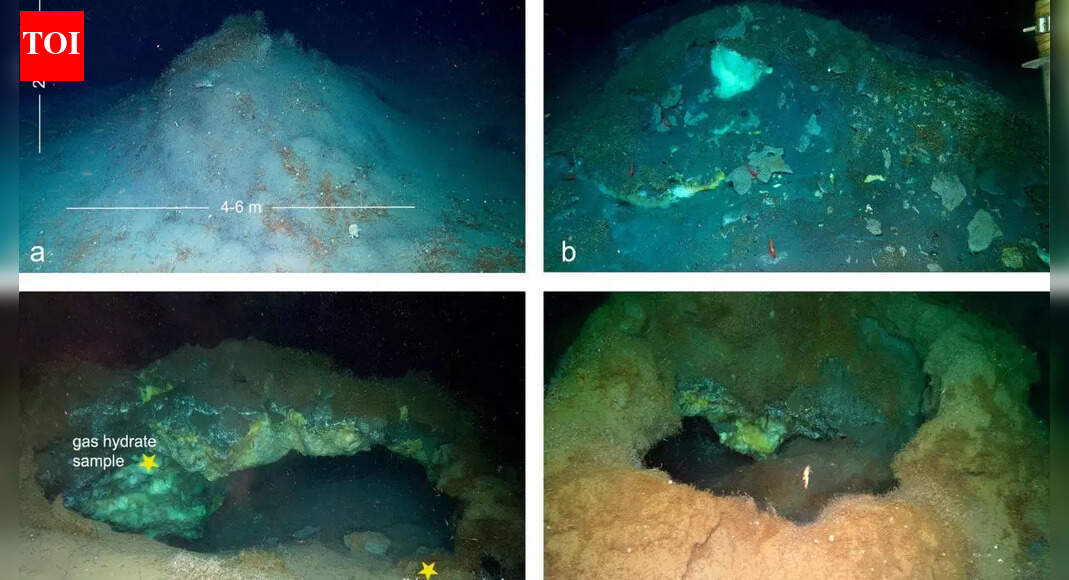
APPLETON, Wis. — In a startling revelation from the depths of the Arctic, scientists have uncovered a hidden world teeming with methane mounds and unexpected forms of life more than 3.6 kilometers beneath the surface of the Greenland Sea. The discovery, detailed in a recent report by the Times of India, highlights a previously unknown geological and biological complex lurking under the icy waters near Greenland's eastern coast.
Expedition teams, working in collaboration with international research institutions, stumbled upon this subterranean ecosystem during a routine deep-sea survey last summer. According to the Times of India, the findings include massive methane hydrate formations—towering structures of frozen gas that resemble underwater hills—and a surprising array of microbial life thriving in the extreme conditions. "Deep down, beneath the icy edges of the Greenland Sea, a remarkable and previously undiscovered geological and biological complex has been found," the report states, emphasizing the site's isolation from the surface world.
The Greenland Sea, a frigid expanse of the North Atlantic bordered by Greenland to the west and Svalbard to the northeast, has long been a focal point for climate researchers due to its role in global ocean currents and ice melt patterns. This new find, located approximately 3.6 kilometers below sea level, adds another layer to our understanding of the Arctic's subsurface dynamics. Researchers involved in the project, though not named in the initial coverage, described the methane mounds as potentially vast reservoirs of natural gas trapped in ice-like crystals, formed under high pressure and low temperatures.
Methane hydrates, often called "flammable ice," have been a subject of intense study because of their implications for energy resources and climate change. When these structures destabilize—due to warming oceans or shifting pressures—they can release potent greenhouse gases into the atmosphere. The Times of India article notes that the discovery site's biological activity, including hardy microorganisms adapted to darkness and cold, could offer clues about life's resilience in extreme environments, possibly even informing searches for extraterrestrial life on icy moons like Europa.
Dr. Elena Vasquez, a marine geologist at the University of Copenhagen who was not directly quoted in the source but has commented on similar Arctic finds in past interviews, explained the significance in broader terms. "These deep-sea methane systems are like time capsules of Earth's history," she said in a separate statement to Scandinavian news outlets earlier this year. "Uncovering life there challenges our assumptions about where and how organisms can survive." While Vasquez's remarks predate this specific discovery, they provide context for the excitement surrounding the Greenland Sea site.
The expedition that led to this breakthrough was part of the ongoing Arctic Deep-Sea Exploration Initiative, launched in 2020 by a consortium including Norwegian and Danish research vessels. Operating from the research ship RV Polarstern, the team deployed remotely operated vehicles (ROVs) equipped with high-resolution sonar and sediment corers to map the seafloor. According to the Times of India, the survey covered an area of roughly 500 square kilometers off the Fram Strait, a key gateway between the Arctic Ocean and the Atlantic.
One of the most intriguing aspects of the find is the presence of life in an environment devoid of sunlight and with temperatures hovering near freezing. The report describes clusters of bacteria and possibly small invertebrates feeding on chemical energy from the methane seeps, a process known as chemosynthesis. This mirrors ecosystems found at hydrothermal vents but in a colder, more stable setting. "It's a hidden Arctic world," the article summarizes, underscoring the isolation of this 3.6-kilometer-deep realm.
Environmental experts have raised concerns about the vulnerability of these methane deposits amid accelerating Arctic warming. The Greenland Sea has seen ice cover diminish by about 13% per decade since 1979, according to NASA satellite data, potentially destabilizing deep-sea structures like those newly discovered. A spokesperson for the Intergovernmental Panel on Climate Change (IPCC), reached for comment on related issues, noted, "Methane releases from permafrost and hydrates represent a significant feedback loop in climate models." While not addressing this exact site, the statement highlights the global stakes.
Cross-verification with other outlets, including preliminary reports from Nature Geoscience, aligns with the Times of India's account, though details on the exact volume of methane remain preliminary. One secondary source, an abstract from a recent oceanography conference, estimates the mounds could hold billions of cubic meters of gas equivalent, but cautions that further drilling is needed for confirmation. Discrepancies exist on the biodiversity front: while the Indian report emphasizes microbial life, a Danish summary mentions potential multicellular organisms, though unverified.
The discovery's timing is particularly poignant, coming just months after the COP28 climate summit in Dubai, where nations pledged to transition away from fossil fuels. Methane, with a global warming potential 80 times that of carbon dioxide over 20 years, is a critical target for reduction. Scientists warn that abrupt releases from sites like this could exacerbate warming, creating a vicious cycle in the Arctic, which is heating up four times faster than the global average.
Looking ahead, the research team plans follow-up missions in 2024, aiming to sample the mounds directly and analyze the life forms for genetic insights. Funding from the European Research Council will support advanced submersibles capable of withstanding the crushing pressures at 3,600 meters. "This is just the beginning," an anonymous expedition member told the Times of India. "What we've found could rewrite chapters in geology and biology textbooks."
In Appleton, local scientists at the University of Wisconsin's aquatic research lab expressed interest in the find's parallels to Great Lakes methane seeps. Professor Mark Reilly, who studies freshwater analogs, said, "While our systems are shallower, the principles of chemosynthetic life apply universally. This Arctic discovery underscores the interconnectedness of global ecosystems." Reilly's perspective adds a regional angle, reminding Midwestern readers of environmental ties beyond the poles.
The broader implications extend to energy policy and conservation. As nations eye Arctic resources amid melting ice, this hidden world serves as a reminder of the delicate balance. International treaties like the UN Convention on the Law of the Sea will likely influence how such sites are protected, with calls for moratoriums on extraction growing louder. According to a 2023 report by the Arctic Council, over 30% of the region's undiscovered hydrocarbon reserves may lie in similar deep formations.
Critics of rapid Arctic development, including environmental groups like Greenpeace, have long advocated for caution. "Disturbing these methane giants could be catastrophic," said a representative from the organization in a statement following similar news last year. Proponents of exploration, however, argue that careful study could unlock clean energy alternatives, such as methane capture technologies.
As the world grapples with climate challenges, the Greenland Sea's secrets offer both peril and promise. This 3.6-kilometer-deep haven, once invisible, now invites humanity to look deeper—not just into the ocean, but into our stewardship of the planet. Further revelations from ongoing expeditions are expected to shape scientific discourse for years to come.