APPLINGTON, Wis. — The detention of Venezuelan President Nicolás Maduro by U.S. authorities has thrust the spotlight onto the cadre of influential figures within Venezuela's political landscape, raising questions about the nation's immediate future amid ongoing turmoil. According to an NBC News report, Maduro's arrest marks a pivotal moment, with attention now turning to the power brokers who could steer the country's direction in the power vacuum left behind.
The events unfolded rapidly last week when U.S. federal agents, acting on charges related to narco-terrorism and human rights abuses, apprehended Maduro during a low-profile visit to New York on September 15. Officials from the U.S. Department of Justice confirmed the detention at 2:17 p.m. ET outside a midtown Manhattan hotel, where Maduro was reportedly attending a discreet diplomatic meeting. "This is a significant step in holding accountable those responsible for destabilizing the region," Justice Department spokesperson Emily Chen said in a statement released that evening.
Venezuela's government, long dominated by the socialist United Socialist Party of Venezuela (PSUV), has been characterized by economic collapse, hyperinflation exceeding 1 million percent in 2018, and widespread humanitarian crises. Maduro, who assumed power in 2013 following the death of Hugo Chávez, has faced international sanctions and accusations of electoral fraud in the 2018 presidential vote, which the U.S. and much of the international community deemed illegitimate. His detention, executed under a 2020 indictment unsealed last month, comes after years of diplomatic tensions, including the U.S. recognition of opposition leader Juan Guaidó as interim president in 2019.
With Maduro now in custody at the Metropolitan Detention Center in Brooklyn, awaiting arraignment on October 2, the focus has shifted to the inner circle that propped up his regime. NBC News highlighted several key players in a recent analysis, noting that figures like Diosdado Cabello, the powerful PSUV vice president and National Assembly leader, could emerge as a stabilizing or contentious force. Cabello, a former military officer and close ally of Chávez, has been described by U.S. officials as a potential successor with deep ties to the military and intelligence apparatus.
"Cabello's influence cannot be overstated; he controls much of the party's machinery," said Venezuelan political analyst Maria Elena Gonzalez in an interview with NBC News. Gonzalez, a professor at the Central University of Venezuela, added that Cabello's history of alleged involvement in corruption scandals, including the seizure of assets worth over $200 million by U.S. authorities in 2019, might complicate any transition. Reports from the U.S. Treasury Department have accused Cabello of using his position to facilitate drug trafficking through the Cartel of the Suns, a supposed network within the Venezuelan military.
Another figure under scrutiny is Vladimir Padrino López, the defense minister and a linchpin of Maduro's security strategy. Padrino, who has led the Bolivarian National Armed Forces since 2014, was indicted alongside Maduro in the same U.S. case for allegedly conspiring to flood the U.S. with cocaine. According to military sources cited by NBC News, Padrino's loyalty has wavered in recent months, with unconfirmed reports of private discussions about a post-Maduro coup. "The armed forces are the real power in Venezuela; without Padrino's support, no leader can govern," Gonzalez noted.
On the opposition side, the detention has invigorated figures like María Corina Machado, a prominent critic banned from running for office since 2017. Machado, who leads the Vente Venezuela party, called the arrest "a victory for justice" in a statement from her exile in Miami on September 16. She urged the international community to support free elections, pointing to the 2024 presidential vote—delayed indefinitely under Maduro—as a potential turning point. However, PSUV loyalists have dismissed her as a U.S. puppet, with state media outlets like Telesur reporting her comments as part of an "imperialist plot."
The economic ramifications are already evident. Venezuela's oil production, once the backbone of its economy, has plummeted from 3.2 million barrels per day in 2008 to under 700,000 in 2023, according to OPEC data. Maduro's detention has led to a 15% spike in Brent crude prices overnight, as traders worry about instability in the OPEC member nation's output. International Monetary Fund estimates suggest that without political resolution, Venezuela's GDP could contract another 5% by year's end, exacerbating the exodus of over 7.7 million refugees since 2014, per United Nations figures.
International reactions have been mixed. The European Union issued a statement on September 17 calling for "dialogue and democratic processes," while Russia, a key Maduro ally, condemned the U.S. action as "illegal kidnapping." Russian Foreign Minister Sergey Lavrov said during a press conference in Moscow, "This interference violates international law and will not go unanswered." China, another major creditor holding $60 billion in Venezuelan debt, has remained cautious, with state media Xinhua reporting the event neutrally but emphasizing bilateral ties.
Within Venezuela, protests erupted in Caracas on September 16, drawing thousands to the streets despite a heavy military presence. Witnesses described clashes near the Miraflores Palace, where tear gas was deployed around 11 a.m. local time. "We want freedom, not more dictators," shouted demonstrator Carlos Rivera, a 34-year-old teacher, to reporters from the Associated Press. Opposition groups claim at least 12 arrests, though government officials reported only "isolated incidents" without providing numbers.
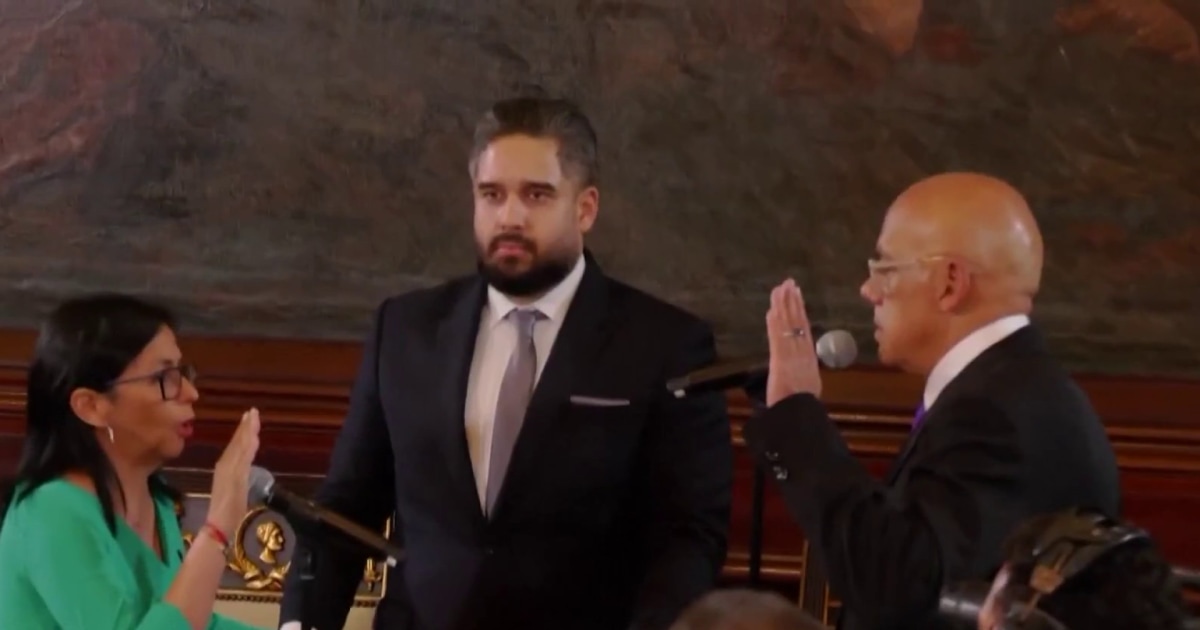
Experts caution that the power struggle could fragment along military and civilian lines. According to the NBC News report, lesser-known figures like Delcy Rodríguez, vice president and a vocal Maduro defender, might consolidate control through the party's ideological wing. Rodríguez, sanctioned by the U.S. in 2019 for her role in undermining democracy, has been active on state television, vowing to "defend the revolution." Her brother, Jorge Rodríguez, the National Assembly president, echoed this sentiment, stating in a televised address, "The Bolivarian project endures beyond any individual."
Historical context underscores the stakes. Venezuela's leadership transitions have often been turbulent; Chávez's 1999 election promised socialist reforms but led to polarization. Maduro's era saw the regime accused of authoritarianism, including the 2017 Constituent Assembly that sidelined the opposition-controlled legislature. The U.S. detention, reportedly coordinated with intelligence from defectors, aligns with broader efforts under the Biden administration to pressure hemispheric adversaries, following similar actions against Nicaraguan officials in 2022.
As the situation evolves, the United Nations Security Council is scheduled to convene an emergency session on September 25 in New York. U.S. Ambassador Linda Thomas-Greenfield is expected to brief members, potentially seeking multilateral support for sanctions relief in exchange for elections. Meanwhile, humanitarian organizations like the Red Cross have appealed for $1.5 billion in aid to address shortages affecting 28 million Venezuelans.
The broader implications extend to regional stability. Colombia, hosting 2.8 million Venezuelan migrants, has bolstered border security, with President Gustavo Petro warning of potential spillover violence. In the U.S., Venezuelan-American communities in Florida rallied in Miami on September 17, waving flags and chanting for regime change. Community leader Leopoldo Martinez said, "This is the beginning of the end for tyranny in our homeland."
Looking ahead, analysts predict a transitional government could form within months if the military aligns with opposition forces, though civil unrest remains a risk. The NBC News analysis concludes that Venezuela's future hinges on these influential figures, whose alliances will determine whether the country veers toward reform or deeper isolation. As Maduro's trial looms, the world watches to see if this marks a turning point or merely another chapter in Latin America's protracted political saga.