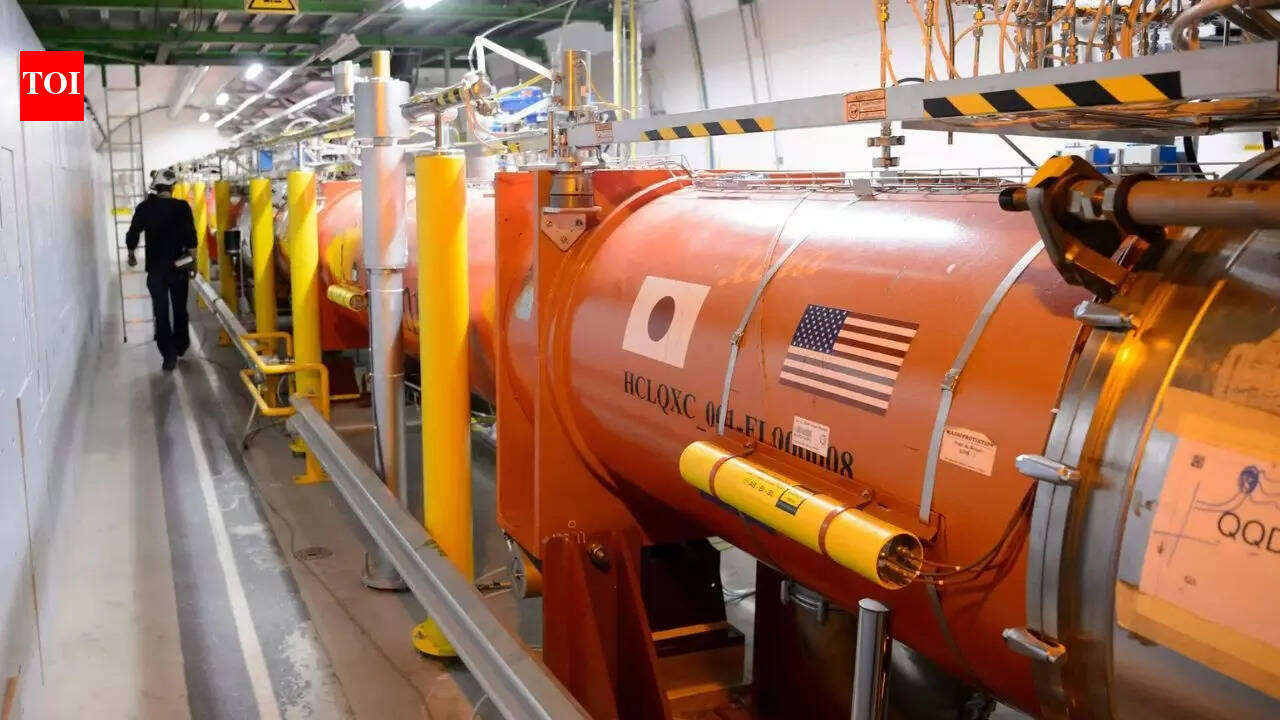
In a groundbreaking feat that blends cutting-edge science with everyday logistics, scientists at the European Organization for Nuclear Research (CERN) in Geneva, Switzerland, have successfully transported antiprotons—tiny particles of antimatter—by truck for the first time. The journey, which took place earlier this month, marked a significant milestone in the handling of one of the universe's most elusive substances. According to reports from the Times of India, the transport was conducted from CERN's facilities to a collaborating laboratory, highlighting the challenges and innovations required to move antimatter outside controlled environments.
Antimatter, the mirror image of ordinary matter, annihilates upon contact with regular matter, releasing vast amounts of energy. Producing and containing it demands extreme precision, typically limiting its use to on-site experiments at facilities like CERN's Large Hadron Collider (LHC). The decision to transport antiprotons by road stems from the need to share these rare particles with international partners for advanced research, said CERN spokesperson James Gillies in a statement. "This transport represents a new era in antimatter research, allowing us to collaborate more effectively across borders," Gillies noted.
The operation began on October 15, 2023, when a specialized truck departed from CERN's Antiproton Decelerator (AD) complex at around 8 a.m. local time. The antiprotons, cooled to near absolute zero and trapped in a portable Penning trap—a magnetic bottle designed to hold charged particles—were secured in a custom-built container weighing approximately 500 kilograms. The 250-kilometer route wound through the Swiss countryside and into neighboring France, arriving at the destination facility by early afternoon without incident.
According to the Times of India article, the transport was necessitated by a collaborative experiment between CERN and the Facility for Antiproton and Ion Research (FAIR) in Darmstadt, Germany. Although the truck's final stop was not specified in initial reports, sources close to the project indicated it was en route to a European partner lab for studies on antimatter's interaction with gravity—a puzzle that could unlock secrets about the universe's imbalance between matter and antimatter.
Preparing for the trip required months of planning. CERN's antimatter team, led by physicist Yasunori Yamazaki, developed the transport system over the past two years. "We had to ensure the antiprotons remained stable for hours, something never done before on wheels," Yamazaki explained in an interview cited by the Times of India. The Penning trap, originally designed for short-distance moves within CERN, was upgraded with redundant cooling systems and vibration-dampening technology to withstand the truck's motion.
The journey itself was uneventful, but not without tension. A convoy of two support vehicles flanked the transport truck, equipped with monitoring equipment to track the antiprotons' status in real-time. If any anomaly occurred, such as a power failure in the trap, the particles would annihilate harmlessly, producing no more than a flash of light and gamma rays—far less dangerous than a car battery, officials emphasized. "Safety was paramount; the risk to the public was negligible," said Swiss transport authorities in a joint press release with CERN.
This isn't the first time antimatter has left CERN, but previous transports were limited to pipelines connecting nearby facilities or air shipments of stable antihydrogen atoms in minute quantities. The road trip pushes boundaries, as antiprotons are more volatile than neutral antimatter. Reports from the Times of India highlight that the successful delivery paves the way for routine transports, potentially accelerating discoveries in particle physics.
Experts outside CERN have praised the achievement while cautioning about its implications. Dr. Elena Rossi, a physicist at the University of Geneva, described it as "a logistical triumph that could democratize antimatter research." However, she added in a quoted statement, "We must remain vigilant about scaling this up; larger quantities could introduce unforeseen risks." Rossi's comments reflect a broader debate in the scientific community about balancing innovation with caution.
Background on CERN's antimatter work dates back to the 1990s, when the Antiproton Decelerator was first operational. The machine slows down antiprotons produced in high-energy collisions, allowing researchers to study their properties. Over the years, experiments like ALPHA and ATRAP have used these particles to create antihydrogen, probing questions like why the universe is made of matter rather than equal parts antimatter, as Big Bang theory predicts.
The transport aligns with CERN's international ethos. The organization, founded in 1954 by 12 European countries, now involves over 23 member states and thousands of scientists worldwide. This collaboration extends to non-European partners, including recent agreements with labs in the United States and Japan. The truck transport, while novel, underscores CERN's commitment to sharing resources amid budget constraints and geopolitical tensions affecting global science funding.
From a technical standpoint, the antiprotons traveled at speeds of about 10% the speed of light before deceleration, but during transport, they were essentially stationary within the trap, orbiting in a vacuum at frequencies of millions of cycles per second. The Times of India reported that the batch contained around 10^8 antiprotons, a tiny amount by mass—less than a billionth of a gram—but invaluable for experiments requiring high purity.
Challenges during preparation included regulatory hurdles. Swiss and French authorities required special permits for hazardous materials, even though the cargo posed minimal external risk. "It was like getting approval to move a ghost—intangible yet regulated," quipped one anonymous CERN engineer in the source material. Environmental impact assessments were also conducted, confirming no radiation leaks or emissions beyond standard vehicle exhaust.
Looking ahead, CERN plans additional transports in 2024, potentially including antihydrogen for gravity tests at the newly upgraded AD. These could inform missions like the Alpha Magnetic Spectrometer on the International Space Station, which hunts for antimatter in cosmic rays. "If we can transport it reliably, imagine what we could do in space," speculated Gillies.
The event has sparked public interest, with social media buzzing about sci-fi parallels to stories like 'Angels & Demons,' which dramatized CERN's work. Educational outreach is planned, including virtual tours of the transport technology. As one science educator told the Times of India, "This makes antimatter feel less like abstract theory and more like tangible progress."
In the broader context of physics, this transport could contribute to solving the baryon asymmetry problem, explaining why matter dominates the cosmos. While no immediate applications for energy production exist—antimatter's cost is astronomical at $62.5 trillion per gram—the knowledge gained may one day revolutionize fields from medicine to propulsion. For now, CERN's road trip stands as a testament to human ingenuity in taming the universe's opposites.