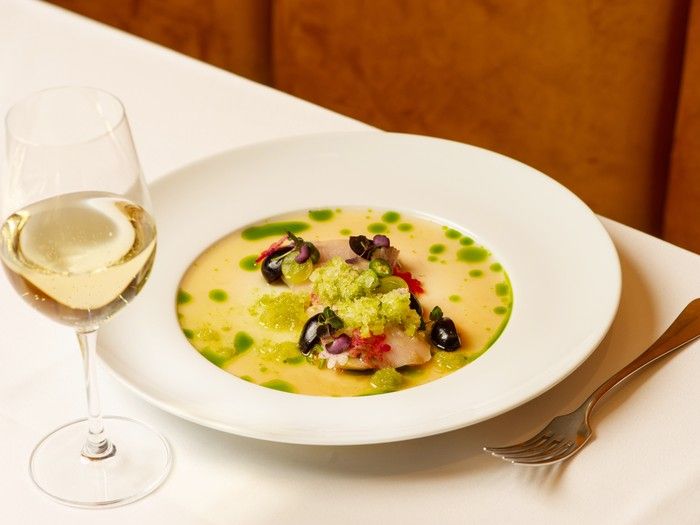
VANCOUVER, British Columbia — As the Vancouver International Wine Festival kicks off its 47th year with France as the featured theme region, the city's culinary landscape is once again highlighting its deep affection for French cuisine. At the heart of this revival stands Le Crocodile, the iconic Alsatian-inspired restaurant that has graced Burrard Street for over four decades, now helmed by celebrated chef Rob Feenie.
Le Crocodile opened in 1983 under the guidance of chef Michel Jacob, who apprenticed at the original three-Michelin-starred Au Crocodile in Strasbourg, France. For 41 years, Jacob cultivated a loyal following among Vancouver's elite diners, offering elegant dishes that blended Alsatian traditions with classic French techniques. "Michel had quite a following," Feenie said in a recent interview. "People knew what they were coming for (and) he knew what his customers wanted."
Feenie, a Vancouver native with a storied career, took over two years ago following Jacob's retirement. His resume includes opening the fine-dining Lumière in 1995, winning Iron Chef America in 2005, and serving as executive chef for the Cactus Club Café chain starting in 2008. Yet, his connection to Le Crocodile runs deeper; he first worked there early in his career, an experience many local chefs liken to attending Harvard. For Feenie, returning to the 909 Burrard St. location feels like a homecoming. "I’m just grateful that I’m back doing this again," he said. "I love making people happy and I love doing it in a place where I first worked when I was 24 years old. I feel I’m back home again."
The allure of French cuisine, according to Feenie, lies in its comforting simplicity. "I just love French food. It’s not the richness, it’s the comfort of it," he explained. He traces his passion back to a school trip at age 16, where he first tasted mussels and frites in Belgium and baguette with brie in Paris. Since then, Feenie has visited France numerous times, favoring the Alsace region due to Jacob's family roots there. He praises the seafood from Normandy and Brittany, the abundance of Michelin-starred establishments, and classic dishes like steak au poivre, coq au vin, crêpes suzette, foie gras, tarte flambé, choucroute, sweetbreads, poulet de Bresse, duck confit, and onion soup from the famed Au Pied de Cochon in Paris's Les Halles district.
"Where do I start? I love the cheeses, I love the bread, I love the butter," Feenie enthused. His affection extends to the foundational role French cuisine plays in modern dining. Before the French Revolution from 1789 to 1799, aristocratic chefs prepared lavish meals in palaces, while commoners dined simply at home or in inns. The revolution displaced these chefs, leading them to open the world's first restaurants in Paris, such as Le Grand Véfour, Les Trois Frères Provençaux, and Méot. This shift democratized fine dining, allowing the middle class to experience noble-level cuisine and service, a model that spread globally.
Despite this influence, Vancouver historically leaned toward taverns for daily meals, steak and lobster for celebrations, and Chinese cuisine along East Pender Street — especially during Prohibition, when it served as a source for "cold tea." The city has long been renowned for its exceptional Asian offerings and a fusion style blending east-west and farm-to-table elements. French restaurants were rarities here until the late 1970s and early 1980s, when their emergence warranted national attention. In September 1983, CBC TV reporter Mike Duffy reported from Vancouver, noting that "a score of excellent French restaurants have opened," including Chez Nous, Bistro la Palette, Café de Paris, and Le Vieux Quebec. These spots catered to affluent patrons seeking extraordinary meals, he said, posing "stiff competition" to Chinatown.
Many of those early establishments have since closed, joining a list of casualties that includes Le Gavroche, Ouest (later West), DB Bistro Moderne, Le Parisien/Left Bank, Jules Bistro, La Regalade, and most recently French Table on Main Street. Opened in 2011 by chef Hervé Martin after 25 years at The Hermitage on Robson, French Table shuttered amid the challenges facing the industry. Yet, according to food writers at the Vancouver Sun, the current French dining scene in the city is arguably at its peak, offering a spectrum from casual bistros to high-end Michelin-recognized venues.
Feenie is preserving Jacob's legacy at Le Crocodile while introducing subtle updates. He plans to divide the menu into a "classics" section featuring staples like Dover sole and veal medallions, alongside new dishes of his own creation. His approach emphasizes lighter sauces made with reductions rather than flour, and incorporates local ingredients: bread from Small Victory, chocolates by Thomas Haas, and produce from regional farmers. This philosophy, Feenie notes, echoes lessons from Emile Jung at the original Au Crocodile, where Jacob apprenticed at age 15. "The irony is that I learned all that from Emile Jung himself," Feenie said. "He actually taught me the lightness of my food."
To underscore the transatlantic ties, Feenie has displayed photos of his time working at the Strasbourg Au Crocodile in the restaurant's hallway. "People always say about my food that it speaks for itself and that’s what French food is all about," he added. The brigade kitchen system, menu structures, and core techniques all stem from French traditions, influencing every modern restaurant worldwide.
Beyond Le Crocodile, Vancouver boasts a vibrant array of French-inspired spots. Casual options include Tableau Bar Bistro at 1181 Melville St. and Alouette Bistro at 567 Hornby St. For Provençal flavors, diners can head to Provence Marinaside at 1177 Marinaside Cres. The Michelin-starred St. Lawrence at 269 Powell St. offers indulgent Quebecois takes on Escoffier classics. Other notables are Au Comptoir at 2278 W 4th Ave., Brasserie Coquette at 2685 Arbutus St., Chez Céline at 4298 Fraser St., Collective Goods at 3532 Commercial St., L’Abattoir at 217 Carrall St., Les Faux Bourgeois at 663 E 15th Ave., Linh Café at 1428 Granville St., and Café Salade de Fruits at 1545 W 7th Ave.
Reviews of these establishments, as compiled by the Vancouver Sun, highlight their unbiased selections and independent recommendations. For instance, Le Crocodile earns praise for its enduring elegance, while St. Lawrence stands out for its sophisticated Quebec influences. The festival, running through late February, pairs these culinary experiences with French wines, amplifying the theme's appeal.
The evolution of French dining in Vancouver reflects broader shifts in the city's palate. While closures underscore the competitive nature of the business, the influx of new concepts suggests resilience. Feenie's return to fine French fare after years in global casual dining signals a renewed appreciation for tradition amid fusion trends.
Looking ahead, the wine festival could spur further interest, drawing visitors to explore these venues. As Feenie puts it, French cuisine's timeless draw is straightforward: "It’s simple, really well-made food." With France in the spotlight, Vancouver's French restaurants are poised to captivate a new generation of diners.
This surge aligns with the city's growing status as a culinary destination, where French elements continue to underpin innovative menus. Whether through Jacob's enduring legacy at Le Crocodile or the diverse offerings citywide, Vancouver's taste for France shows no signs of fading.