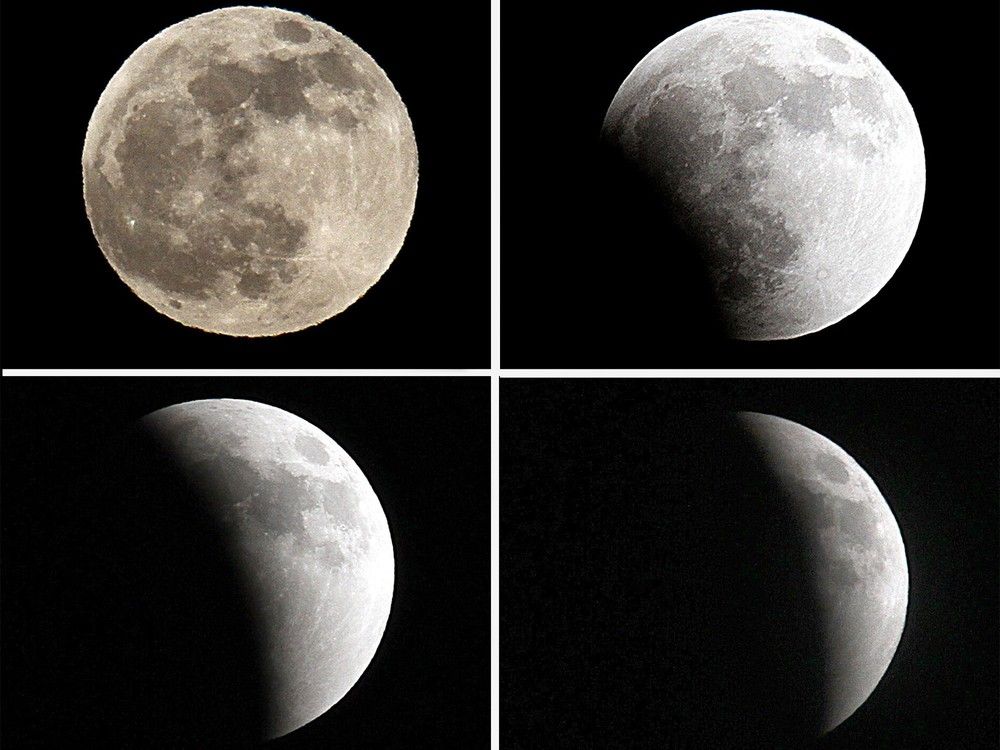
MONTREAL — Stargazers in Montreal and across much of North America have a rare celestial event to look forward to in the early hours of March 3, when a total lunar eclipse will paint the moon in shades of orange-red as it dips toward the horizon.
According to astronomers at the Montreal Planetarium, the eclipse will begin partially at 4:50 a.m., with totality — the moment when the moon is fully immersed in Earth's shadow — starting at 6:04 a.m. However, for viewers in Montreal, the show will be fleeting, as the moon is set to dip below the horizon at 6:30 a.m., just before the total phase ends at 7:02 a.m. The timing coincides with sunrise, meaning conditions won't be ideal, but experts still encourage early risers to catch a glimpse.
"You're really seeing the beautiful dance between celestial bodies," said Gary Boyle, a local astronomer known as The Backyard Astronomer. He emphasized the unique experience of witnessing the event live, adding, "You can look at a picture of the eclipse in a book or see a documentary on TV … but until you've actually seen the moon turn orange in the sky, it's not the same."
The orange-red hue during totality occurs because sunlight passing through Earth's atmosphere is filtered and bent into the planet's shadow, scattering shorter blue wavelengths and leaving longer red ones to illuminate the moon's surface. This phenomenon, often called a "blood moon," has captivated observers for centuries and requires no special equipment — unlike solar eclipses, lunar ones are safe to view with the naked eye.
Lunar eclipses like this one are visible from anywhere on the night side of Earth where the moon is above the horizon, making the March 3 event accessible to a wide audience across the Americas, Europe, and parts of Africa and Asia. In Montreal, the eclipse's low position on the western horizon will demand clear views, prompting recommendations for elevated spots with minimal obstructions.
Olivier Hernandez, an astrophysicist and director of the Montreal Planetarium, advised heading to high ground for the best vantage. "The western horizon is very clear there," he said of the Outremont Summit on Mount Royal, a popular spot in the city. "If I had the courage to wake up, that's probably where I would go." For those venturing outside Montreal, Hernandez suggested other nearby peaks: "Mont St-Hilaire, Mont St-Bruno, Mont St-Grégoire are all good places. As soon as you can elevate yourself slightly and have a clear horizon, that's where it's most interesting."
The event's rarity adds to its appeal. Total lunar eclipses occur less frequently than partial ones because the moon must pass entirely through the central umbra of Earth's shadow. For Montreal specifically, the next total lunar eclipse won't be visible until the overnight hours between June 25 and 26, 2029 — a gap of more than three years.
"We're lucky to have a total eclipse," Hernandez noted. "That's why it's still interesting to go see it," even under suboptimal conditions. He explained the mechanics behind such alignments: For any eclipse, the sun, Earth, and moon must line up precisely, but the moon's orbit is tilted about five degrees relative to Earth's path around the sun, making these events infrequent.
Eclipses happen roughly two or three times a year during periods of about 30 to 47 days when the alignments are favorable. "That's why we can have between roughly two to six, sometimes seven eclipses in total per year, whether solar or lunar," Hernandez said. He added that solar and lunar eclipses often pair up, with a lunar one typically occurring 15 days before or after a solar eclipse — and occasionally both before and after in the same cycle.
This particular eclipse is part of a broader pattern of celestial activity in 2024, following a total solar eclipse that crossed North America in April. While that event drew massive crowds to path-of-totality zones like parts of Texas and upstate New York, the lunar eclipse offers a more widespread spectacle without the need for travel to specific locations.
Local astronomy enthusiasts are already buzzing about the opportunity. Boyle, who has spent decades sharing his passion through public talks and writings, described the eclipse as a reminder of the interconnectedness of our solar system. The event also serves an educational purpose, drawing families and students to planetariums and observatories for guided viewings.
Weather could play a role, as Montreal's early March mornings often bring cloudy skies or light snow. The Montreal Gazette reported that clear conditions are forecasted for the night leading into the eclipse, but viewers are urged to check updates closer to the date. In the event of poor visibility, online streams from observatories worldwide will provide alternatives.
Beyond the visual drama, lunar eclipses have historical and cultural significance. Ancient civilizations interpreted them as omens or divine signs, from the Maya tracking them for calendars to Chinese legends of dragons devouring the moon. Today, they inspire scientific curiosity, helping researchers study Earth's atmosphere through the refracted sunlight.
Hernandez highlighted the eclipse's value in fostering appreciation for astronomy amid urban light pollution. "Even if you only catch the partial phases, it's worth it," he said, encouraging newcomers to the field. Community groups in Montreal, including the Montreal Centre of the Royal Astronomical Society of Canada, plan informal gatherings at recommended sites to share telescopes and expertise.
As the date approaches, excitement is building not just in Montreal but across the region. For residents in nearby areas like Appleton, Wisconsin — where clear midwestern skies could offer even better views — the eclipse presents a chance to connect with the cosmos without the coastal haze. Experts remind viewers to bundle up against the pre-dawn chill and arrive early to secure spots.
Looking ahead, 2024 promises more skywatching highlights, including meteor showers and planetary alignments, but the March 3 lunar eclipse stands out for its totality. With no protective glasses required and the event unfolding over the hemisphere, it's an accessible wonder that underscores the predictable beauty of our orbiting world. Whether from a city summit or a rural hilltop, those who rise early will witness a timeless spectacle.
In the words of Boyle, the eclipse invites us to step outside and marvel at the "beautiful dance" overhead, a brief but profound alignment that won't repeat soon.