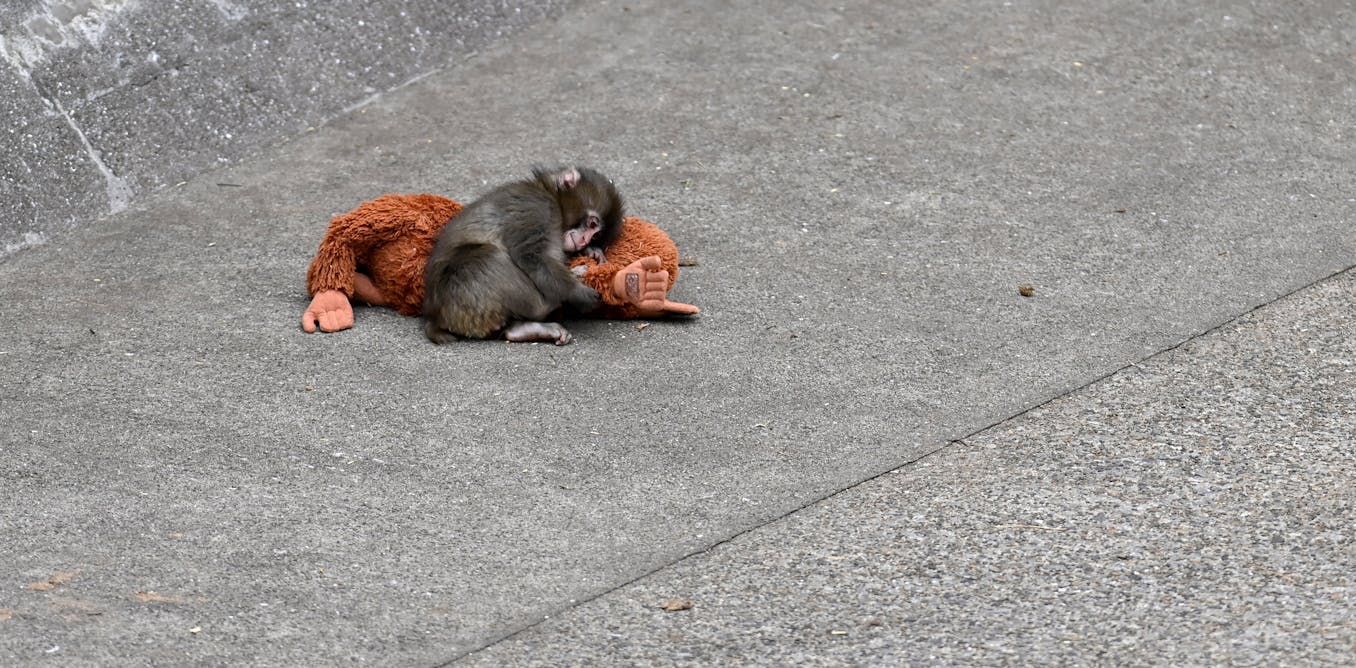
In a heartwarming yet poignant story that's captured the attention of millions online, a young macaque monkey named Punch at the Ichikawa City Zoo in Japan has become an unlikely internet sensation. Abandoned by his mother shortly after birth and rejected by his troop, the baby primate found solace in an unexpected companion: an orangutan plushie provided by zookeepers. Videos showing Punch clinging desperately to the soft toy have racked up views worldwide, highlighting the deep-seated need for comfort in the animal kingdom.
The footage, which began circulating widely in recent weeks, depicts the tiny monkey wrapping his arms around the plushie, refusing to let go even as he explores his enclosure. According to reports from the zoo, Punch's mother showed no interest in caring for him, a behavior sometimes observed in primate groups under stress or in captivity. Zookeepers stepped in quickly, offering the plush toy as a surrogate to provide the tactile reassurance the infant craved. "It's heartbreaking to see, but also a reminder of how these animals seek connection," one zoo staff member told local media, though the facility has not released an official statement on Punch's long-term care.
This viral tale isn't just a feel-good animal story; it echoes a landmark series of psychological experiments conducted over 70 years ago by American researcher Harry Harlow at the University of Wisconsin. In the 1950s, Harlow sought to understand the nature of attachment in primates, challenging the dominant behaviorist theories of the era. Behaviorism, popularized by figures like B.F. Skinner, posited that attachments formed primarily through the fulfillment of basic needs like food and shelter, operating on principles of reward and punishment.
Harlow's work involved separating infant rhesus monkeys from their mothers at birth and placing them in enclosures with two artificial surrogate mothers. One surrogate was a bare wire frame shaped like a monkey, equipped with a bottle to provide milk and water. The other was a similar wire frame but covered in soft terry toweling, offering a cuddly, comforting surface without any nourishment. Observers expected the monkeys to prefer the wire mother that fed them, aligning with behaviorist predictions. Instead, the infants spent the majority of their time—up to 17 hours a day—clinging to the cloth-covered surrogate, only approaching the wire one briefly for feeding.
"Harlow's 1950s experiments established the importance of softness, care and kindness as the basis for attachment," explains the analysis in a recent article on The Conversation, drawing direct parallels to Punch's behavior. The rhesus monkeys' preference for emotional comfort over physical sustenance flipped the script on behaviorism, demonstrating that contact comfort was essential for healthy development. Harlow documented how the isolated monkeys later exhibited severe social and emotional deficits, including fearfulness and inability to interact with peers, underscoring the long-term impacts of early deprivation.
These findings laid the groundwork for modern attachment theory, developed in the mid-20th century by psychologists John Bowlby and Mary Ainsworth. Bowlby, a British psychiatrist, argued that the bond between infant and caregiver is an evolutionary adaptation crucial for survival, providing a secure base from which children explore the world. Secure attachment, fostered through responsive and affectionate caregiving, leads to confident, resilient individuals. In contrast, insecure attachments—stemming from neglect, abuse, or inconsistency—can result in anxiety, avoidance, or disorganized behaviors in adulthood.
Harlow's experiments with monkeys provided empirical support for Bowlby's ideas, bridging animal and human psychology. "Attachment theory posits that healthy child development occurs when a child is 'securely attached' to its caregiver," notes The Conversation piece. "This is achieved by the parent or caregiver providing emotional nourishment, care, kindness and attentiveness to the child." Human studies, such as Ainsworth's 'Strange Situation' procedure in the 1970s, further validated these concepts by observing how toddlers reacted to brief separations from their mothers.
Punch's story at the Ichikawa City Zoo inadvertently recreates elements of Harlow's setup in a real-world, non-experimental context. Without a troop to integrate into, the macaque turned to the plushie for the softness and security he lacked from his biological mother. "Just as Harlow’s monkeys favoured their terry towelling mother, Punch has formed an attachment to his IKEA plushie companion," the analysis observes. The toy, sourced affordably from the Swedish retailer's animal collection, became more than a placeholder; it offered the 'contact comfort' that Harlow deemed vital.
Unlike Harlow's controlled trials, which included a stark choice between the nourishing wire mother and the comforting cloth one, Punch's environment didn't present such a binary. The zoo focused on welfare, ensuring the monkey received proper nutrition through bottle-feeding while the plushie addressed his emotional needs. Reports indicate Punch has shown signs of stabilization since receiving the toy, grooming it and sleeping curled against its fabric. Animal behavior experts monitoring similar cases suggest such interventions can aid socialization, though long-term outcomes depend on gradual integration with compatible troop members.
The parallels between Punch and Harlow's subjects have sparked renewed interest in attachment theory amid today's discussions on mental health and parenting. In an era of increasing awareness about childhood trauma—exacerbated by events like the COVID-19 pandemic, which disrupted family routines for millions—Punch's plushie embrace serves as a metaphor for the human need for emotional support. Psychologists point out that while monkeys and humans differ, the core principles hold: "You can feed a human baby all they need, give them all the dietary nourishment they require, but if you don’t provide them with warmth and love, they’re not going to form an attachment to you," as articulated in the Conversation article.
Yet, this fascination comes with a sobering reflection on the ethics of Harlow's original research. Conducted in the post-World War II scientific climate, the experiments involved deliberate separation and isolation, causing evident distress to the animals. Today, such studies would violate international guidelines on animal welfare, including the 3Rs principle—replacement, reduction, and refinement—endorsed by organizations like the International Primatological Society. "Most of the world now recognises primates as having rights that are, in some cases, equivalent to human rights," the analysis states. "Today, we would see Harlow’s experiments as a cruel and unkind thing to do."
Critics in the 1950s and beyond have condemned Harlow's methods, arguing they prioritized scientific gain over compassion. The researcher himself later expressed some regret, noting the emotional toll on his subjects. Modern primatology emphasizes naturalistic observation and non-invasive techniques, as seen in long-term studies at sites like Gombe Stream National Park in Tanzania, where Jane Goodall's work revealed chimpanzee family bonds without interference.
At the Ichikawa City Zoo, officials have emphasized that Punch's care aligns with contemporary standards, prioritizing his well-being over any experimental value. The facility, located in Chiba Prefecture near Tokyo, houses over 200 animals and promotes conservation education. Zookeepers report that Punch, now several months old, is eating well and showing curiosity, though his future integration remains uncertain. Veterinary assessments indicate no health issues, and the plushie continues to play a central role in his routine.
Beyond the zoo walls, Punch's story has inspired online communities to discuss attachment in pets and children alike. Social media users share personal anecdotes of using stuffed animals for comfort during isolation, drawing loose but meaningful connections. Experts caution against over-anthropomorphizing, but agree the monkey's behavior reinforces timeless lessons: emotional bonds are foundational to thriving.
As Punch clings to his plushie, he embodies a bridge between past science and present empathy. Harlow's controversial legacy, once revolutionary, now underscores the evolution of our understanding—prioritizing kindness in research and care. For the little macaque, the toy offers a soft landing in a challenging world, reminding us all that love, in whatever form, remains irreplaceable.