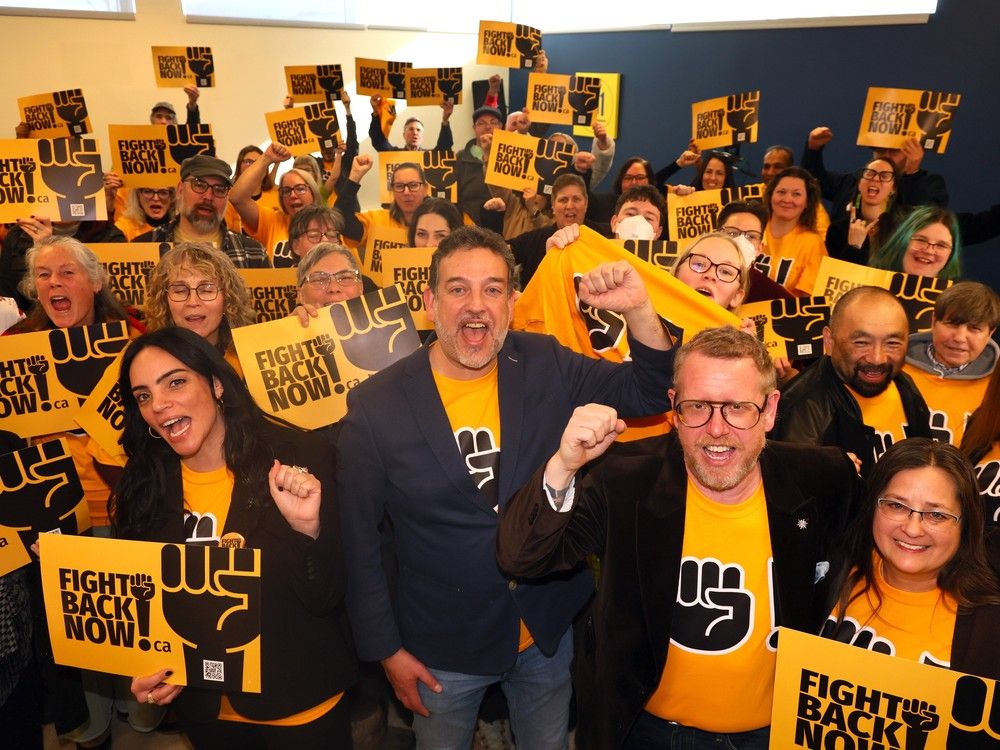
EDMONTON, Alberta — The Alberta Federation of Labour (AFL) announced plans Saturday for a provincewide day of protest on May 29, aiming to rally union members and community supporters against what organizers call an "increasingly radical and undemocratic agenda" from the United Conservative Party (UCP) government.
The demonstrations, coordinated across various sectors, are expected to draw participants from Calgary to Edmonton and beyond, focusing on issues like government overreach, affordability challenges, and the use of the notwithstanding clause to override legal challenges. AFL President Gil McGowan, speaking at a news conference in Edmonton, framed the action as a necessary response to policies he said Albertans did not vote for.
"We’re committing ourselves to mass protest action because the Smith government has gone rogue," McGowan said. "They’re implementing an agenda that Albertans didn’t vote for and which the majority of us don’t support."
McGowan emphasized that the AFL sees widespread frustration among Albertans, many of whom lack a clear way to voice their concerns. "We are convinced that a majority of Albertans have been waiting for someone to provide them with a platform to express their displeasure, apprehension, and yes, even their anger at the direction our province is headed," he added. "We have decided to provide our fellow citizens with that platform."
The announcement comes amid ongoing tensions between the labor movement and Premier Danielle Smith's UCP administration. Just four months ago, in late 2023, the government invoked the notwithstanding clause through Bill 2 to legislate teachers back to work, abruptly ending a three-week strike by the Alberta Teachers' Association. That move, which shielded the legislation from court challenges, drew sharp criticism from unions and opposition parties for undermining workers' rights.
Protesters are also targeting the province's upcoming referendum, scheduled for later this year, which includes questions on issues like pension sovereignty and resource development. McGowan dismissed the process as undemocratic, arguing that the government controls the questions and ignores everyday priorities like housing costs and inflation.
"You don’t get to call it democracy when you write the questions yourself and ignore what people are actually worried about," McGowan said. "This referendum is being sold as ‘letting Albertans decide,’ but the premier chose the questions, controls the process, and is pushing issues that are far removed from what working families are asking for."
Affordability remains a core grievance, with rising living costs exacerbating strains on households. The AFL highlighted how these economic pressures intersect with labor disputes, including chronic underfunding in health care and education. Meanwhile, recall petitions against more than two dozen UCP members of the Legislative Assembly (MLAs) have largely faltered, with at least half failing to meet the signature threshold needed to trigger by-elections as of recent counts.
McGowan noted that changes to recall rules, implemented by the UCP, have raised the bar for success, making it harder for constituents to challenge their representatives. "One of the reasons that we’ve chosen the protest avenue is because, at least for the time being, democratic protest is not illegal in Alberta," he said. "Protest is something that we all have access to, and so it gives us a lot more room to move."
The labor leader addressed why the AFL opted against a general strike, an idea he had floated previously. While discussions within the movement turned to such drastic measures following the teachers' strike, legal barriers proved prohibitive. "The challenge is that general strikes have long been criminalized by our governments here in Canada, both at the federal and provincial level," McGowan explained.
He pointed to the government's actions during the teachers' dispute as evidence of escalating restrictions. "And as we saw in October, our provincial government has gone one step further by criminalizing even legal strikes as they did in the case of the teachers strike," he said. "So anyone who engages in a general strike faces the prospect of fines. They face the prospect of losing their jobs."
Support for the May 29 protests has poured in from various unions. Karen Kuprys, second vice-president of the United Nurses of Alberta, described the toll on health-care workers amid staffing shortages and economic instability. "Workers are frustrated," she said. "They’re working harder than they ever have before, and they’re sick of the chaos and uncertainty, and this is all superimposed upon rising costs and instability."
"Workers are holding together the services we rely on by sheer will," Kuprys added. "They’re tired of being told to do more with less."
In the post-secondary sector, Lee Easton, president of the Confederation of Alberta Faculty Associations, echoed similar sentiments, citing government underfunding and perceived interference in academic affairs. "We’re tired of being bullied," Easton said. "We’re here and we’re ready to fight back."
The choice of May 29 allows three months for preparation, a timeline McGowan described as tight but feasible. "Three months in the big scheme of things is not long, but it will give us an opportunity to organize our own members within the labour movement (and) reach out to people outside the labour movement," he said. Organizers cited practical factors like improved spring weather, which could facilitate outdoor gatherings across Alberta's diverse regions.
The UCP government, through Premier Smith's press secretary Sam Blackett, pushed back against the AFL's plans, portraying them as another unsuccessful tactic by McGowan. "So, first Gil attempted to launch a general strike, and it was a failure. Then he moved on to Plan B, launching recalls against our UCP MLAs to topple this government, he again failed miserably," Blackett said in a statement.
"Now, Gil is on Plan C, a province-wide protest, and just like his previous ploys and his NDP leadership campaign, I expect it to be a colossal failure," Blackett added, referencing McGowan's past involvement in provincial politics.
This exchange underscores the deepening divide between Alberta's labor unions and the UCP, which swept to power in 2019 on promises of economic conservatism and reduced regulation. Since Smith's ascension as premier in 2022, her administration has pursued policies emphasizing provincial autonomy, including sovereignty acts and resource-focused initiatives, often clashing with federal priorities and union demands.
Recent events, such as the First Nations Chiefs' unanimous non-confidence vote in the UCP government last week, add to the backdrop of discontent. That resolution, passed by chiefs from across Alberta, criticized the government's approach to treaty rights and environmental policies. While not directly tied to the AFL protest, it highlights broader Indigenous concerns that could intersect with labor actions.
As preparations ramp up, the AFL is calling on non-union Albertans to join, framing the event as a collective stand for democratic values. Details on specific protest locations and formats remain forthcoming, but organizers anticipate demonstrations at key sites like the Alberta Legislature in Edmonton and government offices in major cities.
The May 29 action could mark a turning point in Alberta's labor landscape, potentially galvanizing opposition ahead of the next provincial election, due by 2027. For workers in essential services, the protests also raise questions about participation limits under existing labor laws. McGowan's comments suggest a cautious approach, prioritizing legal protest over riskier strikes.
With recall efforts stalling and economic pressures mounting, the AFL's mobilization tests the government's resilience and public sentiment. Whether the protests draw the crowds McGowan envisions or fizzle as Blackett predicts remains to be seen, but they signal escalating pushback against UCP policies in Canada's oil-rich province.