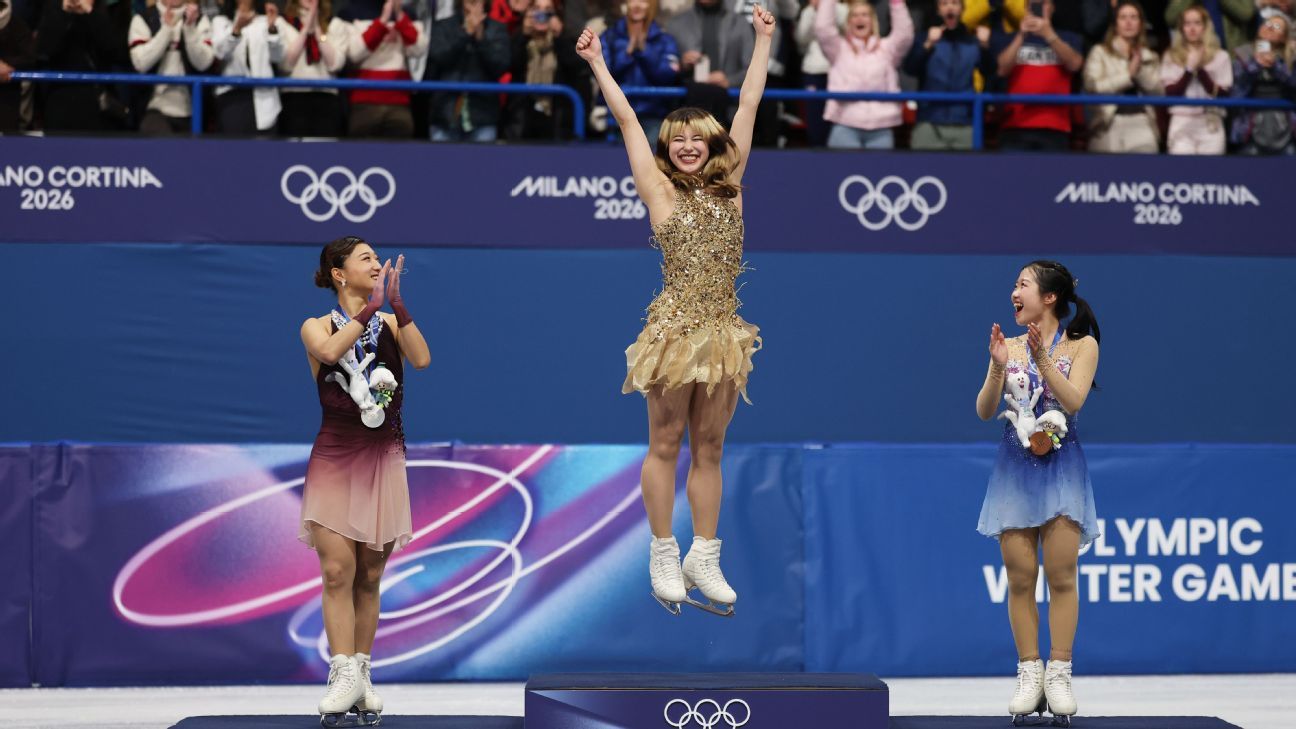
MILAN — Alysa Liu, the 20-year-old California skater who stepped away from competitive figure skating for two years to rediscover herself, captured an unexpected Olympic gold medal in women's singles on Thursday at the 2026 Winter Olympics here. Liu's flawless free skate performance, set to Donna Summer's "MacArthur Park Suite," earned her a season-best score of 150.20, pushing her total to 226.79 and securing the top spot on the podium. It marked the first American gold in the event since Sarah Hughes won in 2002 — more than three years before Liu was even born.
As she left the ice after her routine, Liu turned to a camera and exclaimed, "That's what I'm f---ing talking about!" The outburst captured the joy of a skater who had returned to the sport not with dreams of medals, but simply to express her creativity and reclaim her passion. "I don't need this [medal]," Liu said later in a press conference. "But what I needed was the stage and I got that, so I was all good. No matter what happened."
Liu's victory capped a tumultuous week for the U.S. figure skating team, which entered the Games with high expectations after dominating the 2025 World Championships in Boston, where Americans claimed three of the four titles. The team event, held earlier in the Olympics, saw the U.S. edge out Japan by a single point — the narrowest margin in the event's history — thanks in part to Liu's strong short program performance on February 6. But individual events brought mixed results: Ilia Malinin, the 21-year-old quad axel pioneer, finished eighth in men's singles after unraveling in his free skate; Madison Chock and Evan Bates, three-time world ice dance champions, took silver despite controversy over judging in their rhythm dance; and pairs teams Emily Chan and Spencer Akira Howe placed seventh, while Ellie Kam and Danny O'Shea came in ninth.
The women's singles competition, the final event of the skating program, drew intense anticipation. Dubbed the "Blade Angels" by fans — a trio consisting of Liu, Isabeau Levito and Amber Glenn — the American women had all finished in the top five at last year's worlds, with Levito earning silver and Glenn rallying to fifth after a shaky short program. Hype built through social media edits and even a promotional video narrated by Taylor Swift. All three skated in the final group during the short program, aiming to end the U.S.'s 20-year medal drought in the discipline.
Liu opened the group with a near-perfect short program that highlighted her artistry, landing her in third place entering the free skate, just over two points behind the leader. Levito followed with what she described as an "elegant" routine, but technical scoring placed her eighth. Glenn, skating penultimate, started strong with a triple axel but doubled her planned triple loop, resulting in an invalid element and zero points for it. Her score of 67.39 dropped her to 13th, and she was visibly emotional, crying as she awaited the announcement. "She's overcome a lot, and I just want her to be happy," Liu said of her close friend Glenn. "That's genuinely all I want. And so I'll be seeing her later. Don't worry guys, we stick together."
Heading into Thursday's free skate at the Mediolanum Forum, the top four spots were held by Japanese skaters, with Russia's Adeliia Petrosian — a relative unknown with limited international experience but hints of a quad jump — in fifth. Glenn, starting 13th, delivered a redemptive performance that vaulted her to the early lead. Levito, from eighth, improved but couldn't crack the medals. Then came Liu, whose disco-themed program had the arena on its feet, including supportive cheers from teammate Malinin. Her score guaranteed a medal, and as Kaori Sakamoto and Ami Nakai of Japan took the ice last, Liu watched without apparent anxiety, clapping along to their routines.
When Nakai's score was revealed, confirming Liu's gold ahead of Sakamoto's silver and another Japanese skater's bronze, it was Glenn — finishing fifth overall — who grabbed Liu's hand and raised it in triumph. The moment underscored the camaraderie among the American women, a stark contrast to the pressures that felled others. Malinin, for instance, had led after the men's short but bailed on his quad axel, doubled a quad loop and fell twice in the free skate, later telling reporters he was overwhelmed by negative thoughts. "I was flooded with negative thoughts at the start of my program and simply couldn't recover," Malinin said.
Liu's path to this gold was anything but straightforward. She burst onto the scene as a prodigy, becoming the youngest U.S. national champion at age 13 and competing at the 2022 Beijing Olympics at 16 amid pandemic restrictions. But after a third-place finish at the 2022 World Championships, she retired abruptly. In a now-deleted Instagram post, Liu wrote, "Heyyyyy so I'm here to announce that I am retiring from skating. I started skating when I was 5 so that's about 11 years on the ice and it's been an insane 11 years. A lot of good and a lot of bad but (you know) that's just how it is."
During her hiatus, Liu embraced a normal life denied to her as a child athlete. She attended UCLA, hiked to Mount Everest base camp in 2023 — a trip she called a favorite memory — and pursued interests like dancing and music. A family ski trip reignited her love for physical challenges, leading her back to the rink casually at first. Surprised by her retained skills, she rekindled her passion and recruited former coaches Phillip DiGuglielmo and Massimo Scali, insisting this time everything would be on her terms.
"We never set goals like winning Olympic gold medals," DiGuglielmo said Thursday. "Liu wanted a place to showcase her creativity — she showed equal, if not more, enthusiasm for the dress she wore in her free skate when speaking to the media than she did the final result." At the 2025 World Championships last March, Liu won the short program, and her team treated that as the goal achieved. "At worlds, she won the short and we were like, 'Done, goals achieved. We let her show this amazing short program,'" DiGuglielmo recounted. "They got [to see] the best short program in the world. It's a win. Then it was, 'OK, let's do the free skate and just see how it goes.'" That free skate, the same one that won her Olympic gold, clinched the world title.
Even after that success, Liu's focus remained on the experience rather than outcomes. Her coaches prioritized "making memories," especially after Beijing's restrictions left her with few recollections of earlier achievements like junior worlds or the Junior Grand Prix Final. "She was so not happy that she wound up compartmentalizing, putting that all somewhere in the back," DiGuglielmo said. Liu herself emphasized intentionality in an ESPN interview last fall: "I'm so intentional now. I'm so grounded. Everything I do has a reason for why I do it."
Her approach contrasted with the sport's traditional intensity. While Glenn and Malinin spoke openly about the mental toll of the Olympics, Liu appeared unflappable across her three skates — one in the team event and two individual. At January's U.S. Nationals, when Glenn surpassed her score, Liu smiled throughout. Ashley Wagner, a 2014 Olympic team bronze medalist now in sports psychology, praised Liu's mindset ahead of the Games: "She has this 'Oh, if I want to do something, I guess I could just go try and do it' quality about her. ... Her 'Why' is so pure. ... When you're emotionally connected to your why, you see results."
Liu's win, combined with the team's overall resilience, signals a potential renaissance for U.S. figure skating, which has struggled for popularity since its glory days. Japan outperformed the U.S. in total medals across the five events, but Liu's story — of hiatus, mental health and return — resonated deeply. "Her story of taking a step back, mental health — I think it really attests to you never know what the journey to success is going to be," Glenn told reporters. "I really hope that can reach the skating community, that it's OK to take time."
On the podium, jumping with joy, Liu reflected on her place in history. "I'm honored to be part of this [gold medal] club," she said. "I guess it's a club maybe, but no, I am really honored and they are incredible athletes. ... I hope that with all this visibility I now have, I hope people don't just look at a headline like, 'Oh, she won a gold.' I hope people really, I don't know, take their time to read my story even though it's not fully out. But one day it will be [and] on that day I hope to inspire even more people." As the carefree skater with bleached, tree ring-inspired hair leaves Milan with two golds — one from the team event — her journey may just redefine success in a sport long shadowed by pressure.
Looking ahead, Liu's triumph could boost the sport's profile, much like past American stars did. With Malinin's athletic flair and the women's depth, the U.S. team eyes sustained success, though officials acknowledge the Olympics' unpredictability. For now, Liu's gold stands as a beacon of joy amid the ice's chill.