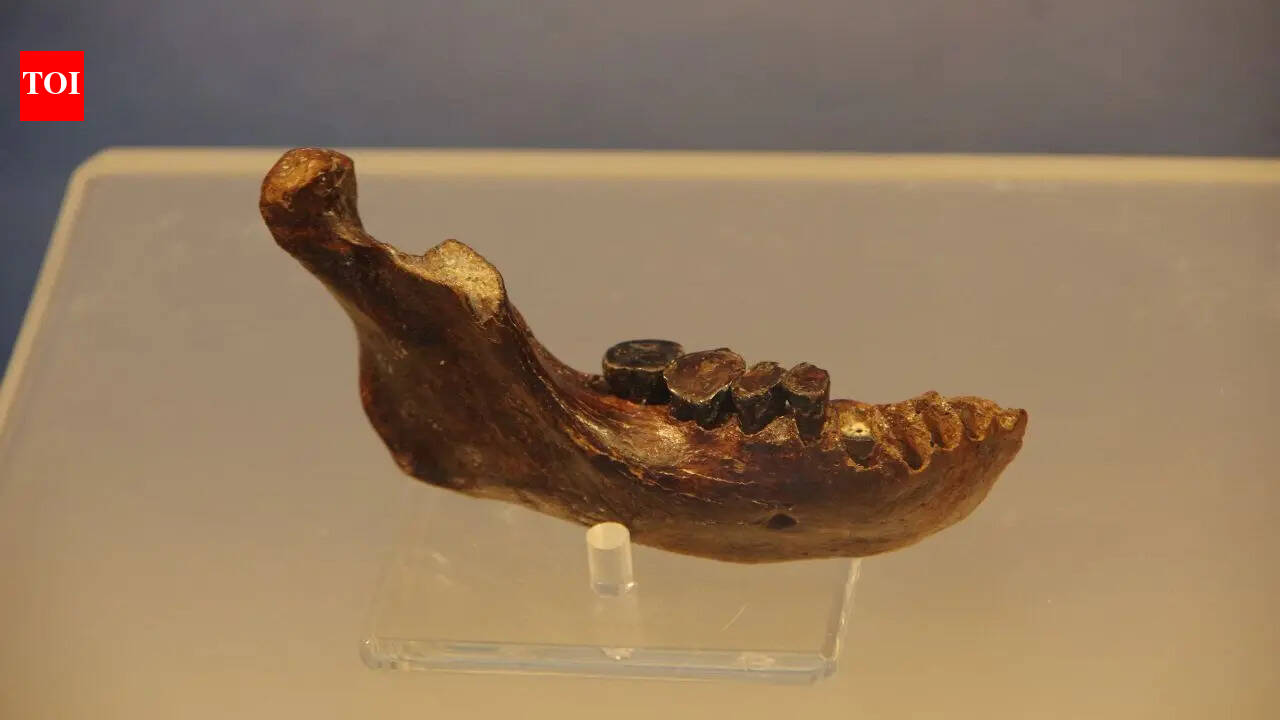
TAIPEI, Taiwan — A seemingly ordinary jawbone dredged from the seabed off the coast of Taiwan has sparked intense debate among anthropologists and could upend long-held theories about human evolution. Discovered more than a decade ago, the fossil, known tentatively as the Penghu mandible, shows features that align with neither modern humans nor the extinct Neanderthals, suggesting the possibility of a previously unknown hominin species in East Asia. According to researchers at the National Taiwan University and international collaborators, this find challenges the narrative that modern humans were the sole dominant hominins in the region after the disappearance of more archaic forms.
The jawbone surfaced in 2008 when Taiwanese fishermen hauled it up from depths of about 100 meters near the Penghu Islands in the Taiwan Strait. At first glance, it appeared unremarkable — a weathered piece of bone amid the catch of fish and debris. But upon closer inspection by local archaeologists, its robust structure and archaic dental features stood out. Measuring roughly 12 centimeters in length, the mandible preserves most of its right side, including three molars that exhibit thick enamel and large roots atypical of Homo sapiens.
Dr. Yousuke Kaifu, a paleoanthropologist at Japan's Senckenberg Center for Human Evolution and Palaeoenvironment, led the analysis of the specimen. In a 2015 study published in the journal Nature Communications, Kaifu's team dated the jawbone to between 10,000 and 70,000 years ago using stratigraphic and morphological comparisons. "This mandible doesn't fit neatly into our existing categories," Kaifu said in an interview with The Times of India. "It's more primitive than modern humans but lacks the distinctive traits of Neanderthals or Denisovans."
The discovery comes at a time when genetic and fossil evidence is increasingly complicating the human family tree. Traditional models posited that Homo sapiens emerged in Africa around 300,000 years ago, migrating out and interbreeding with Neanderthals in Europe and Denisovans in Asia. But finds like the Penghu jawbone suggest a more diverse mosaic of hominins persisted in Southeast Asia longer than previously thought. For context, nearby sites in China, such as the Zhoukoudian cave, have yielded Homo erectus fossils dating back 700,000 years, but nothing quite like this intermediate form.
Experts are divided on the exact classification. Some, like Chris Stringer of the Natural History Museum in London, argue it could represent a late-surviving population of Homo erectus, adapted to island environments. "The Penghu find highlights how fragmented our understanding of Asian hominin diversity is," Stringer noted in a recent commentary for Scientific American. Others, including Maria Martinón-Torres from University College London, propose it might belong to a new species, dubbing it informally "Homo luzonensis" or a related lineage, drawing parallels to the small-statured hominins found in the Philippines' Callao Cave in 2007.
According to the Times of India report, the jawbone's teeth show shovel-shaped incisors common in modern East Asians, hinting at possible gene flow with contemporary populations. However, its overall robustness — with a mandible thickness of 2.5 centimeters — echoes earlier hominins like Australopithecus, though dated much later. This discrepancy has fueled speculation about isolated island evolution, similar to how Homo floresiensis, the "hobbit" species, developed on Flores Island until as recently as 50,000 years ago.
The site's location in the Taiwan Strait adds geographical intrigue. The Penghu Islands, a volcanic archipelago 40 kilometers west of Taiwan's main island, have long been a hotspot for marine archaeology due to strong currents and tectonic activity that preserve deep-sea relics. Fishermen have occasionally reported other fossils, including a 2010 find of a proboscidean tooth, but the jawbone's human-like qualities set it apart. Taiwanese authorities, through the Council for Cultural Affairs, have since regulated dredging in the area to protect potential sites.
Further analysis involved advanced imaging techniques. CT scans revealed internal structures, including a spacious mandibular canal, which differs from the narrower one in Neanderthals. Isotope studies on associated sediments suggest the individual subsisted on a diet of shellfish and tubers, consistent with a coastal lifestyle. "It's like finding a missing link in the Pacific," said Dr. Lee Hsiu-chuan, a curator at the National Taiwan Museum, who assisted in the initial cleaning and cataloging. "This could explain genetic anomalies in modern Taiwanese populations."
Critics, however, caution against overhyping the find. Dr. Erik Trinkaus, an emeritus professor at Washington University in St. Louis, reviewed the 2015 paper and pointed out limitations in the dating. "Without more contextual bones or DNA, it's premature to declare a new species," Trinkaus said. "It could just be a robust variant of early modern humans." Indeed, extraction of ancient DNA from the jawbone has proven challenging due to its marine exposure, which degrades organic material. Ongoing efforts at the Max Planck Institute for Evolutionary Anthropology aim to sequence any preserved genetic material, potentially by 2025.
The broader implications ripple through anthropology. If confirmed as a distinct lineage, the Penghu mandible could support theories of multiple human dispersals from Africa, with archaic groups lingering in Asia's island chains. This aligns with recent discoveries, such as the 2023 announcement of Homo longi fossils from northern China, dated to 146,000 years ago, which some dub "Dragon Man." Together, these finds erode the "Out of Africa" model's simplicity, suggesting waves of migration and hybridization shaped our species.
In Taiwan, the discovery has cultural resonance. Indigenous groups like the Amis and Atayal, whose oral histories speak of ancient ancestors, view it as validation of their deep roots. "Our stories tell of people who lived with the sea spirits," said elder Lin Mei-ling of the Penghu community, in a statement to local media. The government has incorporated the fossil into educational programs, with exhibits at the Penghu Marine Biology Museum drawing 50,000 visitors annually since 2018.
Internationally, the find has prompted calls for better collaboration. The International Council for Archaeozoology urged in a 2022 resolution that Asian nations share more fossil data to map hominin distributions. Meanwhile, funding from the European Research Council supports excavations in the Taiwan Strait, targeting sites up to 200 meters deep using submersible drones.
Looking ahead, scientists anticipate more revelations. A follow-up expedition planned for 2024 by the Taiwanese Academy of Sciences will survey adjacent seabeds, hoping to uncover associated remains like a cranium or limb bones. If successful, it could solidify the jawbone's place in rewriting human origins. As Kaifu put it, "This quiet fossil from the sea might be shouting the story of our forgotten relatives."
For now, the Penghu mandible rests in a climate-controlled vault at National Taiwan University, a humble artifact with monumental potential. As debates continue in academic circles and online forums, it serves as a reminder of how much remains hidden beneath the waves and in the sands of time.