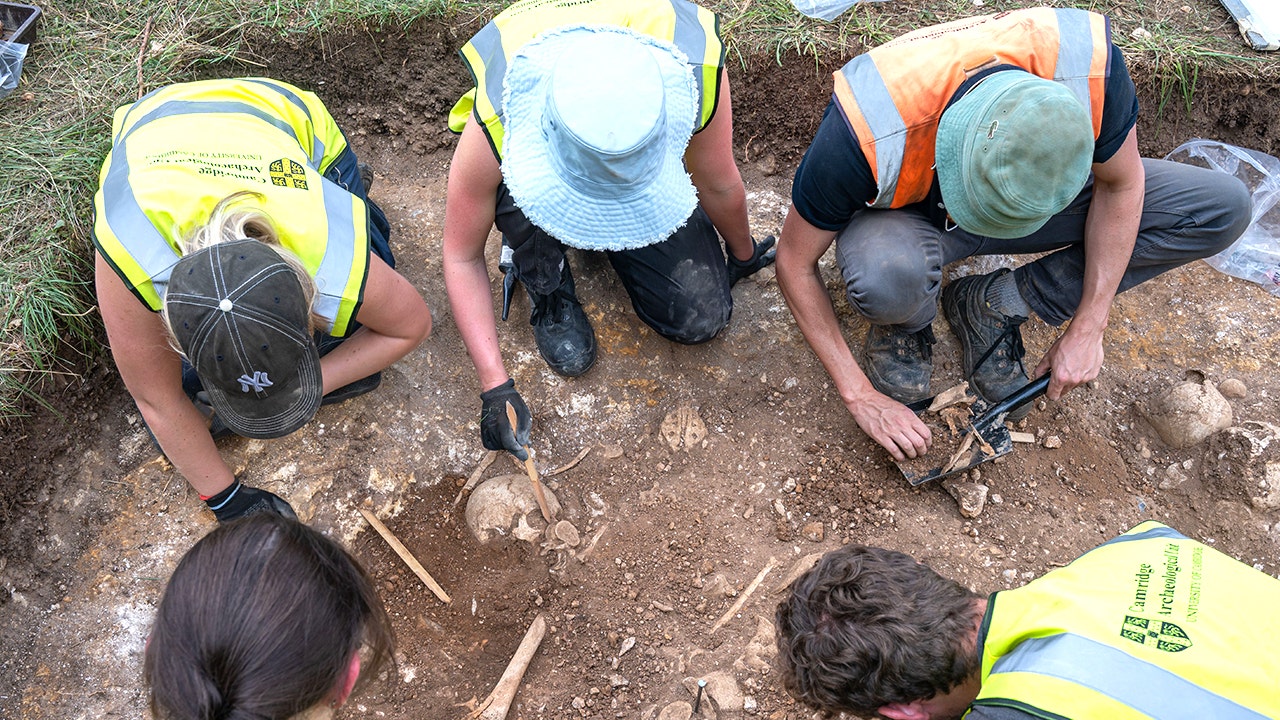
CAMBRIDGE, England — Archaeologists from the University of Cambridge have uncovered a chilling 1,200-year-old mass grave in a rural park south of the city, believed to be an ancient execution site from the Viking era. The discovery, announced in a February 4 press release by the university, reveals the remains of around 10 young men buried in a pit near an Iron Age hillfort, shedding new light on the brutal violence that marked 9th-century Britain.
The site, located in Wandlebury Country Park, was excavated by students and researchers during the spring and summer of 2025. According to the Cambridge Archaeological Unit, the burial dates to the 9th century A.D., a period when Viking invasions were reshaping the region through conquest and conflict. The area was then a contested 'frontier zone' between the Saxon kingdom of Mercia to the west and the kingdom of East Anglia to the east, where territorial disputes often led to bloodshed.
What makes the find particularly striking is the unusual arrangement of the remains. The mass grave contains a mix of complete skeletons and dismembered body parts, including a cluster of skulls without attached bodies and what experts describe as a 'stack of legs.' Four individuals appear to have been buried intact, some in positions that suggest they were bound at the time of death. 'Unusually, the mass grave held a mix of complete and dismembered remains, including a cluster of skulls without clear accompanying bodies and a ‘stack of legs,' as well as four complete skeletons, some in positions suggesting they were tied up,' the university's press release stated.
Oscar Aldred, an archaeologist with the Cambridge Archaeological Unit who led the excavation, pointed to two key pieces of evidence supporting the theory that this was an execution pit rather than a battlefield burial. First, the location itself: the pit lies on the edge of an old Iron Age hillfort, a prominent spot in the landscape that would have been ideal for public executions. 'The context of the burial in connection [to] an old Iron Age hillfort … is a prime location for execution burials,' Aldred told Fox News Digital. 'Execution sites from this period are typically on the edge of a territory, but also in prominent locations in the landscape.'
The second indicator is the evidence of deliberate violence. At least one skeleton shows clear signs of decapitation, with incisions and chop marks on the left side of the lower jawbone. Aldred explained that this type of injury aligns with judicial killings rather than combat. 'If this was a battlefield burial, we would expect to see further trauma on the bone, especially arms and legs, related to battle wounds,' he said. 'In the context of an execution, the setting fits, so to speak.'
Despite these clues, the exact circumstances of the deaths remain under investigation. The remains suggest the bodies were deposited in a state of partial decomposition, which could explain why some parts were grouped together separately. '[It's] very interesting,' Aldred noted. 'The [deceased] individuals were deposited in the state of decomposition, and therefore were not able to hold together, so to speak.' He added that the bone grouping is 'not very common at all' and requires further study to fully understand.
The discovery raises intriguing questions about the social and political dynamics of early medieval England. Wandlebury Hill, the site of the Iron Age fort, was historically recorded as a meeting place for 'hundreds,' the Anglo-Saxon administrative units that gathered to resolve disputes and enforce laws. 'It is the kind of place where you might expect judicial assemblies to take place, where people would have met and made important decisions such as execution orders,' Aldred said. While there's no direct evidence of a specific battle at the site, its position in a frontier zone hints at possible ties to the broader conflicts between Saxon kingdoms and Viking raiders.
Historical context underscores the era's turbulence. The 9th century saw the Viking Great Heathen Army invade England in 865, leading to the conquest of East Anglia by 869 and the fall of other kingdoms. Mercia, under King Burgred, faced repeated assaults, and areas like Cambridgeshire were flashpoints for resistance and retribution. The execution pit could represent either Saxon justice against perceived threats or Viking reprisals, though archaeologists caution against jumping to conclusions without more data.
To unravel the victims' identities and the precise timing of the burials, researchers are turning to advanced scientific methods. DNA analysis will help determine the men's ethnic origins, potentially revealing if they were local Saxons, Viking invaders, or a mix. Isotope testing on their teeth and bones could indicate where they grew up, based on dietary signatures from different regions. Radiocarbon dating will refine the age of the remains beyond the current 9th-century estimate.
'We don’t yet have this information [at] hand because we haven’t fully assessed all the individuals from the burial pit,' Aldred said. 'The bone grouping within the burial pit is something we need to work harder on to understand further.' He emphasized that the team is collaborating with colleagues at the University of Cambridge to address these puzzles. 'We're working with colleagues at the University of Cambridge to take these questions forward,' he added. 'But for now, we are raising the questions rather than definitively answering them.'
This isn't the first time Wandlebury has yielded insights into ancient life. The hillfort, dating back over 2,000 years, has long been a focus for archaeologists due to its strategic hilltop position overlooking the surrounding countryside. Previous digs have uncovered Iron Age settlements and Roman-era artifacts, but the medieval execution pit adds a grim chapter to the site's history. The Cambridge Archaeological Unit's involvement highlights the university's role in preserving and interpreting Britain's past, with students playing a hands-on part in the excavations.
Experts in the field have praised the find as a significant contribution to understanding early medieval violence. While mass graves from this period are not unheard of—such as the infamous Ridgeway Hill burial in Dorset, linked to 10th-century executions—this one's mix of intact and dismembered remains stands out. It echoes other sites where judicial killings were common, like the Tideford execution cemetery in Cornwall, but the frontier location adds a layer of geopolitical intrigue.
As analysis continues, the discovery prompts reflection on how violence shaped medieval society. Executions were public spectacles meant to deter crime and assert authority, often carried out by beheading or hanging at territorial boundaries. The young age of the victims—estimated from skeletal features—suggests they may have been warriors, criminals, or even political prisoners caught in the crossfire of kingdom rivalries.
Local authorities and heritage groups are already discussing how to protect the site. Wandlebury Country Park, managed by the Woodland Trust, attracts thousands of visitors annually for walks and wildlife viewing, but the excavation area has been secured to prevent disturbance. The University of Cambridge plans to share preliminary findings through public lectures and exhibits, aiming to educate the community about this slice of dark history.
Ultimately, the execution pit serves as a stark reminder of the human cost of ancient conflicts. While the full story of these 10 men may take years to emerge, their remains offer a tangible connection to a violent past. As Aldred put it, the setting 'fits' the grim purpose, inviting further exploration into the mechanisms of power and punishment in Viking-age Britain.