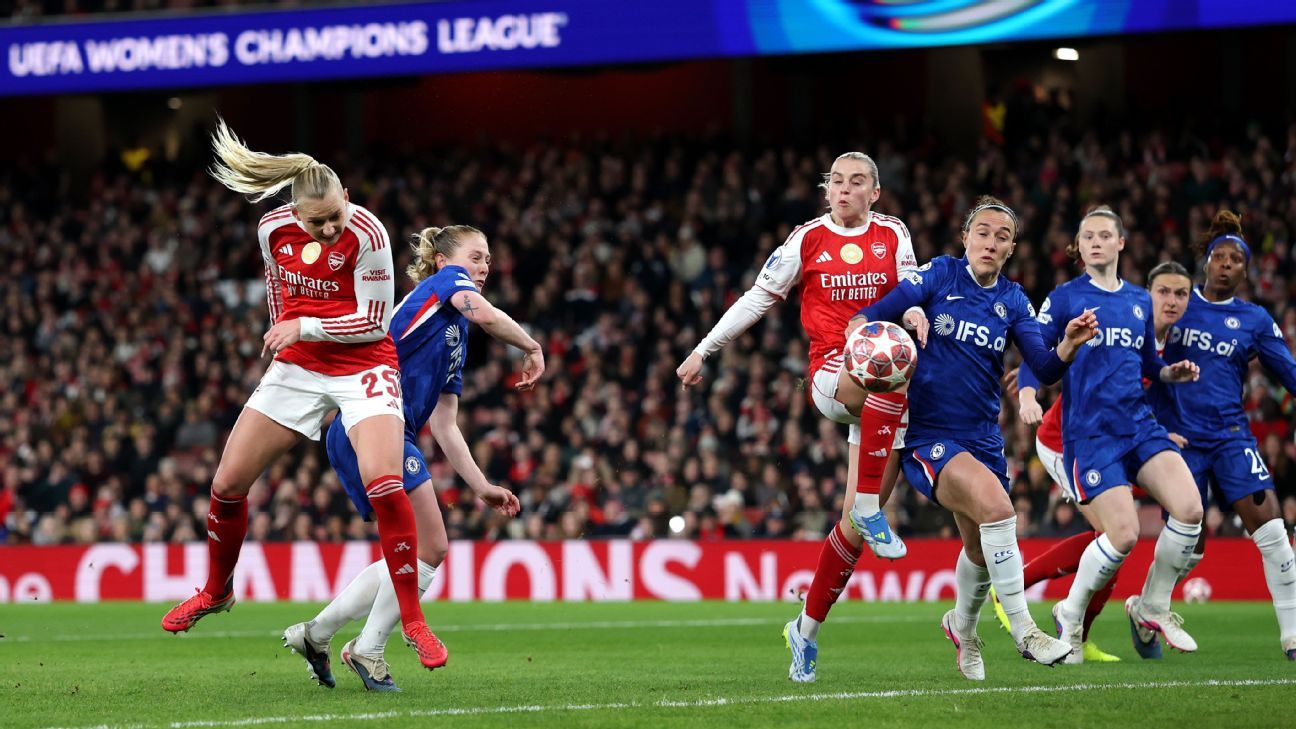
LONDON -- Arsenal delivered a masterclass in clinical finishing on Tuesday night, defeating Chelsea 3-1 in the first leg of the UEFA Women's Champions League quarterfinals at Emirates Stadium. The reigning champions asserted their dominance early, showcasing the precision that propelled them to victory over Barcelona in last season's final, while Chelsea struggled with inefficiency and controversial referee decisions.
The match kicked off with Arsenal striking first in the 12th minute when Stina Blackstenius rose to head home Katie McCabe's free kick, giving the Gunners a 1-0 lead. Just 10 minutes later, Chloe Kelly unleashed a powerful strike from distance that found the back of the net, extending Arsenal's advantage to 2-0. Blackstenius, who netted the winner in the Champions League final in Lisbon last summer, epitomized Arsenal's sharpness in front of goal.
Arsenal generated 11 shots in total, with six on target, converting their limited opportunities efficiently. According to match reports, this efficiency underscored why the Gunners are the only English club to have lifted the UEFA Women's Champions League trophy twice. Chelsea, under manager Sonia Bompastor, appeared disjointed, managing just a fraction of the control despite their pedigree as perennial contenders.
Chelsea mounted a response toward the end of the first half, with Veerle Buurman rising above Arsenal's Laia Codina to nod in what seemed a crucial equalizer. However, referee Alina Pesu disallowed the goal, ruling that Buurman had fouled Codina in the process. The decision, described as soft by observers, was upheld by VAR, preventing Chelsea from shifting the momentum before halftime.
"I don't think any single player on the pitch thought that was a foul to be honest, apart from the ref," Chelsea defender Lucy Bronze said in an interview with Disney+. "But I think as soon as the ref gave it, VAR are not going to overturn it. It was disappointing because I feel like we could have swung the momentum back a little bit and then it just took a little bit longer. It would have been an important goal to score at half-time. And I think we probably could have got even more back into the game in the second half."
Bronze's frustration highlighted the pivotal nature of the call. Had the goal stood, analysts suggest the game's complexion could have changed dramatically, potentially galvanizing Chelsea for a comeback. Instead, Arsenal maintained their composure, entering the break with a two-goal cushion.
In the second half, Chelsea finally broke through in the 58th minute when Lauren James curled a sublime strike into the top corner, reducing the deficit to 2-1. James, returning from an extended injury layoff, has been in scintillating form, and her goal was widely regarded as the highlight of the evening. Yet, it failed to spark a sustained resurgence, as Arsenal's defense held firm.
Sloppy defending from Chelsea allowed Alessia Russo to seal the victory in the 72nd minute, tapping in Arsenal's third goal to make it 3-1. Late in the match, Chelsea thought they had another lifeline when a shot found the net, but it was disallowed for a foul on Arsenal goalkeeper Anneke Borbe by Kadeisha Buchanan. This second VAR intervention, deemed more clear-cut, ensured Arsenal carried a commanding lead into the second leg.
Arsenal manager Renée Slegers' side has found form at a crucial juncture. After a sluggish start to the season and a 2-1 group stage loss to Olympique Lyonnais, the Gunners have peaked for the knockout rounds. This time last year, they trailed Real Madrid 2-0 after the first leg of the quarterfinals but overturned the deficit with remarkable mental fortitude. Now, with a 3-1 advantage, the onus is on them to protect it, a mentality shift that Slegers will demand in the return fixture.
Chelsea's performance was hampered by a mounting injury crisis. Key absences included striker Sam Kerr, sidelined since January, along with Mayra Ramírez and Aggie Beever-Jones. Sources indicate that Catarina Macario is no longer with the club, though an official announcement is pending, and Guro Reiten has transferred to Gotham FC in the NWSL. Defensively, Nathalie Björn, Niamh Charles, and Millie Bright were also ruled out, leaving Bompastor's squad depleted.
Early chances went begging for Chelsea, with Alyssa Thompson and Lauren James both striking the woodwork in the opening exchanges—opportunities they will rue in hindsight. Bompastor reportedly slammed the referee post-match, echoing sentiments from her players about the officiating's impact. Despite these setbacks, Chelsea's depth was once a hallmark, but injuries have tested their resilience.
Looking ahead, both teams will welcome back international players for the second leg on March 27 at Stamford Bridge. Chelsea gains Sam Kerr and Ellie Carpenter from Australia's Women's Asian Cup campaign, where the Matildas fell 1-0 to Japan in the final on Saturday. Arsenal, meanwhile, anticipates the return of Steph Catley, Caitlin Foord, and Kyra Cooney-Cross, all sidelined by fatigue from the same tournament.
This tie remains wide open, effectively at halftime in the two-legged affair. Chelsea overturned a similar deficit against Manchester City in last season's quarterfinals, drawing hope from that precedent. James, in particular, will be pivotal; her ability to create from nothing, including an audacious chip to set up teammates, offers a glimmer of possibility. Chelsea sacrificed early-season results to ensure her fitness for high-stakes games, and none loom larger than this.
The pressure on Chelsea intensifies amid a turbulent domestic campaign. Manchester City leads the Women's Super League by nine points over Manchester United, with Chelsea eight points further back, likely surrendering their six-year title reign. While they hold the League Cup and eye the FA Cup, a Champions League exit would compound the season's woes.
Arsenal's earlier 2-1 victory over Chelsea at Stamford Bridge this season bolsters their confidence. As the only English side with Champions League silverware, they enter the return leg as favorites. For Chelsea, the second leg represents a defining moment, where home support and renewed personnel could yet turn the tide in their quest for a first European crown.
In a broader context, this matchup underscores the growing intensity of women's soccer in England. Arsenal's clinical edge serves as a lesson for aspirants, while Chelsea's resilience—forged through past triumphs—promises a fierce battle. Fans await the decisive clash, which could shape the semifinal path and legacies in the competition.