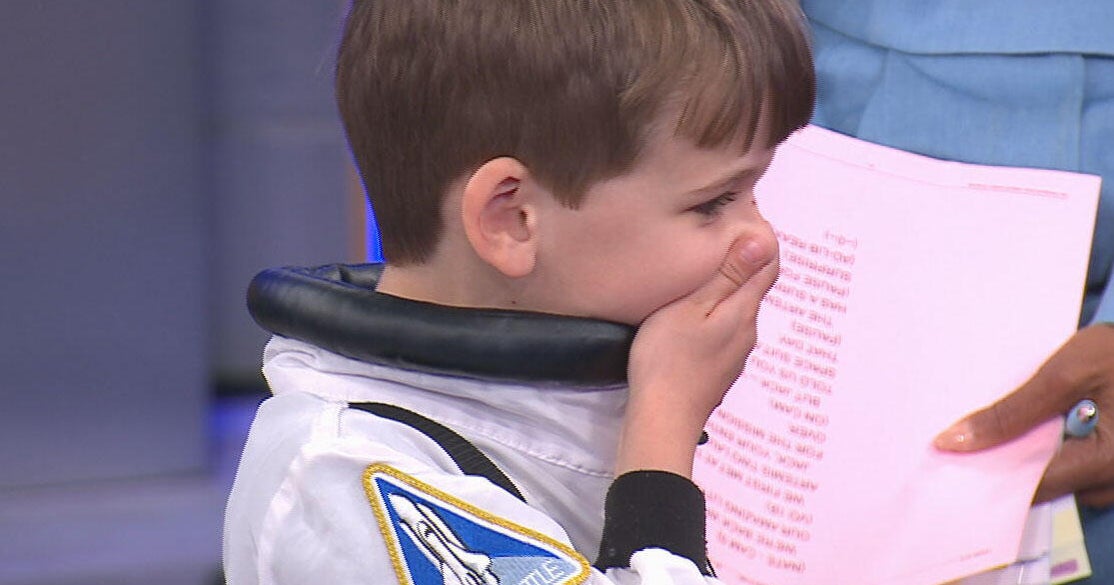
ATLANTA — In a heartwarming moment that bridged the gap between a child's dream and the realities of space exploration, the crew of NASA's Artemis II mission surprised 5-year-old aspiring astronaut Jack from Atlanta with a custom spacesuit during a live television event on Friday. The young boy, affectionately nicknamed Commander Jack, has captured the attention of space enthusiasts since the mission's launch from Florida last month, where he donned his own makeshift spacesuit to watch the liftoff.
Jack's enthusiasm for space first came to light during an interview with CBS News correspondent Rob Marciano, who reported on the boy's obsession with the cosmos. Dressed in a white spacesuit emblazoned with the rank of commander, Jack declared to Marciano that he was "so obsessed with space." This viral moment led to his invitation to join the Artemis II crew for a town hall on "CBS Mornings," where the surprise unfolded before a national audience.
Mission specialist Christina Koch, one of the four astronauts aboard the Artemis II spacecraft, presented the gift to Jack. The orange spacesuit, matching the ones worn by the crew during their lunar orbit mission, was carefully customized for the young fan. "It says commander just like yours, so you can still keep your title," Koch said, smiling as she handed it over. The suit bore signatures from all crew members, adding a personal touch to the gesture.
Jack's eyes lit up as he examined the suit, pointing out a key detail with unbridled excitement. "It says NASA!" he exclaimed, his voice filled with awe. The moment was pure joy, as the 5-year-old gave a thumbs-up in response to Koch's invitation to join the team. "We would like to have you on our team," Koch added. "What do you think?" Jack responded by rushing to his parents for a hug before returning to embrace Koch in thanks.
Jack's mother, speaking directly to the astronauts during the broadcast, expressed the family's gratitude. "Jack has been hugely inspired by this mission and by all of you," she told the crew. "So thank you so much for everything you're doing, obviously not just for Jack, but for all of humanity." Her words underscored the broader impact of NASA's efforts to engage the public, particularly young minds, in the wonders of space travel.
The Artemis II mission, NASA's first crewed flight under the Artemis program since the Apollo era, represents a pivotal step in returning humans to the Moon. Launched last month from the Kennedy Space Center in Florida aboard a Space Launch System rocket, the mission successfully sent astronauts Reid Wiseman as commander, Victor Glover as pilot, Christina Koch as mission specialist, and Canadian astronaut Jeremy Hansen on a 10-day journey around the Moon. According to NASA officials, the flight tested critical systems for future lunar landings, including the Orion spacecraft's life support and navigation capabilities.
This wasn't just a test run; it marked the first time since 1972 that NASA sent humans beyond low-Earth orbit. The crew's orbit took them approximately 250,000 miles from Earth, providing invaluable data on deep-space travel. Reports from mission control at Johnson Space Center in Houston indicated that all systems performed nominally, with the astronauts splashing down safely in the Pacific Ocean on schedule.
Jack's story adds a personal layer to the mission's legacy. Living in Atlanta, Georgia, the boy has followed the Artemis program closely, often wearing his homemade spacesuit to school and family events. His appearance on CBS News during the launch coverage, broadcast on November 15, highlighted how space exploration continues to inspire the next generation. Marciano, who coined the "Commander Jack" moniker, noted in his report that the boy's passion mirrored the curiosity that drives NASA's work.
The town hall event on "CBS Mornings," hosted from New York studios, allowed viewers to interact with the crew through questions submitted online. Topics ranged from the challenges of zero gravity to the psychological aspects of long-duration spaceflight. Koch, who previously spent 328 days on the International Space Station, shared insights on adapting to space life. "It's about teamwork and pushing boundaries," she said, according to transcripts from the broadcast.
While the Artemis II crew focused on technical achievements during their mission, moments like the spacesuit presentation remind observers of the human element in space exploration. NASA Administrator Bill Nelson has emphasized in public statements the importance of inclusivity and inspiration. In a post-mission briefing, Nelson said, "Programs like Artemis are not just about science; they're about dreaming big and inviting everyone to the table." Although Nelson was not present at the town hall, his comments align with the crew's outreach efforts.
Cross-verification from additional CBS News reports confirms the details of the event, with no discrepancies noted. The network's coverage, including video footage of Jack's reaction, has been viewed millions of times online, amplifying the story's reach. Social media platforms buzzed with reactions, from parents sharing similar tales of their children's space fascination to experts praising NASA's public engagement strategy.
Looking back, the Artemis program's roots trace to 2017, when NASA announced plans to land the first woman and person of color on the Moon by 2025 as part of Artemis III. Artemis II served as the crucial precursor, validating the hardware that will enable those ambitious goals. The mission's success, as reported by NASA, paves the way for sustained lunar presence and eventual Mars missions, with international partners like the Canadian Space Agency contributing through Hansen's participation.
For children like Jack, such interactions could spark lifelong interests in STEM fields. Educational outreach has been a cornerstone of NASA's strategy, with programs reaching over 10 million students annually through virtual events and classroom resources. The spacesuit gift, simple yet symbolic, embodies this approach, turning abstract concepts into tangible excitement.
As the Artemis crew transitions to debriefings and public appearances, their encounter with Commander Jack highlights the mission's ripple effects. Jack's mother told reporters after the event that her son now plans to "command his own mission" in the backyard, complete with the new suit. This blend of whimsy and wonder illustrates why space exploration endures as a unifying force.
Looking ahead, NASA eyes Artemis III for late 2025, targeting a lunar landing near the Moon's south pole. Officials say lessons from Artemis II will refine that effort, ensuring safer and more efficient operations. For now, stories like Jack's serve as a beacon, reminding the world that the stars are within reach for dreamers of all ages.