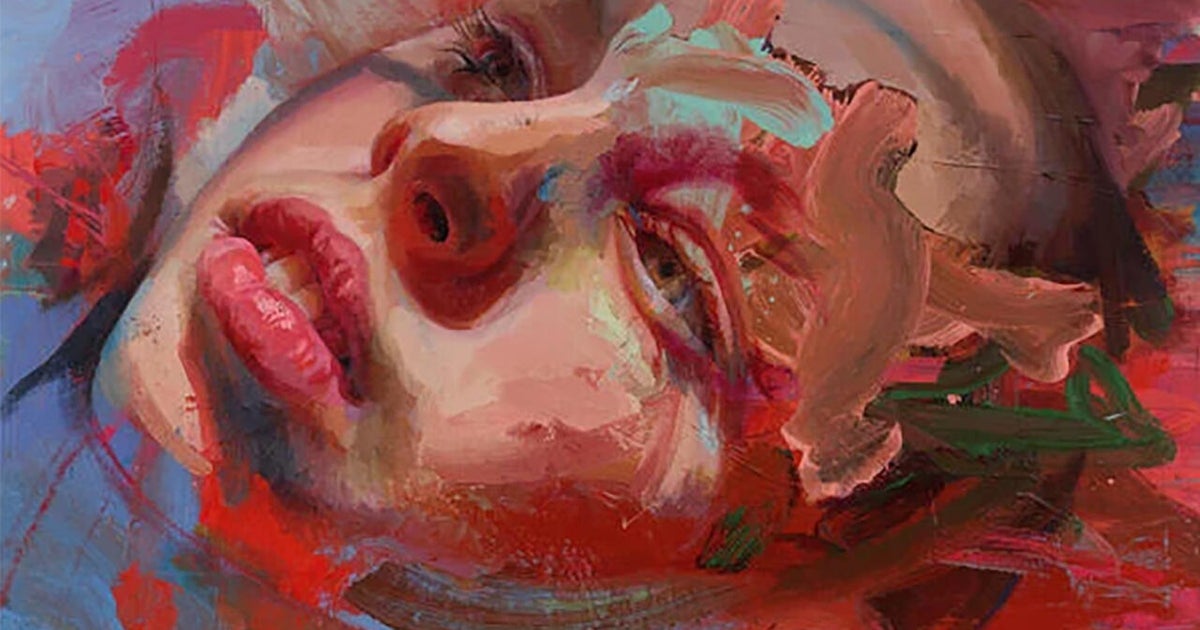
In the sun-drenched canals of Venice, a new exhibition showcasing the latest works of British artist Jenny Saville opened this weekend, drawing art enthusiasts to the Italian city's vibrant cultural scene. At 55, Saville stands as a towering figure in the modern art world, her paintings of the human body—particularly the female form—celebrated for their raw intensity and emotional depth. The show highlights her evolution over three decades, from bold self-portraits in the 1990s to luminous heads that capture the unspoken essence of humanity.
Saville's studio in Oxford, England, serves as the quiet epicenter of her creative process, where colossal heads with luminous, inscrutable faces line the walls. Speaking from this space, she explained her technique for infusing portraits with an inner glow: "I'll just rub the paint in and make it have a sort of inner light that's left here. It's a special thing that only paint can do actually." This method, she said, aims to "distil a sort of essence of what we are as human beings." For Saville, figurative painting is fundamentally about "some sort of communication of the unspoken."
Her breakthrough arrived in the early 1990s with the self-portrait Propped, a daring work that depicted her own body in a vulnerable, propped-up pose. The painting caught the attention of collector Charles Saatchi during her degree show at Glasgow School of Art. Saatchi not only acquired it but commissioned more pieces, propelling her career. Propped would later fetch more than $12 million at auction, underscoring Saville's rapid ascent.
Reflecting on that pivotal moment, Saville recalled the freedom Saatchi offered: "It's incredible opportunity for a 21-year-old. He just said, 'Make whatever you like.' And I stood in the space, I saw the back wall and thought, I'm gonna make a triptych. And I just got to work, really." The resulting work, Strategy (South Face/Front Face/North Face), was another audacious exploration of a woman's body, rendered in three panels that examined form from multiple angles.
Saville's fascination with the flesh dates back to her formative years, influenced by a pantheon of artists who similarly obsessed over the human figure. She cited Lucian Freud, Francis Bacon, Frank Auerbach, Pablo Picasso, Edgar Degas, Egon Schiele, Willem de Kooning, Titian, and Velázquez as key inspirations. "There's not a sort of start point," she said. "Freud, Bacon, Auerbach, Picasso, Degas, they were all artists that I liked. Egon Schiele, De Kooning – people that painted the body. Old master painters like Titian, Velasquez. They were painters that I just was drawn to looking at. You just develop along a certain way and build your language."
Her gaze on the body is both curious and clinical, often delving into the mechanics of flesh. In her first solo exhibition, the painting Branded—though she referenced works like Plan in discussions—featured a torso marked up as if for liposuction, drawing from medical texts on cosmetic surgery. "If you have a cosmetic surgery book or a plastic surgery book, it will show you how flesh is moved around the body in order to keep it alive for reconstruction of a breast, for example," Saville explained. "And I found that fascinating to extend my knowledge really of the body."
Yet Saville insists her approach does not objectify the body but rather positions it in harmony with nature. "I didn't see it as objectifying," she said. "I just saw it as the relationship with nature." This perspective has defined her oeuvre, treating the human form as a landscape to be mapped and explored.
A recent retrospective at the Modern Art Museum of Fort Worth in Texas showcased over three decades of her work, with a particular emphasis on her arresting portraits, most featuring female subjects. The exhibition, which ran through much of 2023, highlighted how Saville's focus on women emerged organically. "It was never a sort of conscious decision: 'Okay, I'm only gonna paint women.' I just did," she noted. "And that became a language. I did a lot of self-portraits."
Motherhood, a profound theme in her work, found expression in pieces like the 2011 painting The Mothers, which captures the wriggling abundance of pregnancy and new life. "The kind of wriggling, the sense of growth – it's a particular period in a woman's life that's just absolutely amazing and poignant and full of abundance," Saville described. "I wanted to communicate that." The painting, part of her broader exploration of female experience, resonated deeply with viewers, evoking the universal yet intimate aspects of creation.
The Venice exhibition, titled The Anatomy of Trust according to promotional materials, builds on these themes with her newest creations, including large-scale canvases that blend portraiture with abstracted forms. Opening on October 7, 2023, at the Gallerie dell'Accademia, it coincides with the city's Biennale buzz, positioning Saville alongside contemporary giants. Curators have praised the show for its timeliness, amid ongoing discussions about body positivity and representation in art.
Saville's commercial success is remarkable, with her paintings commanding millions—a rarity for living artists. Yet she remains grounded, viewing the studio as a sanctuary from market pressures. "I find a studio is the purest space for me, and I leave all of that at the door," she said. "So, when I come in here, I just don't think like that. You know, this painting isn't gonna get better because it's gonna be worth more money."
On the absurdity of art's high prices, Saville offered a balanced view. Laughing at the notion of spending millions on a painting herself, she remarked: "I've never thought about that! Of course it's absurd. A painting can be the price of a house that a family can live in, and when you look at it like that you think, this is absurd." However, she acknowledged the historical benefits: "And on the other flip side of that, if you look through the history of art, art tended to get very good in moments where there have been financial support of artists and art, whether that's the Renaissance, through the papacy or commissions. And we are living through one of those times where we value art financially and culturally. Whether you can take those two things apart, I just don't know."
Despite the glamour, Saville expresses profound gratitude for her path. "Oh my gosh. Absolutely!" she exclaimed when asked if she feels lucky. "You know, I've lived my life doing the activity that I loved when I was a kid. It's really who I am. I think you can ask any painter or sculptor or filmmaker or anybody creative, a dancer, a musician, it's a good way to live." Her words underscore a career built on passion rather than calculation.
As Saville's Venice show unfolds, it invites reflection on the body's enduring role in art. From her Oxford studio to international galleries, her work continues to challenge perceptions, blending the personal with the profound. With auctions still valuing her pieces in the multimillions and retrospectives solidifying her legacy, Saville's influence shows no signs of waning. Future exhibitions, potentially touring Europe and beyond, promise to expand her dialogue on humanity's unspoken depths.
The art world, ever evolving, benefits from voices like Saville's, who bridge classical techniques with contemporary concerns. Her journey—from a young artist in Saatchi's orbit to a Venice headliner—illustrates the power of persistent vision in a market-driven landscape.