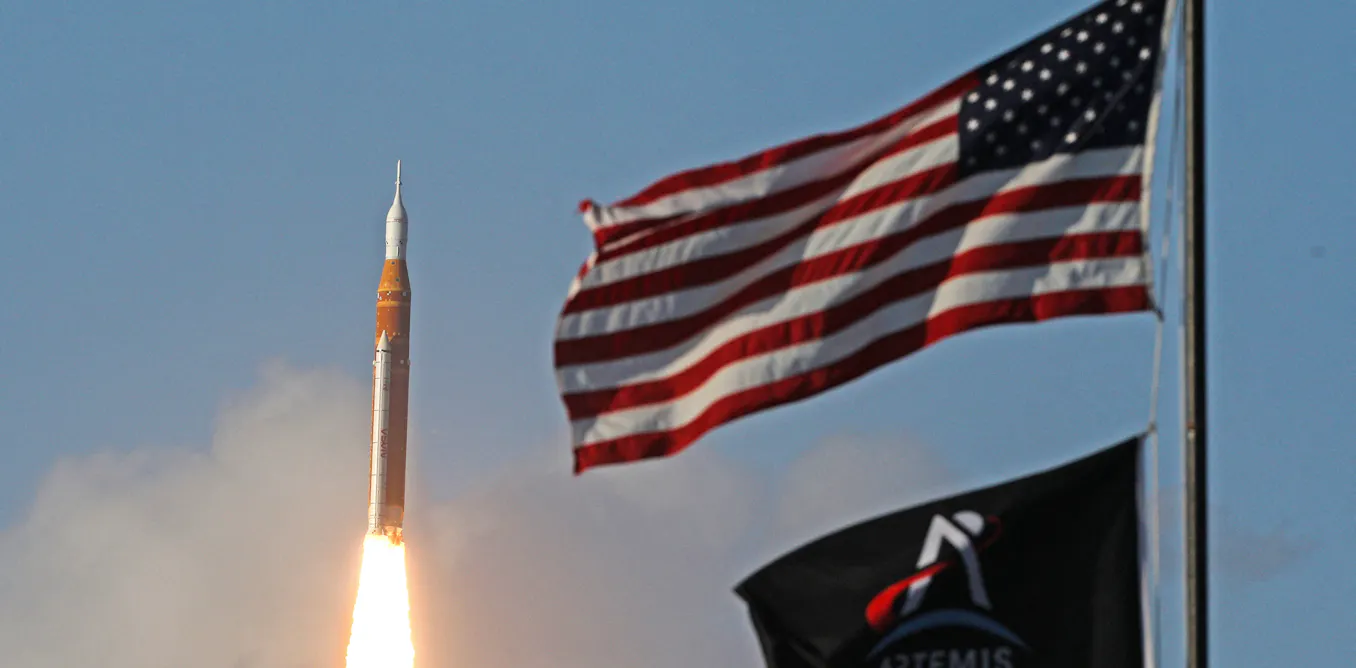
In a milestone that echoed the triumphs of the Apollo era, NASA's Artemis II mission successfully completed the first crewed lunar flyby in more than 50 years, sending four astronauts on a historic journey around the Moon and marking the farthest humans have traveled from Earth since 1972. Launched from Kennedy Space Center in Florida on September 15, 2024, the mission lasted 10 days and returned the crew safely to Earth on September 25, splashing down in the Pacific Ocean off the coast of San Diego. The crew, consisting of NASA astronauts Reid Wiseman, Victor Glover, Christina Koch, and Canadian Space Agency astronaut Jeremy Hansen, orbited the Moon at a distance of about 80 miles, conducting scientific experiments and testing systems for future lunar landings.
The mission achieved several symbolic firsts, including the first woman, Christina Koch, and the first person of color, Victor Glover, to orbit the Moon. Glover, reflecting on the significance during a post-mission press conference at NASA's Johnson Space Center in Houston, said, “people need to be able to see themselves in the things that they dream about.” The achievement was celebrated worldwide, with President Donald Trump hailing it as a "triumph of American ingenuity" in a statement from the White House Rose Garden on September 26, emphasizing its role in restoring U.S. dominance in space exploration.
Behind the jubilation, however, lies a broader U.S. space agenda that extends far beyond this single mission. Artemis II is a key step in NASA's Artemis program, which aims to establish a permanent human presence on the Moon by 2030, including the construction of a lunar Gateway space station and eventual bases at the lunar south pole. According to NASA officials, the program involves partnerships with private companies like SpaceX and Blue Origin, with an estimated cost exceeding $93 billion through 2025. Trump, who has championed the initiative since his first term, described it during a rally in Florida on October 1 as asserting “American space superiority” and establishing a “sustained American presence” on the Moon to develop a lunar economy.
This vision positions the U.S. in what many describe as a new space race, primarily with China. NASA Administrator Jared Isaacman, appointed earlier this year, referred to China as the U.S.'s “geopolitical adversary” in space during testimony before the Senate Commerce Committee on October 5. China's ambitions include its own lunar research station, the International Lunar Research Station, planned for completion by 2030 in collaboration with Russia and other partners. At the heart of this competition are the Moon's finite resources, particularly at the south pole, where deposits of water ice could support human life, produce oxygen, and serve as rocket fuel for deeper space missions, including to Mars.
More ambitious proposals involve mining helium-3 from the lunar surface for potential fusion energy on Earth and extracting resources from nearby asteroids to bring back for commercial use. Experts at the European Space Agency's headquarters in Paris noted on October 10 that these resources could be worth trillions of dollars, but accessing them raises questions about ownership and sustainability. The U.S. envisions a lunar economy driven by private enterprise, with companies like ispace and AstroForge already securing NASA contracts for prospecting missions scheduled for 2026.
To govern these activities, the U.S. has promoted the Artemis Accords, a set of non-binding principles signed by 61 countries as of October 2024. Grounded in the 1967 Outer Space Treaty, the accords provide a framework for resource extraction, safety zones around lunar sites, and data sharing among signatories. Proponents, including U.S. State Department officials, describe them as a “blueprint” for cooperative space exploration, more transparent than China's initiatives. However, critics, such as those from the United Nations Office for Outer Space Affairs in Vienna, argue that the accords sideline multilateral consensus by favoring U.S.-led partnerships, potentially excluding non-signatory nations like Russia and China.
Signatory numbers have grown steadily, but the pace has slowed since Trump's return to office in January 2024. According to State Department records, 19 countries joined in the year leading up to the election, compared to only nine new signatories— including Uruguay, Slovakia, and Ecuador—in the nine months since. Observers at the International Astronautical Congress in Milan last week suggested that geopolitical tensions may be deterring further commitments, though U.S. diplomats expressed optimism for additional joiners by year's end.
While the focus on U.S.-China rivalry often dominates discussions of American space leadership, some experts urge a wider lens that includes scrutiny of U.S. actions on Earth. As Artemis II captivated global audiences in late September, escalating conflicts drew parallels between terrestrial and extraterrestrial ambitions. The U.S.-Israel military campaign against Iran intensified around the same time, with strikes reported in Tehran and surrounding areas. In an October 2 post on Truth Social, Trump wrote in expletive-filled language, hinting at a nuclear threat by stating that “a whole civilization will die tonight” unless Tehran reopened the Strait of Hormuz, a vital oil shipping route.
Further reports from the Iranian state media claimed that a U.S.-backed strike hit a school in Isfahan on October 4, allegedly killing more than 150 people, including children. U.S. officials denied targeting civilians but acknowledged the incident, promising an investigation. This occurred against the backdrop of the ongoing crisis in Gaza, where civilian casualties have exceeded 40,000 since October 2023, according to United Nations estimates. Trump's administration has established a “Board of Peace” to mediate, which critics from the Palestinian Authority in Ramallah have called an “alternative UN” that bypasses established international bodies.
Trump's foreign policy rhetoric has also revived discussions of territorial expansion. In speeches throughout September, he reiterated interest in acquiring Greenland, stating simply, “We need it,” citing its strategic minerals and Arctic position. He floated the idea of annexing Canada as the 51st state during a campaign event in Michigan on September 20, and spoke of the “honour of taking Cuba” in a Fox News interview on September 28. Regarding Venezuela, he declared on October 3 that he would “run” the country to secure its oil reserves. These statements have sparked concerns among international lawyers at The Hague, who warn of violations to sovereignty norms.
Even U.S. allies have voiced unease. During the recent escalation with Iran, Trump criticized NATO partners for not joining the effort, prompting responses from European leaders. Canadian Prime Minister Mark Carney, speaking at the World Economic Forum in Davos, Switzerland, on January 15, 2024, described the global “rules-based order” as “partially false,” noting that “international law applied with varying rigour depending on the identity of the accused or the victim.” Carney's comments, though not directly about space, have been cited by scholars as relevant to questions of U.S. reliability in cosmic governance.
Legal experts from the Global South, including law professor Antony Anghie of the University of Utah, have long argued that the U.S. applies international law selectively to advance its interests. In a recent paper published by the Third World Approaches to International Law Review, Anghie pointed to historical patterns, intensified under Trump, where withdrawals from agreements like the Paris Climate Accord and the Iran nuclear deal set precedents. International organizations, including the International Court of Justice, have raised alarms over these trends, with a September 2024 advisory opinion questioning U.S. compliance in resource disputes.
These earthly dynamics cast shadows on the U.S.-led future in space. As lunar resources shift from hypothetical to tangible stakes, questions persist about whether the U.S. will adhere to frameworks like the Artemis Accords or the Outer Space Treaty when national interests conflict. Trump has justified exiting numerous international instruments, including threats to withdraw from NATO, as noted in his October 7 address to Congress. Scholars at the Max Planck Institute in Heidelberg, Germany, suggest that such patterns could undermine trust in U.S. space leadership, potentially fracturing alliances.
Despite the concerns, NASA and its partners remain focused on the next phases. Artemis III, slated for a 2026 landing with the first woman and person of color on the lunar surface, is in preparation at facilities across the U.S. International observers, from the Indian Space Research Organisation in Bengaluru to the Brazilian Space Agency in São José dos Campos, emphasize the need for inclusive governance to avoid a divided lunar landscape. As the world celebrates Artemis II's feats, the challenge lies in ensuring that space exploration benefits humanity as a whole, not just the ambitions of one nation.
The coming years will test these principles, with China's lunar missions accelerating and private ventures multiplying. Whether U.S. leadership fosters cooperation or competition remains an open question, one that diplomats and scientists alike are watching closely from Washington to Beijing.