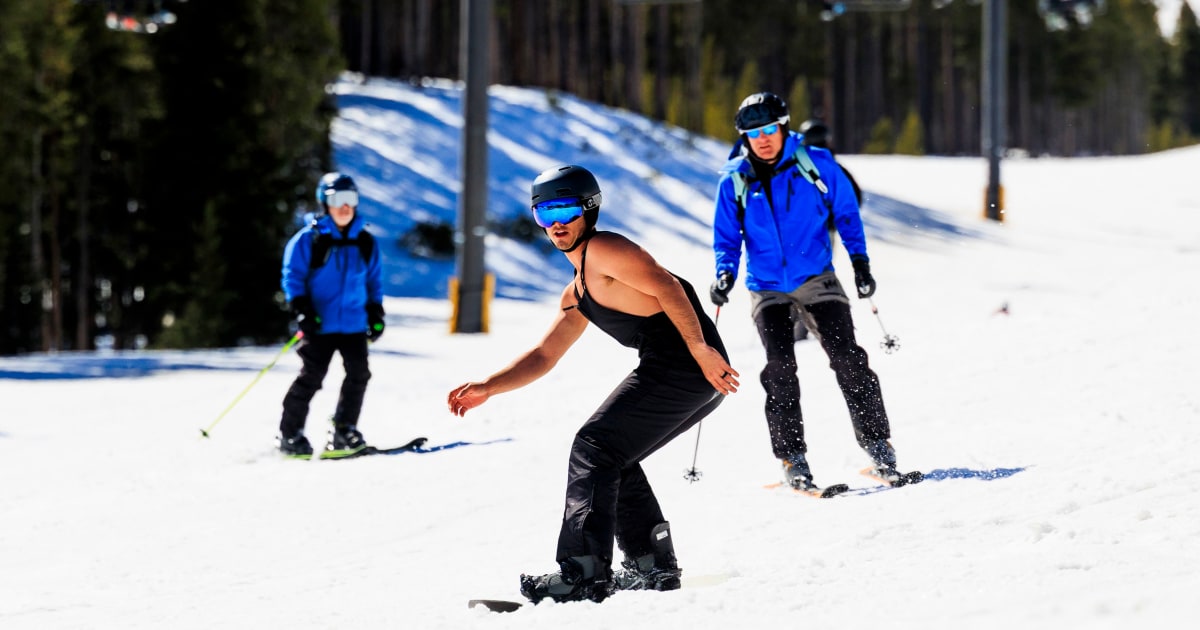
The relentless heat wave that gripped the Western United States for more than a week has finally dissipated, leaving behind a trail of over 1,500 shattered temperature records across 11 states, according to Climate Central, a nonprofit research organization focused on climate science.
This scorching spring event, often described as a heat dome, baked regions from California to the Rocky Mountains, with temperatures soaring 20 to 30 degrees Fahrenheit above average in some areas during its early days in March. As the high-pressure system that trapped the heat moves eastward, scientists, water managers, and local officials are assessing the damage and pondering the extraordinary nature of the phenomenon. Even prior to the heat's arrival, many Western states were grappling with some of the lowest snowpack levels in recorded history, and now, in numerous locations, virtually no snow remains to replenish rivers and reservoirs as summer approaches.
Jennifer Brady, a senior data analyst at Climate Central, described the heat wave as an outlier even amid the escalating extremes driven by climate change. "The heat wave’s widespread footprint and duration made it an outlier ‘even with what we’re experiencing now with climate change and what a lot of people refer to as our new normal, or our new baseline,’" Brady said in an interview. Her organization developed the Climate Shift Index, a tool that measures how much climate change has influenced daily temperatures on a scale from 1 to 5. During this event, about 29% of the U.S. saw maximum temperatures rated as a 5, indicating they were at least five times more likely due to human-caused warming—a record high based on data stretching back to 1970.
This is unprecedented and can be very dangerous,” Brady said.
The implications extend beyond immediate discomfort. With snowpack already depleted, irrigation managers in agricultural heartlands like California's Central Valley and Colorado's Front Range are warning of a potential water crisis this summer. Officials in states such as Nevada and Utah have reported reservoir levels hovering near historic lows, exacerbated by the heat's rapid evaporation of what little moisture was left in soils and streams. In Las Vegas, for instance, Lake Mead's water levels have dropped to about 1,075 feet above sea level, the lowest since the 1930s, according to the U.S. Bureau of Reclamation, though the heat wave accelerated the strain on the system.
Climate scientists emphasize that global warming is a key amplifier of such events. The World Weather Attribution group, an international consortium of researchers, analyzed the early March phase of the heat wave and concluded it was "virtually impossible" without the influence of climate change. In a report released on March 20, the group quantified that heat waves in the West have grown more intense by more than 7 degrees Fahrenheit due to rising greenhouse gas emissions, making this particular event 800 times more likely in today's warmer world than it would have been in the pre-industrial era.
Karen McKinnon, an associate professor in the department of atmospheric and oceanic sciences at the University of California, Los Angeles, explained the uneven warming patterns at play. While the global average temperature last year was about 1.47 degrees Celsius—or 2.65 degrees Fahrenheit—higher than the 1850-1900 baseline, land areas like the Western U.S. are heating up faster than oceans. "Depending on where you are… we can already be getting to, you know, 4 or 5 degrees Fahrenheit warming," McKinnon said. This regional disparity means that places like Phoenix and Denver are experiencing shifts that feel far more dramatic than the global average suggests.
Yet, the sheer length and breadth of this heat dome have prompted deeper questions among researchers. Heat domes form when a persistent high-pressure ridge creates clear skies and sinking air, effectively trapping heat beneath it like a lid on a pot. This one lingered for over eight days in some spots, far longer than typical spring events, affecting everything from urban heat islands in Los Angeles to remote ranchlands in Montana.
Some experts are exploring whether climate change is altering atmospheric circulation in ways that prolong these patterns. The polar jet stream, a high-altitude river of air that steers weather across the Northern Hemisphere, may be playing a role. Traditionally, it acts as a boundary between frigid Arctic air and milder southern flows, but theories suggest warming is making it more "wavy," dipping southward to pull in heat or bulging northward to stall systems in place.
McKinnon noted that while progress is being made, definitive answers remain elusive. "Climate scientists are making progress on investigations into these questions but don’t yet have satisfying answers," she said. "Many scientists have competing theories, she added, and it could take several years to settle on a consensus." One prominent hypothesis posits that melting Arctic sea ice is weakening the temperature gradient between the poles and equator, leading to a meandering jet stream. However, other studies argue that natural variability, like the Pacific Decadal Oscillation, could be contributing without direct ties to emissions.
That’s basically the million-dollar question,” McKinnon said. “Are these circulation patterns made more likely due to climate change?”
Local impacts underscore the urgency. In Oregon, where wildfires have already sparked in the unusually dry conditions, state emergency officials reported over 200 heat-related illnesses during the wave's peak. Farmers in Idaho's Snake River Plain, reliant on irrigation from snowmelt-fed rivers, are bracing for reduced yields in crops like potatoes and wheat. "We've seen evaporation rates double in just the last week," said one irrigation district manager in Boise, who spoke on condition of anonymity due to ongoing negotiations with water rights holders.
Broader context reveals this isn't an isolated incident. The Western U.S. has endured a megadrought since 2000, the worst in 1,200 years according to tree-ring data analyzed by UCLA researchers. Previous heat domes, like the one in 2021 that killed hundreds in the Pacific Northwest, set precedents for how these events compound water scarcity and health risks. Climate Central's analysis shows that days exceeding 100 degrees Fahrenheit in the Southwest have tripled since the 1970s.
As scientists delve into the atmospheric puzzles, practical responses are ramping up. The National Weather Service has expanded its heat alert system, incorporating the Climate Shift Index for more precise warnings. In California, Governor Gavin Newsom's administration announced $500 million in emergency drought funding on March 25, aimed at bolstering reservoirs and promoting water conservation. Federal agencies, including the EPA, are urging urban planners to invest in green infrastructure to mitigate future domes.
Looking ahead, the end of this heat wave offers only temporary relief. With El Niño conditions fading and forecasts pointing to another hot summer, experts warn that without aggressive emissions reductions, such extremes could become the norm. The ongoing research into jet stream dynamics and heat dome persistence will be crucial, potentially reshaping how we predict and prepare for a warming world. For now, Western communities are left to recover, their landscapes parched and their resolve tested by an unforgiving climate.