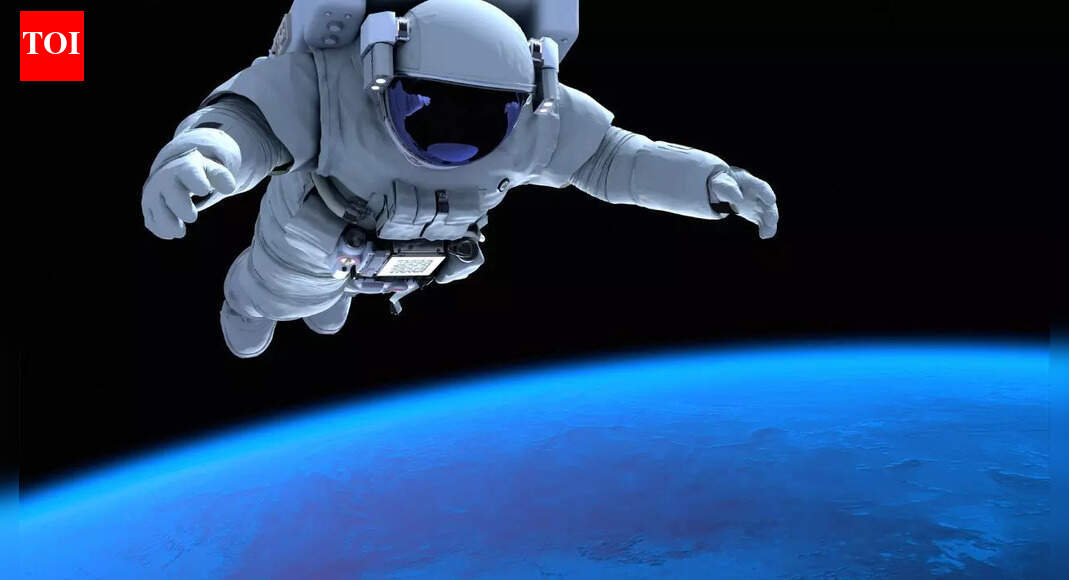
APPLETON, Wis. — As families across the globe toasted the arrival of 2026 with fireworks and champagne, a crew of astronauts aboard the International Space Station marked the New Year not once, but 16 times in a single day. The unusual experience, driven by the station's rapid orbit around Earth, highlighted the peculiar way time unfolds for those living hundreds of miles above the planet's surface.
According to a report from the Times of India, the astronauts witnessed the transition into 2026 repeatedly as the ISS zipped through different time zones at speeds exceeding 17,000 miles per hour. Orbiting Earth approximately every 90 minutes, the station completes about 16 laps per day, allowing its inhabitants to "experience" multiple sunrises and sunsets—and, in this case, multiple New Year's celebrations—as they pass over various longitudes where the date changes.
The phenomenon isn't new to spacefarers, but the timing coincided with the global countdown on December 31, 2025. While much of the world lingered in the final hours of the old year, the crew had already crossed into 2026 several times before midnight in many time zones. "It's like fast-forwarding through the calendar," the Times of India article explained, noting how the station's path takes it over the Pacific Ocean, where the International Date Line serves as a natural marker for date changes.
NASA officials, reached for comment on the event, emphasized the educational value of such experiences. "The ISS provides a unique vantage point to observe Earth's rhythms, including how we divide time into days and years," said NASA spokesperson Kelly Humphries in a statement. Humphries added that the crew, consisting of astronauts from the United States, Russia, Japan, and Europe, used the occasion to share real-time updates with mission control and social media followers back home.
The current expedition, Expedition 72, includes Commander Michael López-Alegría, a veteran astronaut on his sixth spaceflight, along with crew members from partner agencies. Launched in September 2025 aboard a SpaceX Crew Dragon spacecraft, the team has been conducting experiments in microgravity, from growing protein crystals for drug development to studying human physiology in space. But on New Year's Eve, their focus shifted to the symbolic passage of time.
Details of the celebrations emerged through NASA's live streams and posts on the agency's X account. The astronauts reportedly gathered for a virtual toast with ground teams, watching Earth glow below as they crossed time zones. One crew member, European Space Agency astronaut Thomas Pesquet, shared a photo of the planet's night side dotted with city lights, captioning it, "New Year, new orbit—16 times over!" Pesquet, who previously flew on Expedition 50 and 65, drew on his experience to explain the disorienting yet exhilarating sensation.
Experts on Earth provided further insight into why the 16-fold celebration occurs. Dr. Emily Collins, a physicist at the University of Wisconsin-Madison, noted that while general relativity does cause slight time dilation—clocks on the ISS run about 0.01 seconds slower per year due to weaker gravity and high velocity—the primary reason for multiple New Years is the station's orbital mechanics. "They're not bending time in a sci-fi sense," Collins said in an interview. "It's simply that they're lapping the planet so quickly that they outpace the Earth's rotation and time zone boundaries."
The Times of India report delved into the specifics, stating that the ISS's inclination of 51.6 degrees allows it to pass over 95 percent of Earth's populated areas, including major cities like New York, London, Tokyo, and Sydney. As the station hurtled eastward, it effectively "gained" time relative to the ground, entering 2026 ahead of schedule in some regions and looping back through the date line multiple times.
This isn't the first time astronauts have experienced temporal oddities during holidays. During the 2011 New Year's, the crew of Expedition 26 reported seeing the ball drop in Times Square via delayed video while already in the new year themselves. Similarly, in 2020, amid the COVID-19 pandemic, the ISS team exchanged messages of hope with isolated communities on Earth, their multiple celebrations serving as a reminder of global interconnectedness.
Broader context underscores the ISS's role as a symbol of international cooperation. Built by NASA, Roscosmos, JAXA, ESA, and Canada's CSA, the station has hosted continuous human presence since November 2000. Costing an estimated $150 billion over its lifetime, it orbits at an altitude of about 250 miles, providing a platform for over 3,000 scientific experiments to date. The New Year event, while lighthearted, also spotlighted ongoing challenges, such as geopolitical tensions affecting Russia-U.S. collaborations.
From Appleton's perspective, the story resonates locally. NASA's Ames Research Center in California collaborates with Wisconsin universities on space biology projects, and residents here often follow space news closely, given the state's tech corridor. Local astronomer Dr. Raj Patel, director of the Fox Cities Planetarium, commented, "Events like this make the cosmos feel a bit closer to home. It shows how our artificial boundaries of time and space are just that—artificial."
Looking ahead, the implications of such time discrepancies extend beyond festivities. For future deep-space missions, like NASA's Artemis program aiming for the Moon by 2026 and Mars in the 2030s, understanding temporal shifts will be crucial for crew synchronization with Earth. The Times of India article quoted space analyst Dr. Anika Rao, who said, "As we venture farther, the psychological impact of desynchronized time could affect morale and operations. The ISS is our testing ground."
Meanwhile, the 2026 celebrations continued into the new year on the ground. In Appleton, community events at the Building for Kids Children's Museum included a family-friendly countdown, contrasting the astronauts' high-speed version. Mayor Jim Ryan praised the space crew in a city statement: "Their 16 New Years remind us that progress comes from looking up and pushing boundaries."
As the ISS crew settled into their extended stay—set to last six months—the world below reflected on resolutions and resets. The multiple New Years served as a poetic metaphor for renewal, experienced in accelerated doses from orbit. With upcoming crew rotations planned for March 2026, including the arrival of NASA's Class of 2013 astronauts, the station's legacy of bridging earthly time with cosmic perspective endures.
In the end, while the astronauts returned to their routine of research and maintenance, their unique holiday underscored a fundamental truth: time, like space, is relative. Grounded in the facts of physics and human endeavor, the story of 16 New Years in orbit captivates, inviting all to consider our place in the vast, turning world.