DALLAS — At the Conservative Political Action Conference this week, Republicans rallied behind President Donald Trump's military campaign in Iran, but fissures emerged over the conflict's potential scope and duration, reflecting broader anxieties in an election year.
The annual gathering, held in the Dallas area, drew thousands of conservatives amid a tightening midterm cycle where control of Congress hangs in the balance. A CBS News poll released last weekend showed strong GOP backing for U.S. action, with 84 percent of Republicans approving military strikes against Iran. That support dipped to 70 percent among non-MAGA Republicans, while 69 percent of independents opposed the intervention, highlighting a partisan divide that could sway voters concerned about rising energy prices and the war's economic ripple effects.
Speakers and attendees navigated a delicate balance, praising Trump's decisiveness while voicing qualms about escalation. Deborah Thorne, a longtime Trump ally, told CBS News she backs the administration's efforts but stops short of endorsing a prolonged engagement. "I think Trump's right," she said. "I think the Iranian people need to be in charge of their country. I don't think Americans need to go in there and do what they've done in other wars, but I do believe Trump is right as far as we have to finish what we've started with them."
Concerns about ground troops loomed large, especially after Secretary of State Marco Rubio stated Friday that such forces wouldn't be needed to meet U.S. objectives. Yet President Trump has not ruled out the option, and Pentagon officials have prepared detailed plans for possible deployments, according to previous CBS News reporting. Janie Dean, a traveling nurse from central Texas, captured the unease among some attendees. "I don't want our boys and girls going to fight in Iran," she said. "It's going to be another Vietnam. We need to stomp them out once and for all so that that's not an issue with them. And then we need to get out." Despite her worries, Dean affirmed her continued support for Trump, citing trust in his "judgment and discernment."
Former Republican Representative Matt Gaetz of Florida echoed calls for caution during his Thursday remarks at CPAC. While backing the president, Gaetz advocated for diplomacy and warned against a full-scale invasion. "A ground invasion of Iran will make our country poorer and less safe," he said. "It will mean higher gas prices, higher food prices, and I'm not sure we would end up killing more terrorists than we would create."
The conference also featured prominent voices from the Iranian-American community, many of whom fled the country after the 1979 Islamic Revolution and now urge sustained U.S. pressure to dismantle the clerical regime. Shahin Nezhad, a petroleum engineer from Houston who left Iran in 1997, argued that external support is essential for change. "It's a very, very brutal theocratic dictatorship which has been ruling Iran with iron fists for the past 47 years," Nezhad told CBS News. "It's very obvious you cannot just get rid of these people just by civil disobedience. As a nation, what you need is big support from outside."
Nezhad and others attended sessions featuring Reza Pahlavi, the exiled son of Iran's last shah, who ruled until the revolution ousted the monarchy. Pahlavi's appearance underscored hopes among some exiles that U.S. action could pave the way for his leadership or a similar restoration. Nassar Meyman of Dallas expressed optimism but concern over Trump's mixed signals. "I hope Trump will be really serious about getting rid of the regime in Iran and we have a new start with the leadership of Crown Prince Pahlavi," Meyman said. He added worry about Trump's mentions of negotiating with "somebody from within" the regime, saying it "makes us rather worried."
Many Iranian-Americans at CPAC viewed limited ground operations as unavoidable to achieve regime change or neutralize threats like Iran's missile stockpiles. Nezhad suggested that even if U.S. strikes degrade the military, the regime's internal security apparatus could endure without boots on the ground. "So, I think boots on the ground, on a limited basis and for a particular purpose, is probably inevitable. It has to be done," he said.
The war's origins trace back to last month's U.S. strikes on Iran's nuclear facilities, which Trump described as a "short-term excursion" aimed at weakening the country's capabilities. Hours after the initial attacks, the president called on Iranians to rise against their government. Yet his rhetoric has varied: at times suggesting U.S. influence over Iran's future leadership, including openness to a moderate from within, while downplaying Pahlavi's viability despite acknowledging that "some people like him." Trump has emphasized that "it would seem to me that somebody from within maybe would be more appropriate."
Such ambiguity has fueled debates within the GOP, where skepticism of foreign wars has been a hallmark of Trump's brand since his 2016 campaign. Back then, he frequently criticized the Iraq War and distanced himself from party hawks. This week's CPAC discussions revived those tensions, with a handful of prominent conservatives questioning the strategy.
Republican Representative Nancy Mace of South Carolina voiced doubts this week, noting she hasn't "seen an exit strategy yet" and harbors "grave concerns" about the conflict morphing into "another 20-year-plus endless war." Earlier this month, Joe Kent, director of the National Counterterrorism Center, resigned in protest, asserting that Iran "posed no imminent threat." The White House sharply rebutted Kent's assessment, defending the strikes as necessary.
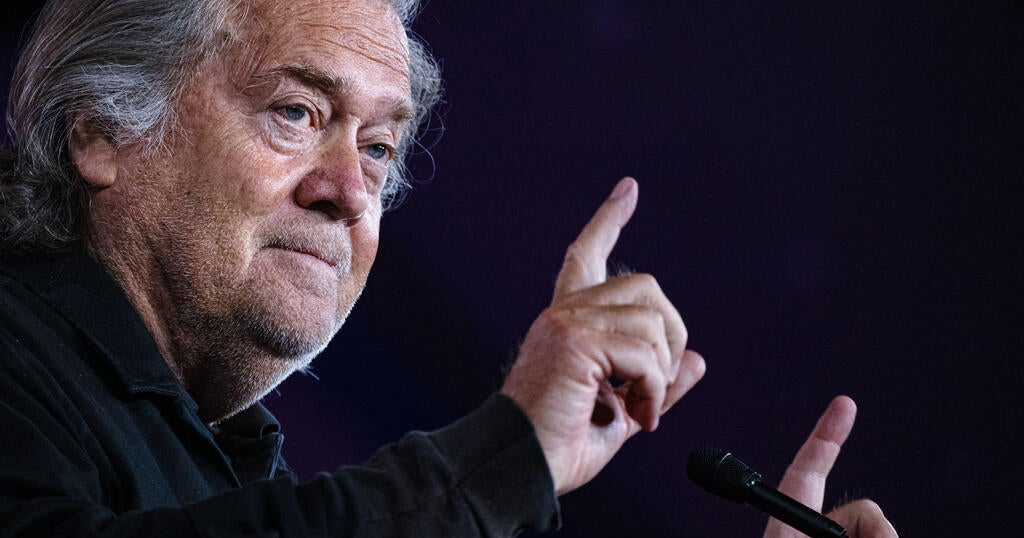
Steve Bannon, the architect of Trump's 2016 campaign and a former White House strategist, addressed the Iran dilemma during his Friday speech at CPAC. A staunch advocate of "America First" policies that prioritize economic nationalism over overseas entanglements, Bannon has long cautioned against escalations in the Middle East. He first raised alarms about the risk of wider war before last year's initial strikes on Iranian nuclear sites.
In his remarks, Bannon deferred to Trump's judgment but called for open debate to build consensus. "You have to be convinced that this is the right thing to do, particularly now that we're on the eve of potentially the insertion of American combat troops," he said. "Your sons, daughters, granddaughters, grandsons could be on Kharg Island or be holding a beachhead down by the Strait of Hormuz." Bannon stressed that supporters must have "full information" to back the president fully, adding, "people have to have his back."
Bannon's comments highlighted the ideological currents at play: a core of interventionist Iranian exiles and hawkish Republicans pushing for decisive action, countered by isolationist voices wary of quagmires. This divide mirrors broader Republican evolution under Trump, where anti-interventionism has gained traction but clashes with calls to confront threats like Iran's nuclear ambitions and regional influence.
As the midterms approach, the war's domestic fallout — from gasoline prices spiking amid disruptions in the Strait of Hormuz to potential drafts — could test GOP unity. Polls indicate independents' opposition might erode Democratic gains if the conflict drags on, but enthusiasm among the base remains high. Trump's approval on foreign policy, per the CBS survey, holds steady at 78 percent among Republicans, buoyed by perceptions of strength against adversaries.
Looking ahead, the administration faces pressure to clarify its endgame. Rubio's assurance against ground troops offers reassurance, but Pentagon preparations suggest contingencies. Iranian officials have vowed retaliation, and analysts warn of proxy attacks via groups like Hezbollah. For now, CPAC attendees like Thorne and Dean embody the party's tightrope: loyalty to Trump tempered by fears of overreach.
The conference wrapped up Saturday with no major policy shifts announced, but the Iran debate is far from over. As Congress reconvenes, lawmakers like Gaetz and Mace may push for oversight, while Iranian-American advocates lobby for bolder steps. In an election season defined by pocketbook issues, the war's trajectory could redefine the political landscape.