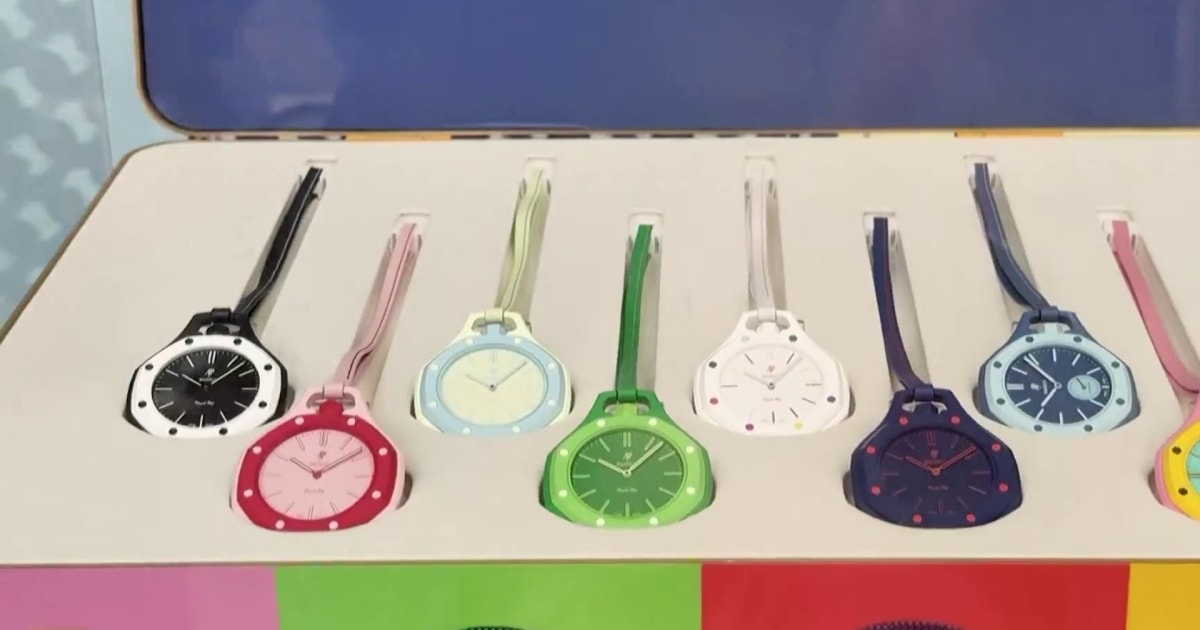
In a surprising twist for the world of high-end timepieces, Swiss luxury brand Audemars Piguet has teamed up with affordable watchmaker Swatch to release a limited-edition pocket watch dubbed the Royal Pop. Priced at just $400, the collaboration has sparked an unprecedented frenzy among watch enthusiasts, with fans lining up on streets days in advance to snag one. According to reports from NBC News, this release stands out from typical luxury watch launches, where exclusivity often keeps prices in the tens of thousands, drawing crowds more reminiscent of sneaker drops than traditional horology events.
The Royal Pop pocket watch draws inspiration from Audemars Piguet's iconic Royal Oak collection, reimagined in Swatch's playful, accessible style. Unlike the solid gold or steel models that define Audemars Piguet's heritage—craftsmen have been perfecting complications in their Le Brassus workshops since 1875—this collaboration strips down the opulence to a fun, pop-art aesthetic. Swatch, founded in 1983 as a response to the quartz crisis that nearly bankrupted the Swiss watch industry, has long specialized in colorful, durable timepieces under $100. Bringing these two worlds together marks a bold move to make luxury design attainable, according to industry observers.
Reports indicate that the launch event, held at select Swatch stores across major cities like New York, London, and Zurich, saw queues forming as early as 48 hours before opening. In Zurich, near Swatch Group's headquarters, one witness described the scene as chaotic yet electric. "I've never seen anything like this for a watch under $500," said local collector Maria Gonzalez, who waited overnight in line. The frenzy echoes the 2022 MoonSwatch collaboration between the same partners, which sold out instantly and resold for thousands on secondary markets, but the Royal Pop's pocket watch format adds a nostalgic twist, harking back to Victorian-era fob watches.
Audemars Piguet, known for its avant-garde designs under the guidance of CEO François-Henri Pinault, has historically catered to an elite clientele, with pieces like the Royal Oak Offshore fetching over $50,000 at auction. Yet, this partnership with Swatch—part of the Swatch Group that also owns Omega and Longines—signals a strategic pivot toward broader appeal. Swatch CEO Nick Hayek Jr. has emphasized innovation in past interviews, stating that collaborations like this "bridge the gap between aspiration and reality." The Royal Pop features a vibrant dial with pop-art motifs, a quartz movement for reliability, and a chain that nods to classic pocket watch elegance, all encased in lightweight plastic for everyday wear.
While the exact release date was set for late October 2023, pre-launch buzz built through social media teasers from both brands. Instagram posts showing the watch's bold colors—neon pinks, electric blues, and metallic golds—garnered millions of views, fueling speculation about limited quantities. Swatch confirmed production would be capped at 10,000 units worldwide, a figure that pales in comparison to their standard lines but ensures scarcity. Retailers reported website crashes on announcement day, with virtual queues numbering in the tens of thousands.
From a historical perspective, Swatch's collaborations with luxury houses aren't new; the MoonSwatch, inspired by Omega's Speedmaster, blended NASA heritage with Swatch's affordability, selling for $260 and becoming a cultural phenomenon. That drop saw similar lines, with fans camping out in Paris and Tokyo. The Royal Pop builds on this success, but its pocket watch design introduces a fresh element. Experts note that pocket watches have seen a resurgence in recent years, popularized by brands like Vacheron Constantin, though at prices exceeding $20,000. By offering a luxury-inspired version at $400, Swatch and Audemars Piguet are tapping into a niche market of young collectors seeking vintage vibes without the vintage price tag.
Not all reactions have been uniformly positive. Some purists in the watch community, active on forums like Watchuseek, argue that diluting Audemars Piguet's prestige with mass-market elements undermines the brand's craftsmanship. "This is Swatch's game, not AP's," one anonymous poster commented, reflecting a divide between traditionalists and those embracing democratization. Conversely, analysts from Bloomberg Intelligence predict the collaboration could boost Swatch Group's sales by 15% in the holiday quarter, citing the halo effect on higher-end lines. Audemars Piguet officials have remained tight-lipped, but a spokesperson told Reuters that the project aligns with their commitment to "innovative storytelling through design."
The economic context adds layers to the story. The global watch market, valued at $50 billion in 2023 according to Statista, has rebounded post-pandemic, with luxury segments growing 20% annually. However, inflation and economic uncertainty have made ultra-premium items less accessible, prompting brands to explore entry-level products. Swatch, with its roots in revitalizing Swiss manufacturing during the 1980s, positions itself as the people's choice, selling over 30 million units yearly. This partnership reportedly took 18 months to develop, involving joint design sessions in Biel/Bienne, Switzerland, where Swatch is based.
On the ground, the launch's impact was immediate. In Los Angeles, a Swatch boutique on Rodeo Drive hosted a pop-up event, where attendees included celebrities and influencers snapping photos of the Royal Pop's display cases. One buyer, tech entrepreneur Alex Rivera, shared his excitement: "At $400, it's an investment in style, not just a watch." Security was heightened due to the crowds, with some stores limiting purchases to one per customer to curb resellers. Online, eBay listings for unopened units quickly climbed to $800, underscoring the hype machine at work.
Broader implications for the industry are significant. Collaborations like this challenge the gatekeeping of luxury, much like how streetwear brands like Supreme disrupted fashion. Watch analysts from Morgan Stanley suggest that such moves could erode barriers, encouraging more heritage brands to partner with accessible labels. Yet, questions linger about sustainability; Swatch's plastic components, while eco-friendly in production, contrast with Audemars Piguet's emphasis on ethical sourcing of materials like rose gold. Environmental groups have praised Swatch's recyclable designs but called for more transparency in joint ventures.
Looking ahead, both companies hint at future projects. Swatch's Hayek has teased expansions into smartwatch integrations, while Audemars Piguet focuses on its Code 11.59 line for innovation. For fans who missed out, secondary markets and potential restocks offer hope, though officials warn of counterfeit risks. As the dust settles on this frenzy, the Royal Pop stands as a testament to how a simple timepiece can unite worlds, blending high art with everyday joy.
In the end, the collaboration not only sold watches but sparked conversations about accessibility in luxury. With lines forming worldwide and social media ablaze, it's clear that at $400, the Royal Pop has redefined what it means to own a piece of horological history. Whether this marks the start of more such pairings remains to be seen, but for now, it's captured the imagination of a new generation of collectors.