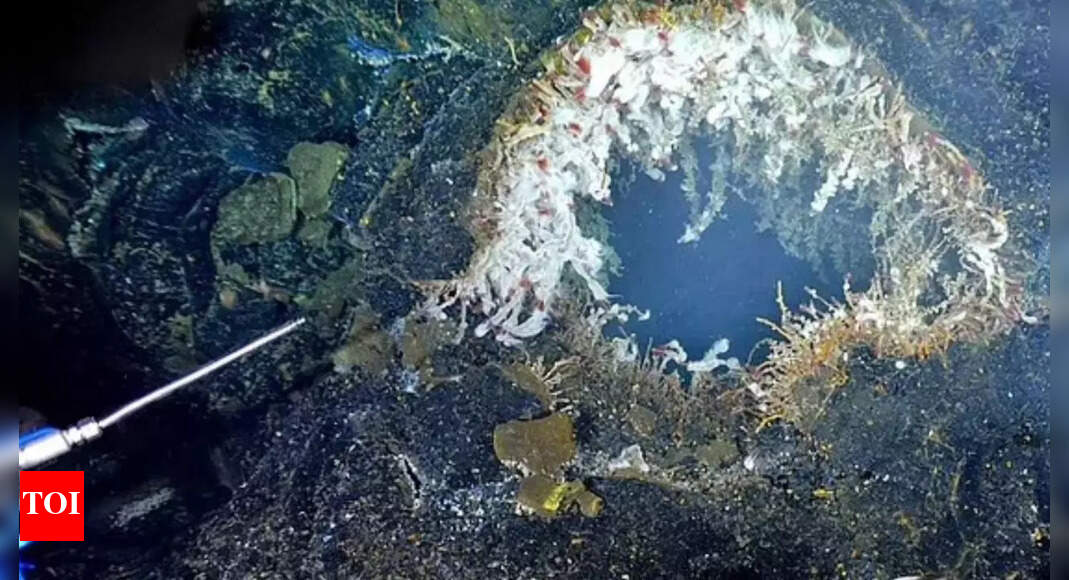
PORTLAND, Ore. — Scientists monitoring one of the Pacific Ocean's most restless underwater volcanoes have issued a warning that Axial Seamount, located about 300 miles off the Oregon coast, could erupt as early as mid-2026. The prediction comes from a team of oceanographers who have been tracking the volcano's seismic activity and inflation patterns for years, raising concerns about potential impacts on marine life and coastal communities, though experts emphasize that the eruption would likely pose no direct threat to human populations on land.
Axial Seamount, a submarine volcano rising from the Juan de Fuca Ridge, has a history of frequent eruptions, with the last one occurring in 2015. According to researchers at the Oregon State University, the volcano is currently showing signs of inflation, a precursor to magmatic activity. "The seamount is inflating at a rate that's consistent with previous eruptive cycles," said Bill Chadwick, a senior research professor at Oregon State University's College of Earth, Ocean, and Atmospheric Sciences, in a recent interview. Chadwick, who has led expeditions to the site, noted that instruments deployed on the seafloor have detected over 1,000 small earthquakes per month since early 2023, a pattern that mirrors the buildup before the 1998, 2011, and 2015 eruptions.
The monitoring effort is part of the Ocean Observatories Initiative, a National Science Foundation-funded program that maintains a network of sensors at Axial Seamount. These instruments measure everything from pressure changes to acoustic signals, providing real-time data that scientists use to forecast volcanic behavior. "We're seeing the magma chamber refilling, which could lead to an eruption by late 2025 or early 2026," reported a summary from the Times of India Science Desk, citing data from the initiative. While the exact timing remains uncertain, the volcano's predictable nature has made it a key site for studying mid-ocean ridge volcanism.
Located at a depth of about 1.4 kilometers (4,600 feet) below the surface, Axial Seamount spans roughly 6 miles in diameter and features three active calderas. Its position along the spreading center of the Juan de Fuca tectonic plate makes it one of the most volcanically active spots on Earth. Eruptions here involve lava flows that create new seafloor, supporting unique ecosystems of deep-sea creatures adapted to hydrothermal vents. However, the buildup of pressure could trigger larger seismic events, potentially affecting the ocean's chemistry and biology in the region.
Experts caution that while Axial Seamount's activity is well-documented, predicting the precise onset of an eruption is challenging. "It's like watching a pot boil; we know it's going to happen, but not the exact moment," Chadwick explained. The 2015 eruption, for instance, was detected just hours before it began, allowing researchers to witness lava flows covering 70 square miles of seafloor. That event released a plume of superheated water and minerals, temporarily altering local currents and temperatures.
From a human perspective, the risks are minimal but not negligible. The volcano is far from shipping lanes and population centers, but an eruption could disrupt submarine cables or influence ocean currents that affect weather patterns along the West Coast. "There's no tsunami risk or ash fallout to worry about," said Julie Newport, a volcanologist with the U.S. Geological Survey's Cascades Volcano Observatory. Newport added that the observatory is coordinating with oceanographic teams to ensure public awareness without causing undue alarm.
Historical context underscores the seamount's significance. Discovered in the 1970s during a U.S. Navy survey, Axial was first confirmed as active in 1996 when hydrophones picked up eruption sounds. Since then, it has erupted at least four times, each cycle lasting about four to five years. The current inflation, measured at 15 centimeters per year by bottom-pressure recorders, exceeds rates seen before previous events, prompting heightened vigilance.
Scientists from institutions like the University of Washington and NOAA are involved in the monitoring, using remotely operated vehicles (ROVs) like the Jason or SuBastian to deploy and retrieve instruments. In a 2023 expedition, teams collected rock samples showing fresh basalt, indicating recent magmatic intrusion. "The data suggests we're on track for another eruption window opening in 2026," according to a report from the Times of India, which highlighted the volcano's role in global plate tectonics research.
Environmental implications are a focal point for marine biologists. Eruptions at Axial release hydrogen sulfide and metals into the water column, fueling chemosynthetic communities but also potentially harming fish populations in the upper ocean. A 2011 study published in Nature Geoscience found that post-eruption plumes extended up to 200 miles, influencing phytoplankton blooms. "These events reshape the seafloor ecosystem every few years," said Verena Tunnicliffe, a deep-sea ecologist at the University of Victoria.
Broader scientific interest lies in Axial's accessibility for study. Unlike land-based volcanoes, its underwater location allows for continuous observation without evacuation concerns. The National Science Foundation has invested over $50 million in the Axial Seamount observatory since 2014, yielding data that informs models for volcanic hazards worldwide. "This is a natural laboratory for understanding how Earth builds itself," Chadwick remarked.
Public engagement efforts are underway through virtual tours and educational programs. Oregon State's Hatfield Marine Science Center hosts webinars explaining the monitoring process, emphasizing the volcano's role in carbon cycling and climate regulation. Deep-sea vents at Axial absorb CO2, potentially mitigating ocean acidification, though eruptions can temporarily reverse this benefit.
As the eruption window approaches, international collaboration is intensifying. Partners from Canada, Japan, and Europe contribute to data analysis, sharing insights via the Global Undersea Research Program. "We're better prepared than ever to document this event," Newport said, noting advancements in AI-driven seismic prediction.
Looking ahead, the potential 2026 eruption could provide unprecedented insights into rapid geological processes. Researchers plan a major expedition in 2025 to upgrade sensors, ensuring comprehensive coverage. While the event will captivate the scientific community, officials stress that coastal residents need not worry about immediate dangers.
In the end, Axial Seamount reminds us of the dynamic forces beneath our oceans. As monitoring continues, the world watches this hidden giant, ready to witness nature's next chapter unfold far below the waves.