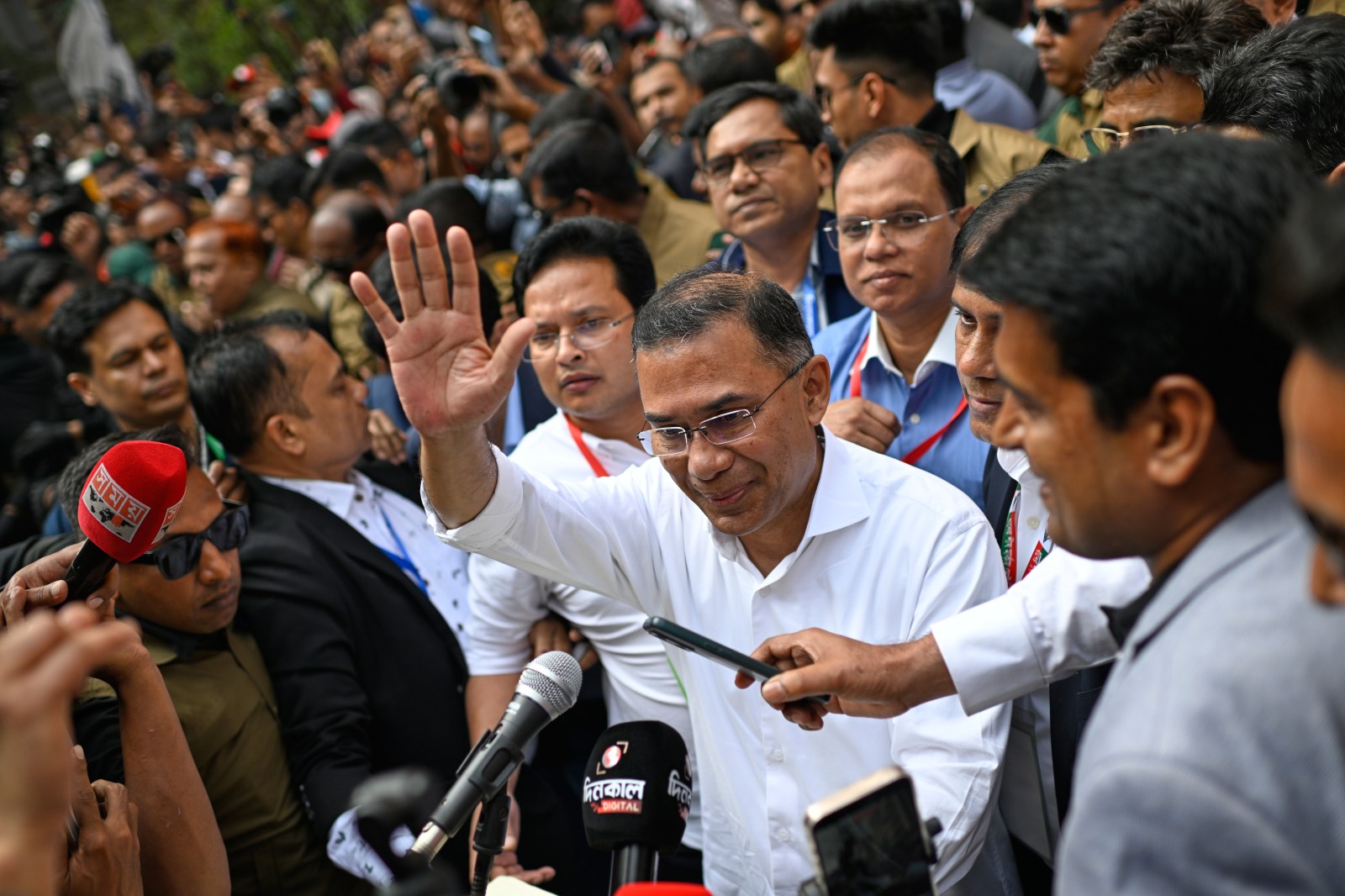
DHAKA, Bangladesh — The Bangladesh Nationalist Party (BNP) declared victory on Friday in the nation's first general election since the 2024 student-led uprising that toppled the previous government, setting the stage for a potential shift in the country's deeply polarized political arena.
The election, held on Thursday across the country under heightened security measures, drew widespread attention as a litmus test for Bangladesh's democratic recovery. According to the BNP's media unit, the party secured a majority of seats in the 350-member Jatiya Sangsad, or Parliament, enough to form the government without coalition partners. While final results from the Election Commission of Bangladesh were still pending as of late Friday, several local media outlets, including Prothom Alo and The Daily Star, reported similar outcomes based on preliminary tallies from polling stations.
Tarique Rahman, the 60-year-old acting chairperson of the BNP and its prime ministerial candidate, led the party's campaign from Dhaka after returning to Bangladesh in December following 17 years of self-imposed exile in London. Rahman is the son of former Prime Minister Khaleda Zia, the BNP's longtime leader who passed away in December at age 78 while under house arrest. Zia's death, just weeks before the election, galvanized BNP supporters, who viewed it as a symbol of the repression endured under the ousted Awami League regime.
In a statement released Friday, Ruhul Kabir Rizvi, the BNP's senior joint secretary-general, congratulated the people of Bangladesh on what he called a "resounding victory for democracy." Rizvi emphasized that the win represented a rejection of the authoritarianism that had defined the past decade. "The people have spoken, and they have chosen change," he said, urging calm as vote counts continued.
Saleh Shibly, press secretary to Rahman, echoed the call for restraint in a separate announcement. He said Rahman had instructed supporters to offer special prayers during the weekly Friday congregational service at mosques but to avoid any celebratory processions that could lead to unrest. "We must honor this victory with peace and unity, not division," Shibly quoted Rahman as saying.
The U.S. Embassy in Dhaka was quick to acknowledge the result, posting a message on X congratulating Rahman and the BNP on their "historic victory." U.S. Ambassador Brent T. Christensen wrote, "The United States looks forward to working with you to achieve shared goals of prosperity and security for both our countries." The statement highlighted international interest in Bangladesh's political transition, especially given the country's strategic location in South Asia and its role in regional trade and counterterrorism efforts.
This election marked a pivotal moment for Bangladesh, coming nearly 18 months after the July 2024 uprising that began as student protests against job quotas and escalated into a nationwide revolt. The demonstrations, which claimed over 300 lives according to human rights groups, forced Prime Minister Sheikh Hasina to flee to India on August 5, 2024, ending her 15-year rule. An interim government led by Nobel laureate Muhammad Yunus took over, promising reforms and free elections, though it faced criticism for delays and internal divisions.
Security was intense during Thursday's voting, with thousands of police and army personnel deployed at polling stations in Dhaka and other major cities like Chittagong and Sylhet. Reports from observers, including teams from the Asian Network for Free Elections (ANFREL), noted isolated incidents of violence, including clashes between rival supporters in rural areas that injured at least a dozen people. The Election Commission extended polling by two hours in some constituencies due to technical glitches with electronic voting machines, a first-time introduction that sparked debates over reliability.
Turnout was estimated at around 65% by midday Friday, higher than the 40% in the disputed 2018 election but lower than the 80% in 2008, according to preliminary figures from the Election Commission. Voter enthusiasm was particularly high in urban centers, where memories of the 2024 protests remained fresh. One voter in Dhaka, 28-year-old university student Ayesha Rahman, told reporters outside a polling station, "This is our chance to build the Bangladesh we dreamed of during the uprising—no more rigged votes or silenced voices."
The BNP's path to this apparent triumph was fraught with historical baggage. For much of the past 15 years, the party had been relegated to the opposition, boycotting the 2014 and 2018 elections under Hasina's Awami League on grounds of systematic rigging and repression. Rahman himself faced a barrage of corruption and criminal charges from Hasina's government, which he dismissed as politically motivated fabrications. Those cases were dropped following Hasina's ouster, allowing his return and clearing the way for his leadership bid.
Hasina's exile in India has continued to strain bilateral relations, with Dhaka accusing New Delhi of harboring her and interfering in internal affairs. The Awami League, now fractured and leaderless, fielded candidates in the election but garnered minimal support, according to early reports. Party spokesperson Taijul Islam acknowledged the loss, saying, "We respect the people's choice, but the journey to true democracy is ongoing."
International observers have mixed views on the election's integrity. The European Union sent a limited delegation due to logistical constraints, while India's election commission declined an invitation amid diplomatic tensions. A spokesperson for the Commonwealth Observer Group, which monitored the vote, stated Friday that the process was "largely peaceful" but called for swift investigations into the reported irregularities. "Transparency in the final count will be key to building trust," the spokesperson said.
Bangladesh's political landscape has long been dominated by the rivalry between the BNP and the Awami League, often punctuated by military coups, assassinations, and allegations of manipulation. The 1975 assassination of founding President Sheikh Mujibur Rahman, Hasina's father, set the tone for decades of instability. More recently, the 2024 uprising exposed deep-seated grievances over economic inequality, youth unemployment, and curbs on free speech, issues that the BNP campaign heavily emphasized.
Rahman's platform focused on economic revival, anti-corruption measures, and restoring judicial independence. He pledged to investigate the 2024 crackdown, in which security forces were accused of killing protesters, and to repatriate Hasina for trial. During a rally in Dhaka last week, Rahman declared, "We will not forget the sacrifices of our youth; their blood will water the tree of democracy." His return in December was met with massive crowds, signaling strong grassroots support despite his long absence.
As the dust settles, questions linger about the new government's ability to deliver reforms. Economists warn that Bangladesh, with its $460 billion economy heavily reliant on garment exports, faces challenges from inflation hovering at 9% and foreign reserves dipping below $20 billion. The interim government's efforts to stabilize the economy, including securing a $4.7 billion IMF bailout in December 2024, will need to continue under BNP leadership.
Looking ahead, the BNP's victory could reshape alliances in South Asia. Relations with India may cool further, while ties with Western nations, as hinted by the U.S. statement, could warm. Domestically, the party must navigate demands from student activists who spearheaded the uprising but remain wary of traditional politicians. One analyst, speaking on condition of anonymity, noted, "This is just the beginning; sustaining this momentum without slipping into old patterns will define Rahman's legacy."
With Parliament set to convene in mid-March, Rahman is expected to be sworn in as prime minister shortly after the final results are certified. For now, the streets of Dhaka buzz with cautious optimism, a far cry from the chaos of 2024. As one elderly BNP supporter put it outside party headquarters Friday, "After so many dark years, the light is finally breaking through."