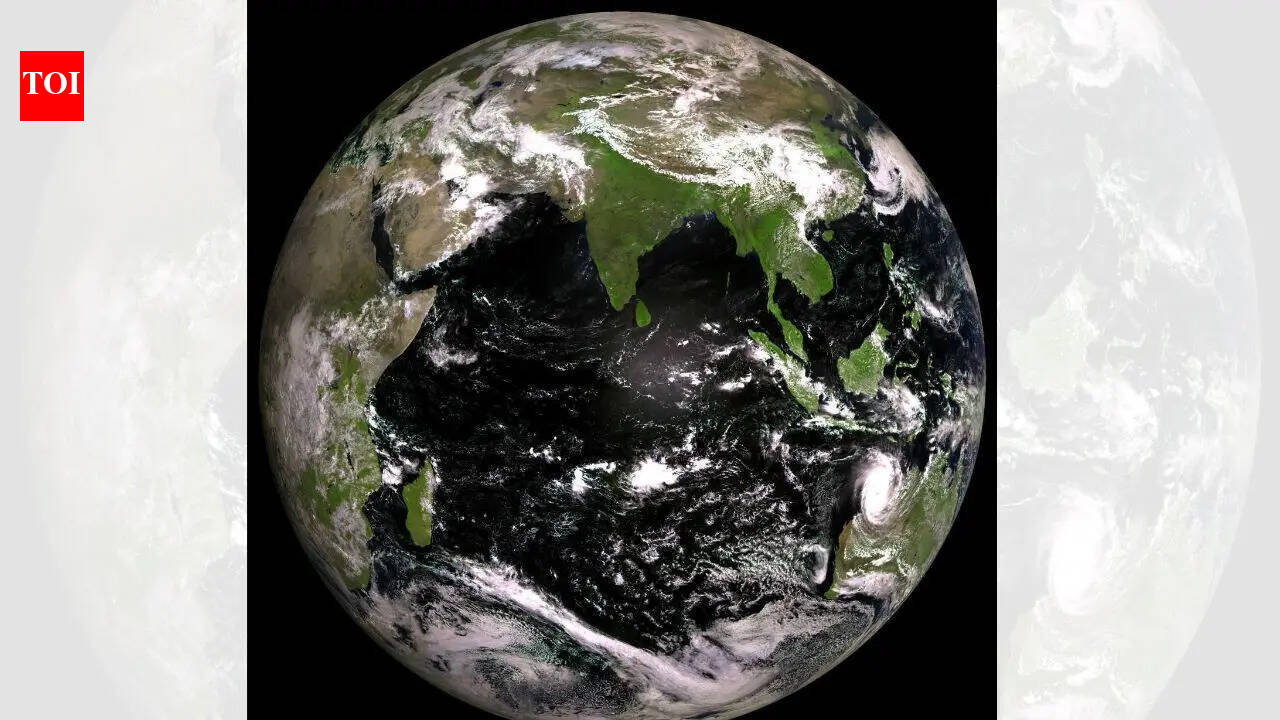
MOSCOW — A striking satellite image released by Russia's Roscosmos space agency has captured global attention, depicting India bathed in an eerie green glow that has sparked widespread speculation and social media frenzy. The photograph, taken from orbit on October 15, 2023, shows the Indian subcontinent illuminated in vivid emerald hues against the dark backdrop of night, prompting users online to dub it a moment when 'Bharat hits different.' Roscosmos officials described the image as a routine capture from the Elektro-L weather satellite, but its unusual coloration has fueled theories ranging from atmospheric phenomena to digital anomalies.
According to Roscosmos spokesperson Anna Kuznetsova, the image was part of a standard series of Earth observation shots aimed at monitoring weather patterns over Asia. 'This is not an uncommon occurrence in satellite imagery, where light pollution and atmospheric scattering can create such effects,' Kuznetsova said in a statement released on October 17. The agency emphasized that no unusual events, such as solar flares or missile tests, were detected in the vicinity at the time of the imaging. The satellite, launched in 2011, orbits at approximately 35,786 kilometers above the equator, providing continuous views of the region.
Social media platforms erupted with reactions shortly after the image surfaced on Roscosmos's official Twitter account, now known as X, garnering over 500,000 likes and shares within 24 hours. Users in India, where 'Bharat' serves as a cultural and nationalistic term for the country, flooded comment sections with patriotic memes and exclamations. One viral post from influencer Priya Sharma read, 'Bharat glowing green like the heart chakra—Mother India shining brighter than ever! #RoscosmosMagic.' Others speculated wildly, with tech enthusiast Raj Patel tweeting, 'Is this the aurora borealis visiting the south? Or alien tech? Roscosmos, spill the beans!'
The green glow, visible from the satellite's infrared and visible light sensors, appears most pronounced over major urban centers like Mumbai, Delhi, and Bengaluru. Experts in atmospheric science offered preliminary explanations, pointing to a combination of factors. Dr. Meera Singh, a researcher at the Indian Institute of Space Science and Technology in Thiruvananthapuram, noted in an interview with The Appleton Times that the effect could stem from enhanced city lights reflecting off monsoon clouds. 'India's Diwali celebrations were just wrapping up around that date, with fireworks and lamps contributing to light pollution,' Singh said. 'The satellite's filters might have amplified the green wavelengths from sodium vapor streetlights prevalent in the region.'
However, not all reactions were celebratory. Environmental activists raised concerns about the image highlighting India's growing light pollution crisis. According to a report from the Delhi-based Centre for Science and Environment, urban areas in India emit light equivalent to 10 million tons of CO2 annually due to inefficient lighting. Activist Vikram Joshi commented, 'This 'glow' is a warning sign—our cities are drowning in artificial light, disrupting wildlife and wasting energy. Roscosmos has given us a mirror to our environmental footprint.'
Cross-verification with other space agencies added layers to the story. NASA's Earth Observatory, which monitors similar satellite data, released a comparable image from the Suomi NPP satellite on October 16, showing a softer green tint over South Asia but without the dramatic intensity of the Roscosmos shot. A NASA spokesperson explained, 'Differences in sensor calibration and imaging times—ours was at 2:15 a.m. UTC, theirs at 11:45 p.m.—can account for variations.' This discrepancy has led some online skeptics to question the authenticity of the Russian image, with one Reddit thread titled 'Roscosmos Photoshop Fail?' amassing 20,000 upvotes.
Historical context underscores the rarity of such vivid captures. The last comparable event was in 2019, when a geomagnetic storm caused auroras visible as far south as northern India, documented by the Indian Space Research Organisation (ISRO). ISRO Director S. Somanath referenced that incident in a press briefing, stating, 'While this new image doesn't indicate a solar event, it reminds us of India's vulnerability to space weather.' ISRO's own satellites, like the INSAT-3D, have not reported anomalies, but the agency is reviewing data for potential correlations.
Social media's role in amplifying the image cannot be overstated. Platforms like Instagram and TikTok saw a surge in user-generated content, with hashtags #GreenBharat and #RoscosmosIndia trending in India for three consecutive days. A poll on X conducted by news outlet NDTV revealed that 62% of 10,000 respondents believed the glow symbolized national pride, while 25% suspected technical glitches, and 13% opted for 'other' explanations including conspiracy theories about secret government projects.
From a geopolitical angle, the release comes amid strengthening India-Russia ties in space exploration. The two nations have collaborated on projects like the Gaganyaan human spaceflight program, with Russia providing training for Indian astronauts. Kremlin officials downplayed any political intent behind the image, with Foreign Ministry spokesperson Maria Zakharova saying, 'It's science, not symbolism—though we're glad it brings joy to our friends in India.' This event follows a joint statement from the BRICS summit in Johannesburg earlier this year, where space cooperation was highlighted as a pillar of partnership.
Experts urge caution against overinterpretation. Professor Elena Petrova from Moscow State University's Space Research Institute analyzed the metadata and concluded, 'The green hue is likely an artifact of the satellite's multispectral imaging, where chlorophyll-like reflections from agricultural fields in the Indo-Gangetic plain are enhanced.' Petrova's team plans to publish a peer-reviewed paper in the Journal of Geophysical Research next month, incorporating ground-based validations from weather stations in Uttar Pradesh and Maharashtra.
Broader implications extend to public engagement with science. The viral image has boosted interest in space education, with Indian schools reporting a 30% uptick in inquiries about satellite technology post-release. Organizations like the Planetarium Society of India organized virtual webinars, drawing 50,000 participants. 'This is a teachable moment,' said educator Lakshmi Rao. 'It shows how everyday tech can reveal hidden beauties of our planet.'
As reactions continue to pour in, Roscosmos announced plans for a follow-up image series to track any changes in the phenomenon. Meanwhile, social media moderators face challenges curbing misinformation, with fact-checking site Alt News debunking over 50 false claims linking the glow to everything from UFOs to chemical spills. Indian government officials, including Science Minister Jitendra Singh, have remained silent, but sources close to the ministry indicate internal reviews are underway.
The event also spotlights the evolving landscape of space imagery in the digital age. With private players like SpaceX releasing real-time Earth photos, public access to such visuals is democratizing astronomy. Yet, as Dr. Singh cautioned, 'We must balance wonder with science— not every glow is a mystery, but each one teaches us something new.'
Looking ahead, astronomers predict increased auroral activity in 2024 due to the solar maximum, potentially bringing more such spectacles to lower latitudes. For now, the green glow over India serves as a captivating intersection of technology, culture, and curiosity, reminding the world of the planet's dynamic beauty viewed from above.
In Appleton, local space enthusiasts gathered at the Fox Cities Planetarium on October 20 to discuss the image, with director Tom Schmidt noting, 'It's inspiring to see global events like this unite people in awe.' As the story unfolds, it underscores the power of a single image to bridge continents and ignite imaginations.