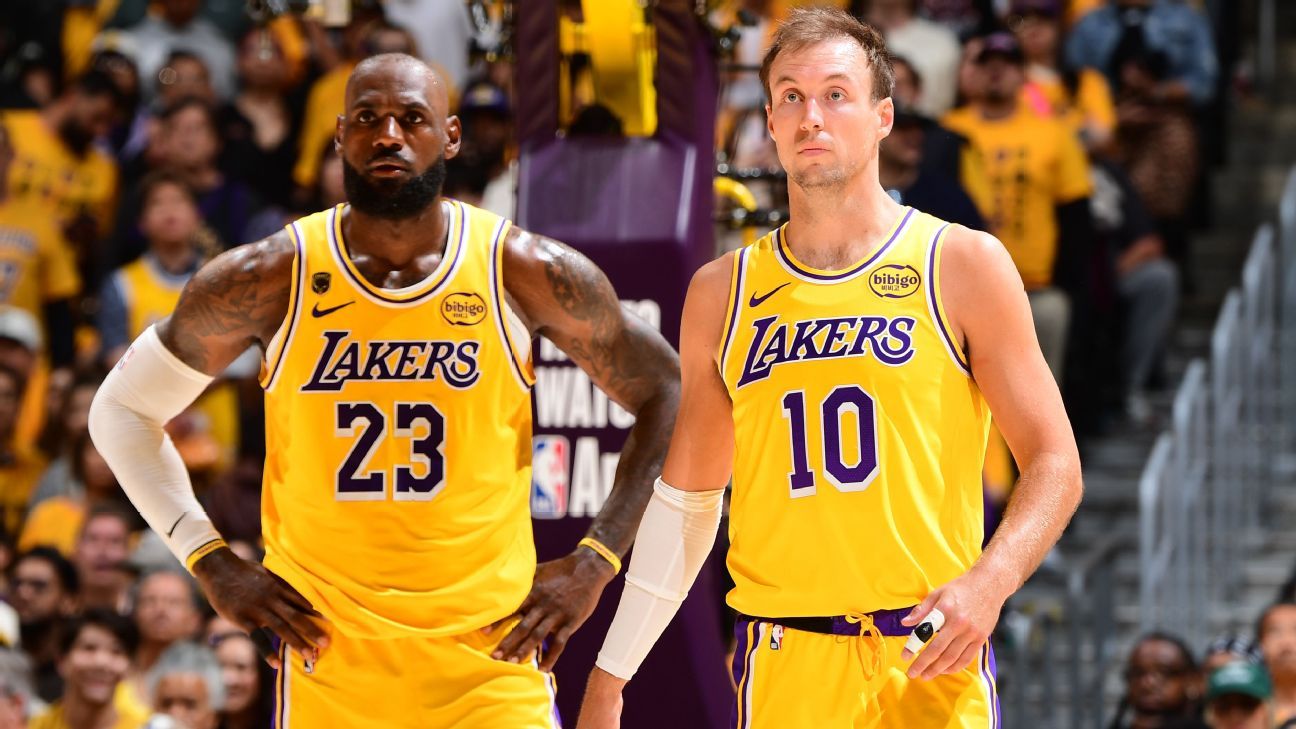
In the opening weekend of the NBA playoffs, timeless strategies and emerging talents set the tone for an exciting postseason, with LeBron James once again proving his enduring impact on the game. On Saturday, the Los Angeles Lakers defeated the Houston Rockets in Game 1, relying on a classic formula that has powered James' teams for nearly 25 years: pairing his playmaking with sharp outside shooting. Luke Kennard, a sharpshooter who once broke James' Ohio high school scoring record, led the charge with five 3-pointers and 27 points, many of them assisted by James.
The victory evoked memories of James' high school days, particularly the 2000 Ohio state championship where a teammate's barrage of 3-pointers dismantled the defense focused on the young James. As Brian Windhorst of ESPN noted, the faces may change, but the strategy remains devastating—give James the ball, spread the floor, and let him orchestrate while shooters exploit the space. In Game 1, James dished out 13 assists, including eight in the first quarter alone, drawing defenders and creating open looks for his teammates.
"He displayed great leadership throughout," Lakers coach JJ Redick said after the game. "We talked all week about being connected offensively and trusting the pass. He led us." This approach has been a staple throughout James' career, with players like Daniel Gibson, JR Smith, and Danny Green thriving off his passes in past playoffs. Even in that 2000 high school game, now viewable on YouTube, a freshman named Dru Joyce hit seven 3-pointers to break the zone defense around James, foreshadowing the tactics that would follow him to the pros.
Across the league, other first-round series highlighted fresh lessons as the playoffs tipped off on Saturday and Sunday. In the East, the Cleveland Cavaliers addressed a season-long defensive concern with a new strategy that stifled the Toronto Raptors in their Game 1 win. Cleveland, which ranked 15th in defense during the regular season amid injuries and 41 different starting lineups under coach Kenny Atkinson, focused on denying the ball to Toronto's leading scorer, Brandon Ingram.
During the regular season, Ingram averaged 20 shots per game against the Cavaliers, his third-highest total against any Eastern Conference opponent. But in Game 1, starting with primary defender Dean Wade, Cleveland shadowed Ingram from the outset, limiting him to just nine shots overall and only one in the second half. Ingram reached the free-throw line 10 times but struggled to score or even handle the ball effectively.
"They tried to deny me the ball every time that I went down the floor," Ingram said. "Obviously, they knew most of the stuff that we've been running all year. ... We got to figure out how to make the adjustment next game, and let that not be too effective." Toronto's challenges were compounded by the absence of starting point guard Immanuel Quickley, sidelined with a right hamstring injury. Replacement Jamal Shead hit five 3-pointers but took two more shots than Ingram, a tradeoff the Cavaliers welcomed.
The Cavaliers also controlled the tempo, slowing the game in line with their status as one of the league's slowest teams—a factor influenced by opponent James Harden's style. Toronto managed just three fast-break points, underscoring Cleveland's disciplined plan that could carry into deeper playoff rounds. This approach helped the Cavs overcome their midseason defensive woes, where injuries disrupted rhythm and forced constant lineup changes with 24 different players seeing action.
In the Western Conference, the Oklahoma City Thunder delivered a dominant 35-point victory over the Phoenix Suns in Sunday's Game 1, reinforcing their reputation as a home juggernaut. Last season, the Thunder won two Game 7s en route to the title and boasted an average home playoff margin of 29 points. Over the past two seasons, including the NBA Cup, they hold a 149-40 record despite injuries, and their first-round home wins now average 35 points.
The Suns arrived fatigued after a grueling schedule—three games in three cities over six days—while the rested Thunder showcased efficiency that will challenge any opponent in the series. A key under-the-radar stat was Oklahoma City's 34-2 edge in points off turnovers, highlighting their possession-obsessed philosophy built around Shai Gilgeous-Alexander's half-court prowess. The Thunder prioritize jumping passing lanes, ball security, and athletic defenders with long arms to generate extra possessions, whether through rebounds, steals, or deflections.
In the first half alone, OKC cycled through 11 players, executed near-perfect defensive rotations, notched eight steals, and scored 21 points off turnovers in just 24 minutes. This performance served as a sobering message not only to Phoenix but to the entire league: lose the turnover battle in Oklahoma City, and the game is over. The Thunder's construction emphasizes winning every possession, making them a formidable force in a best-of-seven series.
Meanwhile, the Detroit Pistons' Game 1 loss to the Orlando Magic on Sunday exposed vulnerabilities that plagued them throughout the regular season. As the only home team to fall among the eight Game 1s, Detroit heard qualified praise all year for their toughness—both physical and mental—but criticism for offensive limitations, particularly poor 3-point shooting. Cade Cunningham, likely headed for first-team All-NBA honors, exploded for 39 points on 27 shots, valiantly carrying the load in a 60-win season.
However, support was scarce: only Tobias Harris reached double-digit attempts, going 5-of-15 underwhelmingly, while Jalen Duren, an offensive force late in the year, took just four shots and was outplayed by Magic center Wendell Carter Jr. The Pistons shot 4-of-16 on passes from Cunningham, and their bench combined for 4-of-16. Overall, they made just 10 of 32 3-pointers, one below their league-worst season average of 11 per game (28th in the NBA).
The Magic, riding momentum from their play-in tournament win, capitalized on these weaknesses to secure the victory. While Detroit's core like Cunningham and Duren shone two-way throughout the season, their lackluster perimeter game made them vulnerable, especially against top seeds like the Thunder, Spurs, and Celtics who looked dominant in their openers. The Pistons, with their grit, remain capable of adjustments for Game 2, but the exposure was glaring.
One of the weekend's brightest spots came from San Antonio Spurs center Victor Wembanyama, who showed no fear in his playoff debut during a Game 1 win over the Portland Trail Blazers. The 22-year-old phenom scored 12 points in the first quarter and 21 in the first half en route to 35 points overall, though his stat line included just five rebounds, one assist, and two blocks—pedestrian by his lofty standards.
Comparing Wembanyama's outing to other greats' first playoff games puts it in elite company. LeBron James posted a 32-point, 11-rebound, 11-assist triple-double in an 11-point win in his debut. Kevin Durant scored 24 on 7-of-24 shooting in a loss, while Stephen Curry had 19 points and nine assists, also in defeat. Luka Doncic tallied 42 points, seven rebounds, and nine assists in his Dallas debut but lost, and a young Kobe Bryant scored 17 in his first playoff start, making game-winning free throws.
Shaquille O'Neal, often compared to Wembanyama for early center dominance, had 24 points and 19 rebounds in his first playoff game—a loss. Wembanyama's poise and output in a victory signal his readiness for the postseason spotlight, adding intrigue to the Spurs' series against Portland. As the playoffs progress, these early lessons—from James' facilitation to defensive innovations and young stars' emergence—suggest a wide-open tournament where adaptability will be key.
With series shifting to road games for Game 2s this week, teams like the Lakers, Cavaliers, Thunder, Magic, and Spurs carry momentum, while the Rockets, Raptors, Suns, and Pistons seek adjustments. The first weekend underscored the NBA's blend of veteran savvy and youthful promise, setting up compelling matchups ahead in cities from Los Angeles to Oklahoma City.