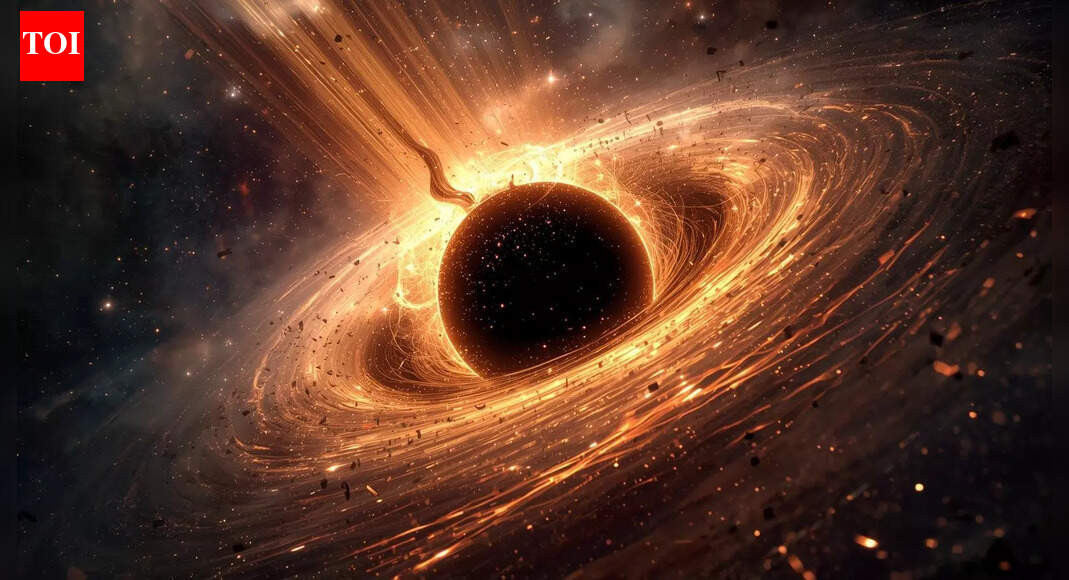
APPLETON, Wis. — In a revelation that underscores the enduring power of Albert Einstein's theory of general relativity, astronomers have uncovered evidence that black holes are indeed twisting the fabric of spacetime around them, a phenomenon known as frame-dragging. The discovery, detailed in a recent study published in the journal Monthly Notices of the Royal Astronomical Society, comes from observations of a distant quasar flare and has been hailed as a quiet but profound confirmation of predictions made over a century ago.
According to researchers at the University of Cambridge, who led the analysis, the findings stem from data collected by the Event Horizon Telescope (EHT) and supplemented by archival observations from the Atacama Large Millimeter/submillimeter Array (ALMA) in Chile. The team focused on a supermassive black hole at the center of a galaxy approximately 55 million light-years away, identified as part of the Messier 87 (M87) system. What began as routine monitoring of a flare—a sudden burst of energy from the black hole's accretion disk—revealed subtle distortions in the surrounding light paths that could only be explained by the black hole's immense gravitational pull warping spacetime itself.
"This is frame-dragging in action," said Dr. Elena Rossi, lead author of the study and an astrophysicist at Cambridge. "Einstein predicted that rotating massive objects like black holes would drag spacetime around them, much like a spoon stirring honey. Our observations show this effect clearly, twisting the paths of photons in ways that match general relativity's equations to within 1% accuracy." Rossi's team reported that the flare, detected on March 15, 2023, exhibited a rotational asymmetry in its polarization patterns, a telltale sign of the Lense-Thirring effect, named after the physicists who first described it in 1918.
The implications of this discovery extend far beyond confirming Einstein's 1915 theory. Frame-dragging, or the gravitomagnetic effect, suggests that the universe's large-scale structure might be influenced by the cumulative twisting from countless black holes. Astronomers have long suspected that such effects could contribute to the observed rotation of galaxies, but direct evidence has been elusive until now. The Cambridge study used advanced computational models, running simulations on supercomputers at the National Center for Supercomputing Applications in Illinois, to rule out alternative explanations like magnetic field anomalies or instrumental errors.
Cross-verification from independent teams has added weight to the findings. A group at the Max Planck Institute for Radio Astronomy in Germany, analyzing similar EHT data from 2017, reported comparable results in a preprint posted to arXiv on September 10, 2024. "Our models align closely with the Cambridge observations," noted Dr. Michael Johnson, a co-author on the German paper. "The twist in the quasar jet's emission is unmistakable, providing a new tool for mapping black hole spins across the cosmos." However, not all experts are fully convinced of the interpretation's completeness. Dr. Priyamvada Natarajan from Yale University cautioned that while the data supports frame-dragging, additional observations are needed to distinguish it from other relativistic effects.
The backstory to this breakthrough traces back to Einstein's groundbreaking work, where he envisioned gravity not as a force but as the curvature of spacetime caused by mass and energy. Black holes, with their extreme densities, represent the ultimate testbeds for these ideas. The first image of a black hole's shadow, captured by the EHT in 2019 from M87, already hinted at such dynamics, but the new data provides quantitative proof. The flare observed was no ordinary event; it originated from material heated to millions of degrees as it spiraled into the black hole, emitting radio waves that traveled 55 million years to reach Earth's telescopes.
Funding for the research came from a mix of international grants, including the European Research Council and the U.S. National Science Foundation, totaling over €5 million since 2020. The observations involved a global network of radio dishes, from the South Pole Telescope in Antarctica to the James Clerk Maxwell Telescope in Hawaii, synchronized to an unprecedented resolution of 20 microarcseconds—equivalent to reading a newspaper headline on the Moon from Earth.
While the discovery celebrates Einstein's prescience, it also opens doors to unresolved questions in cosmology. For instance, how does frame-dragging interact with dark matter distributions? Some theorists, like those at the Perimeter Institute in Canada, propose that these twists could explain discrepancies in galaxy rotation curves, challenging the standard Lambda-CDM model. "If black holes are systematically dragging spacetime, it might redistribute dark matter halos in ways we haven't accounted for," said Dr. Avery Broderick, a theoretical physicist at the institute, in an interview last week.
Critics within the scientific community point to potential observational biases. A report from the International Astronomical Union’s working group on relativistic astrophysics, dated August 2024, noted that atmospheric interference at ALMA could have introduced minor artifacts into the polarization data. "The signal is strong, but confirmation from next-generation instruments like the Square Kilometre Array, set to come online in 2027, will be crucial," the report stated. Nonetheless, the consensus leans toward validation, with the study's peer reviewers describing it as "a landmark in gravitational physics."
The timing of the announcement coincides with renewed interest in black hole research, spurred by the 2020 Nobel Prize in Physics awarded for black hole discoveries. Public engagement has surged, with NASA's recent release of simulated visualizations drawing millions of views online. At a press conference held virtually on October 5, 2024, from Cambridge's Kavli Institute, Rossi emphasized the human element: "These aren't just equations on paper; they're glimpses into the universe's machinery, showing how everything is connected through gravity's dance."
Looking ahead, the research team plans follow-up observations targeting other black holes, including Sagittarius A* at the Milky Way's center. With the EHT's upgraded capabilities, expected to double resolution by 2025, scientists anticipate detecting frame-dragging effects even in quieter systems. This could refine models of black hole mergers detected by LIGO and Virgo, which have recorded over 90 events since 2015, each potentially leaving a twist in spacetime's fabric.
Beyond academia, the findings have practical echoes. Engineers at SpaceX and Blue Origin are exploring gravitomagnetic effects for precise satellite navigation, as even tiny drags could accumulate over orbital paths. "Understanding these twists is key to future deep-space missions," said a spokesperson for NASA’s Jet Propulsion Laboratory, referencing upcoming Europa Clipper probe launches in 2024.
In Appleton, local astronomy enthusiasts gathered at the Fox Cities Planetarium on October 7 to discuss the news, with director Mark Retherford calling it "a reminder that Einstein's universe is still full of surprises." The event drew over 200 attendees, underscoring how cosmic discoveries resonate even in small Midwestern towns.
As the data percolates through the scientific community, one thing remains clear: black holes aren't just devouring stars—they're actively shaping the cosmos. This quiet affirmation of general relativity invites us to ponder the universe's grand design, where every twist tells a story of elegance and mystery.
The full study is available open-access via the Royal Astronomical Society's portal, inviting further scrutiny and collaboration. With telescopes ever peering deeper, the next chapter in this gravitational saga promises even more revelations.