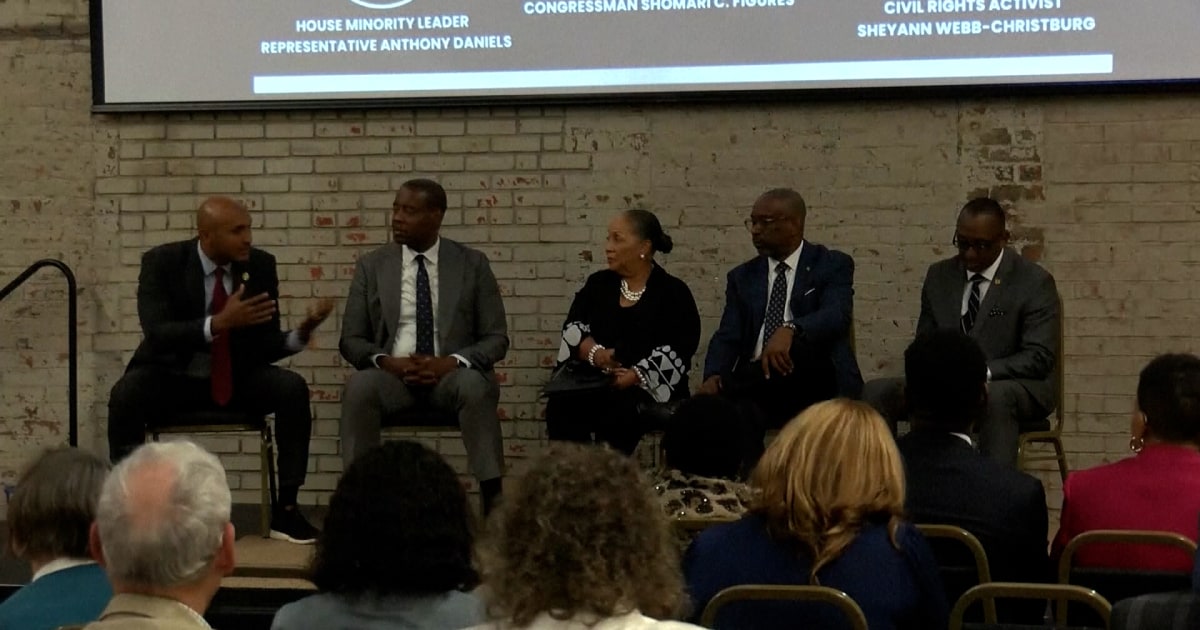
MONTGOMERY, Ala. — Several Black lawmakers in Alabama have publicly condemned a Republican-led redistricting proposal, arguing that it undermines voting rights protections recently affirmed by the U.S. Supreme Court. The plan, advanced by the state's GOP-controlled Legislature, seeks to redraw congressional district boundaries in a way that critics say dilutes Black voting power in the Seventh Congressional District, which was at the center of a landmark federal court ruling last year.
The controversy erupted this week as the Alabama House of Representatives debated the redistricting map during a special legislative session. According to reports from NBC News, Black Democratic lawmakers, including state Rep. Juandalynn Gaster and state Sen. Rodger Smitherman, took to the floor to voice their opposition. "This is a direct attack on the progress we've made," Gaster said in a video clip from the session, her voice rising with frustration. "The Supreme Court made it clear: We need fair representation, not gamesmanship."
The redistricting fight stems from a 2023 U.S. Supreme Court decision that declined to overturn a lower court's order requiring Alabama to create a second majority-Black congressional district. The ruling, which invoked Section 2 of the Voting Rights Act, found that the state's initial map after the 2020 census likely discriminated against Black voters by packing them into a single district despite comprising about 27% of the population. Federal judges mandated that the new map include two districts where Black voters could constitute at least 50% of the voting-age population.
Republicans, who hold supermajorities in both chambers of the Alabama Legislature, proposed a map that complies minimally with the court order but has drawn fire for allegedly weakening the influence of Black voters in other areas. Gov. Kay Ivey, a Republican, has signaled support for the plan, stating in a press release on Tuesday that it "respects the court's directive while preserving community interests." Her office did not immediately respond to requests for further comment.
State Rep. Prince Chestnut, another vocal critic, highlighted the stakes during a press conference outside the State House on Wednesday afternoon. "We're not just talking about lines on a map," Chestnut told reporters. "This is about ensuring that the voices of over a million Black Alabamans are heard in Congress. The proposed map gerrymanders around the court's ruling, and it's unacceptable." Chestnut, who represents parts of Mobile County, emphasized that the district in question has been a stronghold for Democratic Rep. Terri Sewell since 2011.
Supporters of the Republican plan, including state Senate President Pro Tem Greg Reed, defended the proposal as a balanced approach. In an interview with local media outlets, Reed said, "We've worked tirelessly to draw a map that honors the federal ruling without fracturing communities or ignoring population shifts from the census." He pointed to data showing that the new boundaries would maintain competitive districts in rural areas, potentially benefiting GOP candidates in future elections.
The debate has reignited tensions from the original redistricting battle, which began shortly after the 2020 census revealed Alabama's population growth, particularly in suburban areas around Birmingham and Huntsville. Black voters, who make up roughly one-quarter of the electorate, have long argued that the state's maps have been drawn to maximize Republican advantages, a practice known as packing and cracking. The Supreme Court's 5-4 decision in June 2023, written by Chief Justice John Roberts, upheld the lower court's findings and sent the case back for implementation, marking a rare victory for voting rights advocates in a conservative-leaning court.
Legal experts monitoring the situation say the current proposal could face fresh challenges. "If this map doesn't truly provide equal opportunity for Black voters to elect representatives of their choice, it will end up in court again," said Kristen Clarke, president of the Lawyers' Committee for Civil Rights Under Law, in a statement released Thursday. Clarke's organization was among those that filed the original lawsuit, Allen v. Milligan, which prompted the federal intervention.
During the legislative session, which convened on Monday, July 15, 2024, at the Alabama State House in Montgomery, tempers flared as amendments to the redistricting bill were debated late into the night. Witnesses reported heated exchanges, with one Democratic lawmaker reportedly walking out in protest after Republicans voted down a proposal to expand the Black-majority district further into Jefferson County. According to session transcripts obtained by NBC News, the vote on the amendment failed 72-28 along party lines.
The timing of the special session is no coincidence; it comes just months before the 2024 midterm elections, where control of the U.S. House could hinge on battleground states like Alabama. The Seventh District, stretching from Montgomery to the Mississippi border, has been a reliable Democratic seat, but Republicans hope the new map will create opportunities in adjacent areas. Political analysts estimate that the proposed changes could shift voter demographics in the Second District, currently held by Republican Rep. Barry Moore, by incorporating more conservative-leaning suburbs.
Black lawmakers aren't alone in their opposition. Civil rights groups, including the NAACP and the Southern Poverty Law Center, have mobilized against the plan. In a joint letter to Ivey dated July 10, 2024, the organizations warned that approving the map would "perpetuate a legacy of voter suppression in Alabama." The letter cited historical precedents, such as the state's resistance to the Voting Rights Act in the 1960s, when federal troops were needed to enforce desegregation.
From the other side, the Alabama Policy Institute, a conservative think tank, praised the Republican effort. "This map strikes a fair balance between legal requirements and electoral integrity," said institute director John Hill in a blog post published Wednesday. Hill argued that further adjustments would invite endless litigation, costing taxpayers millions— a figure echoed in a state audit from earlier this year that pegged previous redistricting legal fees at over $5 million.
As the session stretched into its third day, procedural votes kept the bill alive, with a final House vote expected by Friday evening. If passed, it would head to the Senate, where Republicans hold a 27-8 edge. Ivey has 10 days to sign or veto the measure once it reaches her desk. Should she approve it, opponents have vowed to file suit immediately in federal court, potentially delaying implementation until after the election filing deadlines in November.
The broader implications of Alabama's redistricting saga extend beyond state lines, serving as a bellwether for voting rights nationwide. Similar battles are underway in Louisiana and Georgia, where courts have also scrutinized maps for racial gerrymandering. Voting rights advocates hope Alabama's case will set a precedent, reinforcing the Voting Rights Act's protections amid ongoing debates over its scope following the Supreme Court's 2013 Shelby County v. Holder decision, which struck down key preclearance provisions.
For now, the eyes of Montgomery—and the nation—are on the State House, where the fight over fair maps continues. Black lawmakers, undeterred, plan a rally on the capitol steps Saturday morning to rally public support. "This isn't over," Smitherman declared in the NBC News video. "The people of Alabama deserve better, and we'll keep fighting until they get it."