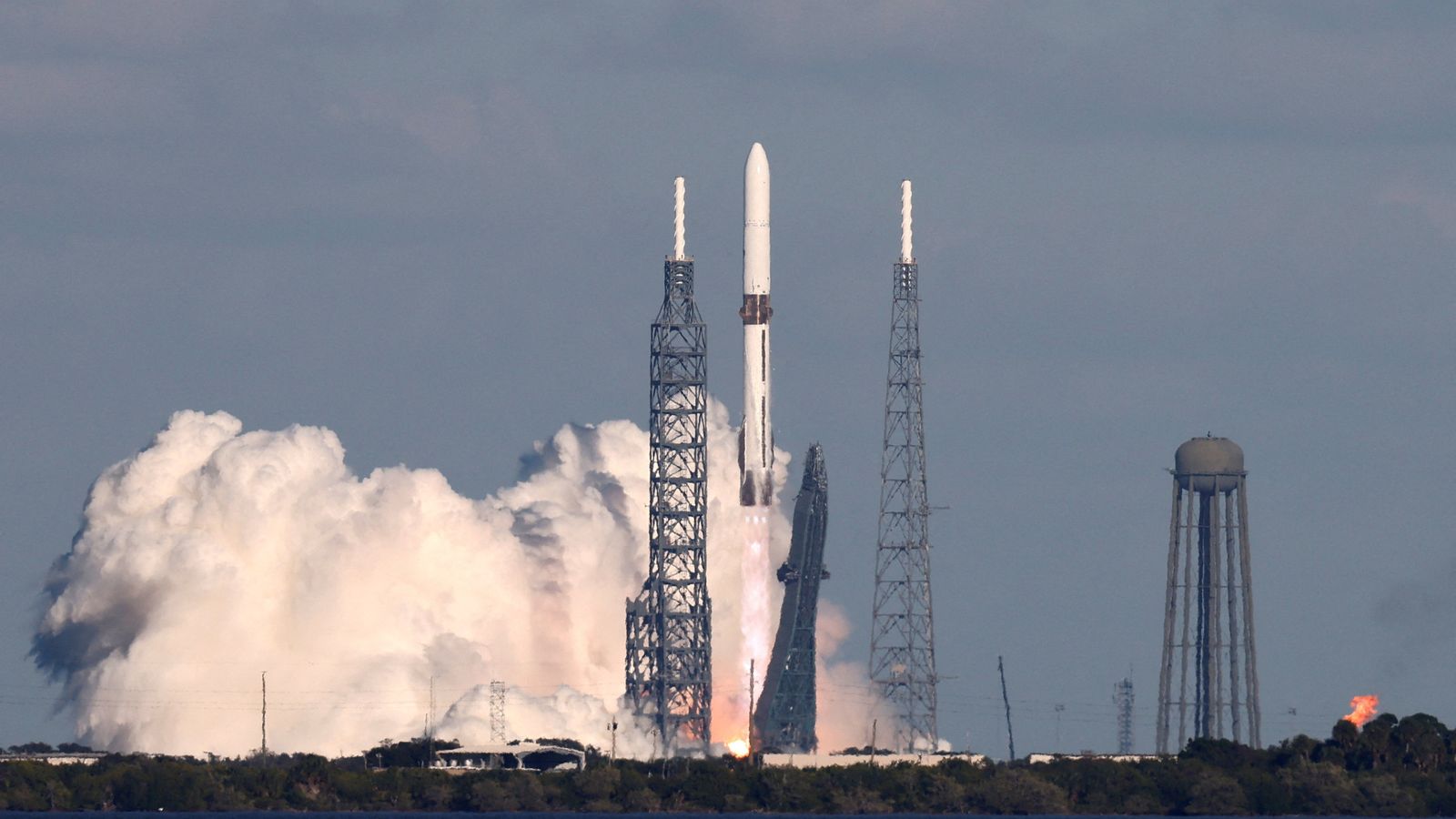
CAPE CANAVERAL, Fla. — In a milestone for the burgeoning commercial space industry, Blue Origin successfully launched its massive New Glenn rocket from Florida's Cape Canaveral Space Force Station on Thursday, carrying two NASA spacecraft bound for Mars and achieving a first-of-its-kind booster landing for the company.
The launch, which had been delayed for four days due to adverse weather conditions, marked the second flight of the 98-meter-tall rocket, named after pioneering astronaut John Glenn. Crowds gathered at the historic spaceport erupted in cheers as the rocket lifted off, overcoming two last-minute postponements on Thursday caused by technical checks and lingering weather concerns. According to Blue Origin officials, the mission proceeded flawlessly after liftoff, with the rocket's first stage separating and returning to Earth for a pinpoint landing on a floating platform positioned 375 miles offshore in the Atlantic Ocean.
Staff at mission control cheered wildly as the booster touched down upright, a feat the company had never accomplished before with a rocket of this scale. "This is a huge step forward," a Blue Origin spokesperson said in a post-launch statement, emphasizing the recovery's role in enabling reusable technology. The booster, part of the reusable design critical to reducing launch costs, splashed down successfully after the upper stage continued its trajectory toward orbit with the payloads intact.
On board the New Glenn were two identical spacecraft from NASA's Escapade mission—Escape and Plasma Acceleration and Dynamics Explorers—named Blue and Gold. These orbiters are headed to Mars, where they are expected to arrive in 2027 to study how solar wind interacts with the planet's magnetic environment and influences atmospheric escape. Scientists say the data will provide insights into Mars's climate history and help safeguard future human missions to the Red Planet by better understanding space weather risks.
The Escapade probes represent Blue Origin's first major contract with NASA for deep-space exploration, shifting the company's focus from suborbital tourism to ambitious orbital and interplanetary endeavors. Previously, Blue Origin's smaller New Shepard rocket had been synonymous with space tourism, hosting high-profile passengers like singer Katy Perry, who floated in weightlessness and performed a rendition of "What a Wonderful World" during one mission. That January's inaugural New Glenn flight had successfully deployed a prototype satellite but failed to recover the booster, highlighting the challenges of scaling up reusability.
This week's success comes amid intensifying competition in the private space sector, particularly between Blue Origin, founded by Amazon billionaire Jeff Bezos, and Elon Musk's SpaceX. Musk, whose company has pioneered reusable rocket technology with its Falcon 9 boosters, quickly acknowledged the achievement on X, formerly Twitter, posting his congratulations to the Blue Origin team. While SpaceX has routinely landed large boosters since 2015, Blue Origin's accomplishment with the New Glenn—comparable in size to many historic rockets but smaller than SpaceX's Starship—signals its intent to catch up in the race for cost-effective space access.
The New Glenn rocket stands 98 meters tall and 7 meters wide, with a payload capacity of 45 metric tonnes to low Earth orbit, roughly equivalent to the weight of 20 fully loaded semi-trucks. Launched from Launch Complex 36, the same pad once used for NASA's early Apollo missions, the rocket's path took it eastward over the Atlantic, where the first stage executed a powered descent and landing on the droneship. Blue Origin described the recovery as "essential" for sustaining frequent NASA science missions, noting that reusability could slash per-launch costs by up to 90 percent over time.
Weather had been a persistent hurdle leading up to the launch. The first attempt on Sunday was scrubbed due to thick clouds and the risk of lightning strikes in the area. Wednesday's try fell victim to a powerful "cannibal storm"—a rare meteorological event where two hurricanes merge—disrupting operations across the Southeast. By Thursday, conditions cleared just enough for the go-ahead, though teams remained vigilant for any upper-level wind shear that could jeopardize the booster's return.
Inside the control room at Cape Canaveral, the atmosphere was electric as telemetry data streamed in. Eyewitnesses reported that engineers and technicians high-fived and hugged upon confirmation of the booster's touchdown, with one observer noting the platform's stability despite the ocean swells. The successful landing not only validated months of testing but also boosted morale at Blue Origin, which has faced criticism for its slower development pace compared to rivals.
Jeff Bezos, the world's second-richest person with a net worth exceeding $200 billion, has invested heavily in Blue Origin since its founding in 2000. The company, headquartered in Kent, Washington, employs thousands and aims to make space travel routine. This Mars-bound mission underscores Bezos's vision of a multi-planetary future, echoing Musk's ambitions but with a focus on steady, methodical progress. Analysts point out that while SpaceX leads in launch cadence—conducting over 100 missions last year—Blue Origin's entry into NASA's portfolio could diversify options for government payloads.
The Escapade mission, valued at around $100 million according to NASA estimates, builds on decades of Mars exploration. Previous orbiters like NASA's MAVEN have studied similar phenomena, but Escapade's dual-probe design allows for stereoscopic observations of solar wind effects. "Understanding atmospheric escape is key to unraveling why Mars lost much of its once-thick atmosphere," said a NASA project scientist in a pre-launch briefing, adding that the findings could inform strategies for terraforming or protecting habitats on the planet.
Beyond the technical triumphs, Thursday's launch reignites discussions about the new space race driven by private enterprise. Unlike the Cold War-era competition between the U.S. and Soviet Union, this one pits tech titans against each other in a quest for dominance in satellite deployment, lunar landings, and Mars colonization. Blue Origin's progress may pressure SpaceX to accelerate its Starship program, which has seen recent test flights but faces regulatory hurdles from the Federal Aviation Administration.
Looking ahead, Blue Origin plans additional New Glenn launches in 2026, including commercial satellite deployments and potential crewed missions. NASA officials expressed satisfaction with the performance, stating that the partnership opens doors for more collaborative deep-space efforts. Meanwhile, the Escapade spacecraft will spend the next 18 months cruising through space, gathering data en route to Mars.
As the sun set over Cape Canaveral on Thursday evening, the spaceport buzzed with post-launch celebrations. For Blue Origin, the day represented not just a technical victory but a declaration of competitiveness in an industry transforming humanity's reach beyond Earth. With rivals watching closely, the race to Mars—and perhaps the stars—gains new momentum.