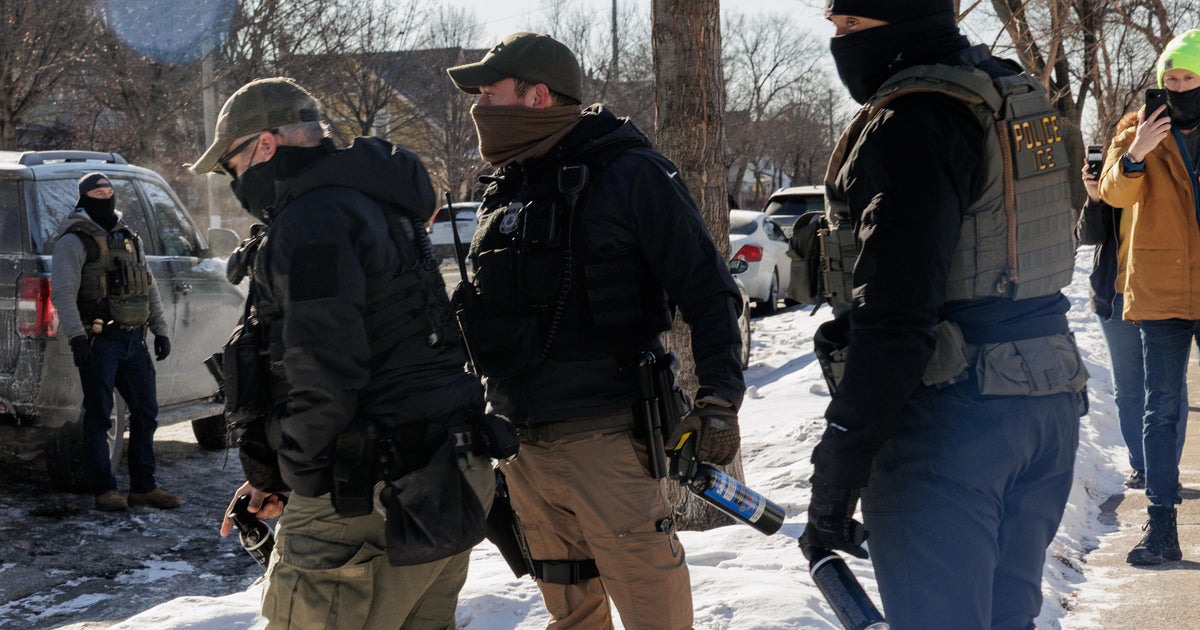
MINNEAPOLIS — Federal border czar Tom Homan announced Wednesday morning that authorities will immediately draw down 700 law enforcement personnel from Minnesota, marking a potential de-escalation in the state's monthslong immigration crackdown known as Operation Metro Surge.
Homan, speaking at a news conference in Minneapolis at 8 a.m., stated, "We will draw down 700 people effective today." The announcement comes amid widespread criticism of the operation, which has involved thousands of Immigration and Customs Enforcement (ICE) and Border Patrol agents in the Minneapolis area. It follows a fatal shooting by federal agents last week and ongoing concerns about the operation's impact on communities, businesses, and families.
The drawdown news arrived a day after Minnesota Department of Corrections Commissioner Paul Schnell told CBS News that conversations with federal officials, including those reporting to Homan, had been ongoing but details remained "sketchy." Schnell noted there were no visible signs of a reduction in federal forces yet and expressed deep concern over reported tactics, such as agents appearing at bus stops and entering apartment buildings without targeted priorities. "We don't want roving bands of agents going into apartment buildings and asking people for their papers," Schnell said. "We want a focused, targeted operation aimed at people who actually pose a risk to public safety."
Operation Metro Surge, launched several months ago, has targeted immigration enforcement in the Twin Cities region, leading to heightened tensions. Last month, federal agents fatally shot Renée Good and Alex Pretti in separate incidents in Minneapolis, events that have fueled accusations of excessive force and a possible cover-up by the White House and Department of Homeland Security (DHS). A report from Democratic members of the U.S. House Committee on Oversight and Government Reform, released this week, accused President Trump, Homeland Security Secretary Kristi Noem, and DHS of lying repeatedly about the shootings. "Let's be clear: the killings of Renée Good and Alex Pretti could have been prevented, and they should both still be alive," wrote Ranking Member Rep. Robert Garcia, D-California. "President Trump, [Homeland Security Secretary] Kristi Noem, and [the U.S. Department of Homeland Security] have lied over and over again and are now trying to cover up the truth. The Trump Administration needs to be held accountable."
The family of Renée Good, referred to by loved ones as "Nay," shared emotional testimony Tuesday at a Congressional forum on DHS tactics. Brent and Luke Ganger, Good's brothers, spoke about the profound loss and the surreal scenes unfolding in Minneapolis. "The deep distress our family feels because of Nay's loss is in such a violent and unnecessary way is complicated by feelings of disbelief, distress and desperation for change," Brent Ganger said in his opening statement. He described his 4-year-old niece's innocence amid the grief, noting how she told him, "there are no bad people, and that everyone makes mistakes."
I was talking to my 4-year-old last week, when she noticed I was not doing well. I had to come here today and talk to some important people. She knows that her aunt died and that somebody caused it to happen. She told me that there are no bad people, and that everyone makes mistakes. She has Nay's spirit.
The brothers painted a vivid picture of Good's character, likening her to "dandelions and sunlight." Luke Ganger, delivering thoughts from the eulogy he gave at her funeral on Saturday, said, "When I think of Renee, I think of dandelions and sunlight. Dandelions don't ask permission to grow. They push through cracks in the sidewalk, through hard soil, to places where you don't expect beauty, and suddenly there they are — bright, alive, unapologetically hopeful." He emphasized her role as a mother, sister, and community member who embodied kindness and resilience, concluding that "Renee is not gone from us. She's in the light that finds us on hard days."
Tensions escalated further Tuesday when federal immigration officers, with guns drawn, arrested activists trailing their vehicles in Minneapolis. An Associated Press photographer witnessed the scene, where at least one person wearing anti-ICE clothing was handcuffed face-down on the ground. The arrests occurred despite the recent departure of a high-profile commander from the operation, signaling that frictions have not fully subsided.
The operation has also deeply affected local schools and families. Federal authorities released fourth-grader Elizabeth Zuna late Tuesday, the first of several students detained in the Minneapolis suburb of Columbia Heights. Elizabeth and her mother were picked up by ICE on January 6 while on their way to school and held at the Dilley Immigration Processing Center in south Texas. Columbia Heights Public Schools Superintendent Zena Stenvik said in a statement, "We are filled with joy at the anticipation of the family when Elizabeth's father can once again be reunited with his daughter and wife." However, their return to Minnesota remains uncertain due to a measles outbreak at the facility that may require quarantine. Stenvik added, "we do not know the status of Elizabeth's health at this time."
Elizabeth attends the same school district as 5-year-old Liam Ramos, who along with his father was released from ICE custody in Texas earlier this week following a court order from U.S. District Judge Fred Biery. Ramos had been held in what DHS calls "tender age detention centers," a term that drew sharp rebuke from state leaders. Minnesota Gov. Tim Walz, speaking at a news conference Tuesday alongside Attorney General Keith Ellison and school superintendents, called the facilities "just so wrong and just such a strange usage of words of how they're trying to justify something that cannot be justified."
Walz highlighted the lack of transparency, saying, "We don't know how many others are in the same situation that didn't get a photo that went viral." He demanded accountability, posting on social media, "Minnesota needs to know the number of children in federal detention, who they are, and where they're being held." Ellison quoted Judge Biery's ruling, which described Operation Metro Surge as "ill-conceived and incompetently implemented" and criticized the Trump administration's actions as a "perfidious lust for unbridled power and the imposition of cruelty in its quest know no bounds and are bereft of human decency." Ellison noted, "This is a judge who's prone to mild language, even in strong, even in serious cases." Fridley Public Schools Superintendent Brenda Lewis, who recently wrote an op-ed in The New York Times criticizing the operation, also attended and voiced concerns about its effects on students.
Columbia Heights schools resumed classes Tuesday after closing Monday due to a racially and politically motivated bomb threat. Stenvik called for immediate de-escalation by ICE, emphasizing the district's focus on reuniting four other students still in federal custody.
The economic fallout from the surge has been significant, particularly in immigrant-heavy neighborhoods. In Brooklyn Park, a Minneapolis suburb, officials reported widespread fear leading to business closures and revenue drops of up to 50 percent. Mayor Hollies Winston compared the impact to the COVID-19 pandemic, saying the presence of federal agents has caused residents, including U.S. citizens, to stay indoors. "The effects could last for years unless recovery efforts are made," Winston warned, noting harm to trust in local police.
A January survey by Meet Minneapolis, the city's tourism organization, found that 80 percent of 101 respondents — including restaurants, hotels, retail shops, and event organizers — experienced canceled or reduced bookings. Senior Vice President Courtney Ries said, "We know that various neighborhoods and businesses are seeing some of those impacts as it relates to visitor traffic." Additionally, 90 percent reported fear or stress affecting operations, and 72 percent noted staffing absenteeism. On St. Paul's east side, small Latino-owned businesses have seen reduced foot traffic as community members avoid going out.
In response, the Latino Economic Development Center announced grants for affected businesses to cover payroll, rent, loans, and other expenses. While primarily for St. Paul's east side, the center encouraged applications from across the state, stating it is exploring further support opportunities.
As the drawdown begins, questions linger about the timeline and full scope of the reduction. Homan had indicated last week that he was preparing to pull back thousands of agents, but specifics were unclear. Schnell's comments suggest federal and state officials may still differ on the pace of de-escalation. Local leaders, including Walz and Ellison, continue to push for greater transparency and an end to what they describe as inhumane practices. The operation's legacy — from economic strain to family separations and loss of life — will likely shape discussions on immigration enforcement in Minnesota for years to come.