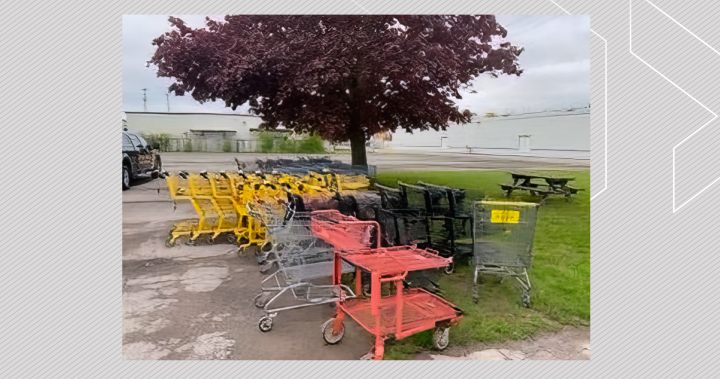
Brampton, Ontario – In a move to address the persistent problem of abandoned shopping carts cluttering city streets and properties, Brampton city council has decided against requiring retailers to install geo-locking technology on their carts. Instead, the council voted on April 15 to stick with a newly approved $100 fee aimed at recouping costs for retrieving the wayward buggies. The decision came after a detailed staff review highlighted significant practical hurdles in mandating the high-tech solution across the city's diverse retail landscape.
The issue of abandoned shopping carts has been a growing concern for Brampton residents, with complaints pouring in about the metal frames left haphazardly on sidewalks, in parks, and along roadways. According to city officials, these carts not only create unsightly litter but also pose real dangers. "Abandoned carts can pose hazards for pedestrians, cyclists and motorists, impede accessibility and create risks to public safety," the original council motion stated, emphasizing the threats they present to everyday navigation in the bustling suburb northwest of Toronto.
Environmental impacts have also been a focal point. Officials noted that the carts, often exposed to the elements, contribute to pollution as they rust and degrade, while also endangering local wildlife that might get entangled or injured by the scattered debris. Brampton's urban growth, with its expanding population of over 650,000, has amplified these problems, as more shopping trips lead to more carts ending up far from their stores.
The council's original push for geo-locking stemmed from a desire for a proactive fix. Geo-locking systems, which use radio frequencies to automatically lock a cart's wheels when it strays beyond a store's designated perimeter, have been adopted in some urban areas to keep carts on-site. However, after reviewing a comprehensive staff report, council members opted to scrap the mandate, deeming it unfeasible for widespread implementation in Brampton.
"While such technology may be effective in certain retail environments, site ownership structures, operational differences among retailers and existing cart management practices present considerations for implementing a uniform citywide requirement," the staff report concluded. This assessment was pivotal in swaying the council, as it outlined the logistical nightmares of enforcing such a policy.
One major challenge cited was the retail setup in Brampton, where many stores operate as tenants in multi-use shopping plazas. In these scenarios, retailers lack control over the surrounding parking lots or adjacent lands necessary to install and calibrate the geo-locking infrastructure. Forcing the technology could disrupt operations and lead to uneven enforcement, staff argued.
Equity issues further complicated the proposal. A blanket requirement might unfairly burden smaller businesses or those with effective cart management already in place, imposing additional costs without proportional benefits. "It could impose unnecessary costs on businesses that already manage carts effectively," the report warned, highlighting the need for a more tailored approach to the problem.
Instead, Brampton is leaning on its recently passed 2026 budget measure: a $100 administrative fee charged to retailers each time city staff collect and return an abandoned cart. This policy, approved earlier this year, is designed to offset the time and resources expended by municipal workers on these retrievals. City staff estimate that Brampton handles between 400 and 500 such carts annually, a figure that underscores the scale of the issue and the potential revenue from the fines—up to $50,000 if every retrieval incurs the full charge.
The retrieval process itself is no small task. Crews from the city's public works department often navigate busy streets and private properties to locate and transport the carts back to stores, sometimes dealing with damaged or heavily soiled units. "The measure is meant to offset staff time and resources," a previous report explained, positioning the fee as a fair way to encourage retailers to tighten their own controls without dictating specific technologies.
Local retailers have mixed reactions to the decision, though specific quotes from business owners were not immediately available following the April 15 vote. Some industry representatives have previously voiced support for voluntary geo-locking in high-theft areas, but others worry about the cumulative impact of fees if cart abandonment persists. Brampton's Retail Council, while not commenting directly on this policy, has in the past advocated for collaborative solutions between cities and stores to curb urban blight.
This isn't the first time Brampton has grappled with cart-related woes. In recent years, similar complaints have arisen in neighboring Peel Region municipalities like Mississauga and Caledon, where abandoned carts have clogged stormwater drains and exacerbated flooding risks during heavy rains. Across Ontario, cities have experimented with various deterrents, from awareness campaigns to partnerships with grocery chains, but geo-locking remains rare due to its upfront costs—often exceeding $10,000 per store for installation and maintenance.
The staff report drew on examples from other jurisdictions, noting that while geo-locking works well in standalone big-box stores with ample land, it's less practical in dense strip malls common in Brampton. For instance, major chains like Walmart and Loblaws have piloted the technology in select locations, but scaling it citywide could strain smaller operators. Officials emphasized that the $100 fee provides flexibility, allowing retailers to choose their prevention methods while holding them accountable for the fallout.
Resident advocates welcomed the council's pragmatic stance. One community group leader, speaking on condition of anonymity due to ongoing local discussions, said the fines send a clear message without overregulating businesses. "It's about shared responsibility—stores need to step up, but the city can't dictate every tool," the advocate remarked, reflecting a sentiment echoed in public forums leading up to the vote.
Looking ahead, Brampton plans to monitor the effectiveness of the fee system once it rolls out in 2026. City staff will track retrieval numbers and fee collections, potentially adjusting the policy if abandonment rates don't decline. In the meantime, public education efforts are ramping up, with signage at high-complaint areas reminding shoppers to return carts properly.
The decision underscores broader challenges in managing urban amenities amid rapid suburban expansion. As Brampton continues to grow, balancing resident safety, environmental health, and business viability will remain key. For now, the $100 fine represents a middle-ground solution, one that aims to clean up the streets without locking down innovation in cart control.