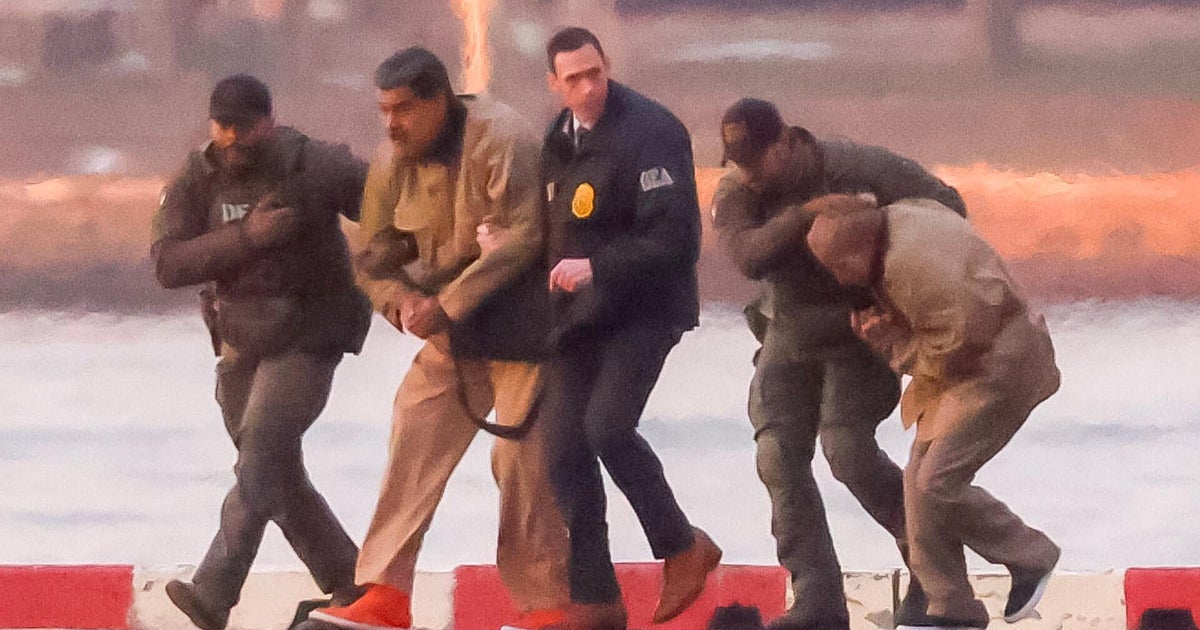
New York City -- Nicolás Maduro, the longtime president of Venezuela, was transported under heavy security to a federal courthouse in Manhattan on Tuesday morning, where he is scheduled to face arraignment on charges including international drug trafficking and narco-terrorism. The 61-year-old leader, who has ruled Venezuela since 2013 amid widespread economic collapse and political unrest, appeared somber as he was escorted from a secure vehicle by U.S. Marshals, according to witnesses at the scene.
The charges against Maduro stem from a long-standing U.S. indictment unsealed in 2020 by the Southern District of New York, accusing him and several top aides of conspiring to flood the United States with cocaine as part of the so-called 'Cartel of the Suns.' Prosecutors allege that Maduro's regime has deep ties to Colombian drug cartels, using Venezuelan territory as a smuggling corridor. His wife, Cilia Flores, a powerful figure in her own right as president of Venezuela's constituent assembly, is also named in the indictment alongside other officials like Diosdado Cabello and Tareck El Aissami.
'This is a significant moment in the fight against transnational crime,' said Damian Williams, the U.S. Attorney for the Southern District of New York, in a statement released Monday evening. 'For years, Maduro's government has facilitated the flow of deadly drugs into American communities, enriching a corrupt elite while devastating the Venezuelan people.' Williams emphasized that the case is built on evidence from defectors, wiretaps, and financial records seized during international operations.
Maduro's arrival in New York follows a dramatic arrest in Caracas last week, reportedly carried out by Venezuelan opposition forces with U.S. intelligence support, though details remain murky. According to Venezuelan opposition leader María Corina Machado, who spoke to reporters via video from exile in Miami, 'The people of Venezuela have suffered under Maduro's tyranny for too long. His capture is a victory for justice and a step toward restoring democracy.'
The indictment, first announced by then-Attorney General William Barr in March 2020, details how Maduro and his inner circle allegedly received millions in bribes from the Revolutionary Armed Forces of Colombia (FARC) to protect drug shipments. Prosecutors claim that between 2014 and 2018, over 20 tons of cocaine -- worth billions on the street -- transited through Venezuela en route to the U.S. One key allegation involves a 2018 seizure by U.S. authorities of a Venezuelan military plane carrying 1,200 kilograms of cocaine, which they link directly to Maduro's security apparatus.
Legal experts following the case say the arraignment could set the stage for a high-profile trial, potentially exposing more about Venezuela's role in global narcotics networks. 'This isn't just about drugs; it's about state-sponsored terrorism,' said Bruce Bagley, a University of Miami professor specializing in Latin American politics, in an interview with The Appleton Times. 'Maduro's regime has weaponized corruption to maintain power, and the U.S. is now holding him accountable.'
Inside the courthouse, proceedings are expected to begin at 10 a.m. ET, with Magistrate Judge Sarah Netburn presiding. Maduro's defense team, led by prominent New York attorney Benjamin Brafman, has already filed motions challenging the extradition process. Brafman argued in court papers that 'the charges are politically motivated and lack credible evidence,' pointing to Maduro's status as a sitting head of state.
Venezuela's ongoing crisis provides critical context for the case. Under Maduro's leadership, the country has seen hyperinflation peak at over 1 million percent in 2018, mass emigration of more than 7 million people, and repeated U.S. sanctions aimed at curbing his regime's activities. The drug trafficking allegations add another layer, with critics arguing that Maduro's policies have turned Venezuela into a narco-state. Supporters, however, view the U.S. actions as imperialistic interference.
In Caracas, Maduro loyalists rallied outside the presidential palace on Monday, chanting slogans in support of their leader. 'This is a Yankee plot to steal our sovereignty,' said one protester, identified as a local union leader, to international media. Venezuelan Foreign Minister Yván Gil echoed this sentiment in a televised address, calling the arrest 'an illegal kidnapping' and vowing diplomatic retaliation.
The U.S. State Department has maintained that Maduro's transfer was lawful, coordinated through international channels. A spokesperson noted that 'Venezuela's opposition government, recognized by the international community, facilitated the handover.' This refers to the interim government led by Juan Guaidó, whose legitimacy has waned but remains a point of contention. The U.S. first recognized Guaidó as interim president in 2019, imposing sanctions on Maduro's circle that froze assets and barred transactions.
Details of the alleged crimes paint a picture of systemic corruption. According to the 32-count indictment, Maduro personally approved 'cocaine flights' from remote Venezuelan airstrips, with proceeds funneled into regime coffers. One exhibit cited in court documents describes a 2017 meeting where Cabello, a close Maduro ally, allegedly negotiated a $5 million payment from FARC leaders. Flores, Maduro's wife, is accused of using her influence to shield operations, including laundering funds through real estate in Florida.
International reactions have been swift. The United Nations Human Rights Office called for a fair trial, stating in a release that 'extradition processes must respect due process, regardless of political context.' Meanwhile, allies like Russia and Cuba have condemned the U.S. move, with Russian President Vladimir Putin labeling it 'extrajudicial aggression' during a call with Latin American leaders.
As Maduro awaits formal charges, the implications for Venezuela loom large. Analysts suggest his removal could accelerate political transition, though power struggles within the military -- a key pillar of his support -- may complicate matters. 'The military's role in the drug trade is central; their defection was key to his arrest,' said Ronna Rísquez, an investigative journalist who has covered Venezuelan corruption for years. Rísquez, speaking from Bogotá, added, 'But rebuilding trust in institutions will take decades.'
Back in New York, security around the Daniel Patrick Moynihan U.S. Courthouse has been heightened, with barricades and additional NYPD presence. Pro-Maduro demonstrators, organized by Venezuelan expatriate groups, gathered nearby, waving flags and holding signs reading 'Free Maduro -- End U.S. Imperialism.' Counter-protesters, including Venezuelan exiles, called for accountability, one shouting, 'Justice for the victims of his regime!'
Looking ahead, the arraignment is just the beginning. If convicted, Maduro faces a mandatory minimum of 10 years, potentially life in prison. Prosecutors have hinted at cooperating witnesses from within Venezuela's elite, which could unravel more secrets. For now, the world watches as one of Latin America's most controversial figures confronts American justice, a development that could reshape regional dynamics for years to come.