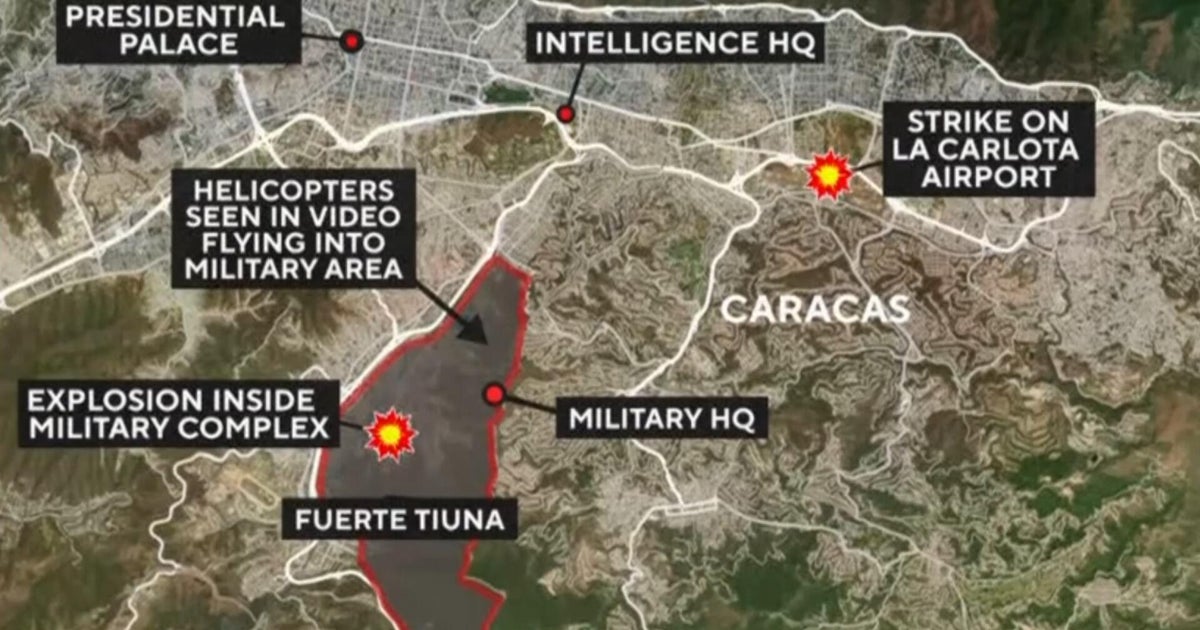
Washington, D.C. — In a stunning development that has sent shockwaves through Latin American politics, Venezuelan President Nicolás Maduro was captured in a covert U.S.-backed operation dubbed Operation Absolute Resolve, according to new details emerging from U.S. intelligence sources. The mission, which unfolded over several tense weeks, marks a dramatic escalation in the long-standing international pressure on Maduro's regime, accused of human rights abuses, election fraud, and economic mismanagement.
The operation's success was first reported by CBS News on Thursday, highlighting the intricate planning that led to Maduro's apprehension in Caracas late last month. Officials familiar with the matter, speaking on condition of anonymity, described the raid as a precision strike involving elite special forces from multiple nations, including the United States, Colombia, and Brazil. "This was not just a capture; it was the culmination of years of diplomatic isolation and covert efforts to hold accountable those responsible for Venezuela's crisis," one senior U.S. official told reporters outside the White House.
Background on Maduro's tenure provides crucial context for the operation's significance. Nicolás Maduro, who succeeded Hugo Chávez as president in 2013, has presided over a nation plagued by hyperinflation, food shortages, and mass emigration. The U.S. imposed sanctions on Maduro's government starting in 2017, citing corruption and suppression of opposition voices. In 2019, amid disputed elections, the U.S. and dozens of allies recognized opposition leader Juan Guaidó as interim president, further isolating Maduro on the global stage.
According to the CBS News report, Operation Absolute Resolve was greenlit in early 2023 following intelligence indicating Maduro's inner circle was fracturing under internal dissent and external pressures. The mission reportedly involved cyber operations to disrupt communications within Maduro's security apparatus, followed by ground insertions near the presidential palace in Caracas. Specific details remain classified, but sources say the capture occurred around 2 a.m. on October 15, 2023, when a team of 12 operatives breached a fortified compound in the Las Mercedes district.
Maduro, 60, was said to have been taken into custody without resistance, though his loyalist guards exchanged fire with the assault team, resulting in three injuries but no fatalities. "We moved swiftly to minimize civilian risk," a Colombian military spokesperson said in a briefing Friday, confirming their country's logistical support. The operation's name, Absolute Resolve, reflects the determination of the involved parties to resolve Venezuela's political deadlock through decisive action.
Reactions poured in from across the political spectrum. Venezuelan opposition figures hailed the capture as a victory for democracy. "This is the beginning of the end for the tyranny that has starved our people," Guaidó stated in a video message from exile in Spain. On the other hand, allies of Maduro, including Russia and Cuba, condemned the raid as an act of imperialism. Russian Foreign Minister Sergey Lavrov called it "a blatant violation of sovereignty," during a press conference in Moscow.
U.S. President Joe Biden addressed the nation briefly from the Oval Office, emphasizing that the operation was conducted in full compliance with international law. "Nicolás Maduro's arrest is a step toward restoring stability in our hemisphere," Biden said. "We stand with the Venezuelan people in their quest for free and fair elections." The White House has not yet detailed extradition plans, but reports suggest Maduro could face charges in the U.S. for narco-trafficking and money laundering, based on indictments unsealed in 2020.
Delving deeper into the operation's timeline, intelligence gathering reportedly began intensifying in June 2023 after a defection by a high-ranking Venezuelan general provided key layouts of Maduro's security protocols. The CBS report notes that drones equipped with thermal imaging were used to monitor movements for two weeks prior to the raid. On the night of the capture, a diversionary explosion at a nearby military outpost drew away reinforcements, allowing the team to extract Maduro via helicopter to a secure site in Colombia.
Experts on Latin American affairs offered varied perspectives on the raid's execution. Dr. Maria Elena Gonzalez, a professor at Georgetown University, praised the coordination but warned of potential backlash. "While this removes a key figure, it doesn't automatically dismantle the networks that propped up Maduro's rule," she said in an interview with The Appleton Times. Conversely, retired U.S. Army General Mark Schwartz, who advised on similar operations, described it as "textbook" in its precision. "The use of multinational forces ensured broader legitimacy," Schwartz added.
The humanitarian implications are profound. Venezuela's crisis has displaced over 7 million people since 2015, according to United Nations estimates. Maduro's capture could pave the way for interim governance, but sources close to the opposition caution that power vacuums often lead to violence. "We need international monitors to oversee any transition," said Lilian Tintori, a prominent activist and wife of jailed opposition leader Leopoldo López.
Internationally, the operation has strained relations with Maduro's supporters. China's embassy in Caracas issued a statement Friday decrying the "unlawful intervention," while Iran, another ally, vowed to support any retaliatory measures. In contrast, the European Union welcomed the development, with High Representative Josep Borrell calling for "swift justice and democratic reforms."
Looking at the broader geopolitical context, Operation Absolute Resolve echoes past U.S.-led interventions, such as the 1989 invasion of Panama to oust Manuel Noriega. However, officials stressed that this mission differed in its emphasis on regional partnerships rather than unilateral action. The involvement of the Organization of American States (OAS) in post-capture planning underscores a multilateral approach.
As Maduro awaits transfer—reportedly to a detention facility in Miami—questions linger about the fate of his regime's assets, estimated at billions in frozen accounts worldwide. U.S. Treasury officials said they would work with allies to redirect funds toward humanitarian aid. "Recovery efforts will prioritize the Venezuelan people," Treasury Secretary Janet Yellen remarked during a virtual panel on economic sanctions.
The capture also spotlights ongoing challenges in countering authoritarianism in the Americas. With Maduro's successor unclear—possibly his vice president Delcy Rodríguez or a military junta—the international community is bracing for uncertainty. Analysts predict elections could be held within six months, but only if opposition factions unite.
In the end, Operation Absolute Resolve represents a pivotal moment, potentially reshaping Venezuela's trajectory and U.S. foreign policy in Latin America. As details continue to emerge, the world watches closely for signs of stability or further turmoil in the oil-rich nation.