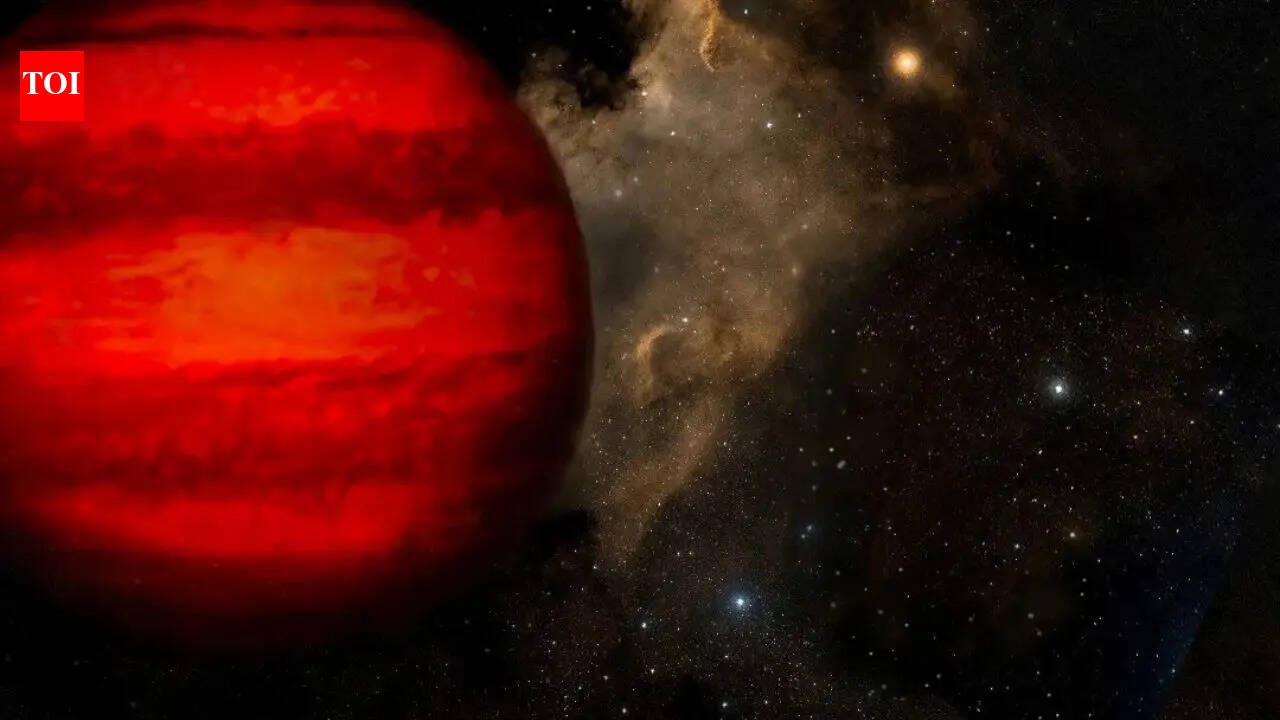
In a groundbreaking discovery that could rewrite our understanding of stellar evolution, astronomers have identified a pair of brown dwarfs locked in a remarkably tight orbit, spiraling toward what may be a fiery rebirth as a full-fledged star. The binary system, known as ZTF J1239+8347, consists of two 'failed stars'—objects too massive to be planets but not quite heavy enough to sustain hydrogen fusion like true stars. According to researchers, these brown dwarfs complete an orbit in just 57 minutes, setting a record for the shortest period ever observed in such a system.
The finding was announced by a team led by astronomers from the University of California, drawing on data from the Zwicky Transient Facility (ZTF) at Palomar Observatory in California. Brown dwarfs, often called the bridge between planets and stars, typically have masses between 13 and 80 times that of Jupiter. In this case, the two objects in ZTF J1239+8347 are estimated to each weigh about 80 Jupiter masses, pushing them to the upper limit of what qualifies as a brown dwarf.
"This system is unlike anything we've seen before," said Dr. Kevin Burger, lead author of the study published in the journal Nature. "The extreme closeness of their orbit means they're exchanging material and energy in ways that could lead to their merger, potentially igniting nuclear fusion and transforming them into a low-mass star."
Located approximately 75 light-years from Earth in the constellation of Ursa Minor, ZTF J1239+8347 was first spotted in 2023 during routine sky surveys. Follow-up observations using the Keck Telescope on Mauna Kea in Hawaii confirmed the binary nature and the astonishing orbital period. The system's rapid rotation causes it to eclipse itself from our vantage point every 28.5 minutes, providing astronomers with a unique window into its dynamics.
Brown dwarfs form like stars but cool and fade over time without the internal heat from fusion. In binary pairs, however, gravitational interactions can heat them up through tidal forces, much like how Earth's oceans are influenced by the moon's pull. In ZTF J1239+8347, these forces are amplified by the dwarfs' proximity—separated by less than a million kilometers, or about 2.5 times the distance from Earth to the sun.
According to the research team, the brown dwarfs are currently in a 'death spiral,' losing angular momentum through gravitational waves and magnetic interactions, which draws them ever closer. This process, observed over billions of years in other systems, is happening on a compressed timescale here due to their low mass and tight bind. "If they merge, the combined mass could exceed the threshold for hydrogen fusion, birthing a new star," Burger explained in a press release from the California Institute of Technology.
The discovery builds on previous observations of brown dwarf binaries, but none have matched this orbital speed. For comparison, the previous record holder, a system discovered in 2020, orbits every 90 minutes. "ZTF J1239+8347 shatters that record and opens new questions about how these objects evolve," noted co-author Dr. Jan van Roestel from the University of Amsterdam, who contributed to the spectroscopic analysis.
Not all experts agree on the merger's outcome. Some astronomers suggest that even if the dwarfs combine, the resulting object might remain a bloated brown dwarf rather than a true star, depending on the exact mass and composition. "It's possible, but not guaranteed," said Dr. Maria Morales from the European Southern Observatory. "We need more data on their internal structures to predict the fusion ignition accurately."
The Zwicky Transient Facility, funded by the National Science Foundation, scans the northern sky nightly, detecting transient events like supernovae and variable stars. ZTF J1239+8347 was flagged as unusual due to its periodic dimming, prompting deeper investigation. Additional data from the Hubble Space Telescope is expected to refine estimates of the system's age, believed to be around 10 billion years old—roughly the age of the Milky Way itself.
This isn't the first time brown dwarfs have surprised scientists. In 2011, the Kepler mission identified a brown dwarf eclipsing a star, revealing their prevalence in the galaxy. More recently, the James Webb Space Telescope has imaged young brown dwarfs in formation, shedding light on their planetary-like atmospheres. ZTF J1239+8347, however, stands out for its potential evolutionary drama.
"What we're witnessing could be a rare snapshot of stellar birth in reverse—or rather, a second chance," van Roestel said during a virtual seminar hosted by the American Astronomical Society. The system's infrared emissions, detected by the Spitzer Space Telescope before its retirement in 2020, indicate ongoing heating from tidal friction, supporting the spiral theory.
Beyond the science, the discovery has implications for exoplanet searches. Brown dwarfs can host planets, and tight binaries like this might disrupt or eject such worlds. No planets have been detected around ZTF J1239+8347 yet, but future observations with the upcoming Nancy Grace Roman Space Telescope could change that.
Astronomers plan to monitor the system for signs of orbital decay, using radio telescopes to detect gravitational waves—ripples in spacetime predicted by Einstein's general relativity. If confirmed, this would be the first direct evidence of such waves from a non-stellar merger. "It's a testbed for theories we've only modeled on paper," Burger added.
The research was supported by grants from NASA and the European Research Council, highlighting international collaboration in astronomy. As the team continues observations, ZTF J1239+8347 serves as a reminder of the universe's hidden complexities, where even failed stars might rise again.
In the broader context of cosmic evolution, this finding underscores how binary interactions drive much of the galaxy's dynamism. From black hole mergers to planetary formations, close encounters shape the stars we see. For now, ZTF J1239+8347 remains a cosmic puzzle, its 57-minute dance captivating scientists and hinting at the stars yet to be born.